the bird on fire

The Palm Valley School Student Blog

Subscribe to Blog via Email

Enter your email address to subscribe to this blog and receive notifications of new posts by email.

Powered by Genesis

Save me

October 20, 2022 by szachik@pvs.org Leave a Comment

I challenged the blog staff to write a short story. Luke was especially happy about that. Penny took up the challenge with her own fish tale.

Blog Advisor Zachik

A Short Story by Middle-Schooler Penny Andreas

“Welcome! Welcome Ladies and Gentleman to the ‘Great World Circus!’” Thomas W. Ratgrape stood in front of the crowd, feeding off of their applause. His great big smile on his face stood out in the spotlight, and his brightly colored red suit shone in the circus ring. 

“Thank you. Thank you, everyone. No, really, I mean it. Now, first up, we have your one, and only, ‘Dancing Monkey!’” 

The brass music boomed over the speaker. Thomas rushed behind the curtain, his support-staff followers running after him. 

“Sir, you go back on after the monkey.” 

“Sir, sir, your suit is unbuttoning!”

“Sir Your father wants to–”

“JUST SHUT UP!” Thomas yelled. “I DO NOT CARE! JUST GET ME THAT FISH!”

Everyone looked at each other, wondering who should move first. 

“WELL! WHAT ARE YOU DOING? THE FISH ISN’T GOING TO COME BY ITSELF!” 

They all started running again, worried that their master, Thomas, would yell and fire them. Soon enough, the monkey was done dancing, and the crowd was becoming bored. Thomas quickly looked around, desperately looking to see if the fish was there. 

“Gertrude! Gertrude, where is the fish?” Thomas frantically said to Gertrude, who was the janitor of the circus. 

“I dunno,” she said.  

Thomas sighed and quickly started to pace across the maroon carpet. 

“I’ve got it! I’ve got the fish coming throoooooough!”

“Lacey? You were the last person I thought would get the fish. Is it well? Eh, no matter, we have to get it on!”  

Thomas ran out of the curtains and quickly took his spotlight. The music stopped, and a loud drum roll burst out of the speakers. 

“Ladies and gentlemen, welcome the amazing, magnificent ‘Talking Fish!’”

Gertrude placed the giant fish tank onto the scooter, and rolled it out into the circus ring. The fish, Margarine, tried to swim, but her tank was too small. She couldn’t even move. 

“How incredibly rude. What do they even want me to do?” Margarine asked. She looked beyond her dirty, small glass like aquarium, and saw the crowd. Her eyes were blinded by the lights. She refused to look at the crowd and tried to turn her head. Out of the corner of her eye, she saw Thomas and his mean, stink-eye glare. He slowly walked over to her. 

“Fish, if you don’t start talking, I will make your life worse than it is.”

He walked away squinting at her. Margarine floated there, speechless. What am I supposed to do? She pushed on the glass, daring to break it, daring an escape. The glass was strong, yet Margarine was stronger. That glass popped out and shattered on the hard cement ground. Water spilled out, creating a tidal wave that carried Margarine across the ground. She frantically tried to swim, hoping she could make it to the clear water pond just outside the door of the tent. She was almost there when Thomas stepped in front of her and picked her up. He apologized to the bored audience and quickly walked backstage. As soon as he was behind the curtain, he threw the fish against the wall into a water tank. 

“HOW DARE YOU EMBARRASS ME IN FRONT OF MY PEOPLE?! MY AUDIENCE?! YOU ARE A DISGRACE! YOU SHOULD BE SORRY FOR WHAT YOU HAVE DONE! THERE WILL BE CONSEQUENCES!”

He stormed out of the room, leaving Margarine alone in the dark. She swam to the bottom of the tank, and belly flopped onto the gravel. She longed for her sweet, clean, clear pond that they  polluted in order to capture her. She missed her poor family, swimming alone in the river to which they were transferred. She missed them so dearly. But at that moment, *click*. 

The custodian Gertrude walked through the door and turned on the lights. She took out her mop and bucket of water and started to clean the floor. 

“Hello, Gertrude,” said Margarine.

“AHHHHHHHHH!” Gertrude yelled, dropping her mop. 

“Well, don’t be frightened for goodness sake. I was only being polite.

”Gertrude stared at her in awe. How could the fish be speaking? Was she dreaming? Was she even alive?

“You really speak? How?”

Margarine laughed. 

“I don’t really know. I just started to talk one day. But when the world found out, they captured me, and pulled me into this…this horrible place.”

“Well, I guess we are similar in that way. I wanted to go to college, but I got fired from my job and lost all  my money and had to work at this dump.”

“Perhaps we could someday escape, though that day would be far far away due to the situation here,” Margarine sighed. 

That’s when Gertrude had an idea. They could escape. They could get out of this miserable, terrible, horrible place. 

Gerturde jumped up into the air. “I know how we can escape!”

Margarine was delighted. “How might we do that?”

“Tomorrow night, when you perform for the last time, you can tell the audience how bad Thomas is treating you, and then they will have to all leave, and right then we could leave, too!”

Margarine was thrilled. She was so happy with the thought that she could see her loving family and pond again. That night, she slept for the first time. 

The next day, Margarine woke up with joy, but suddenly it diminished like water on fire. She awoke to everyone running around, yelling, and frantically waving their arms. Thomas was not around surprisingly. At the corner of her eye, she noticed Gertrude standing with her mop. Gertrude met eyes with Margarine, and broke a small smile. 

“WHAT IS ALL THE CHAOS?!” Thomas suddenly walked into the main room. Everybody froze and immediately turned to Lacey. Thomas started to slowly walk across the room. 

“What…is going….on?” snarled Thomas. 

Lacey’s eyes were wide open, and her legs were trembling. She opened her mouth, but no words came out. 

“I-I–I…I LOST THE MONKEY!” Lacey started to cry. She went down on her knees. “I’m sorry! I’m so sorry!” 

Thomas looked down at her like a hawk watching its prey from above. He walked silently to the back of the room. 

“Find it. Or else,” Thomas said. He walked out of the room, smoke metaphorically fuming out of his ears. Gertrude rushed over to Margarine. 

“Don’t worry,” whispered Gertrude, “I stole the dancing monkey, and I’m going to replace it with a normal foolish monkey.”

Margarine sighed, worried that the plan wouldn’t work. She swam to the top of the tank and said, “He will have to put me on instead, and then we can escape?”

“Precisely,” smiled Gertrude. She then walked away and went back to her mopping. 

Two hours later, Thomas prepared for the show, for he was on in 5 minutes. 

“Are we prepared? Is everything ready? Where is the monkey?” 

Gertrude pretended to be rushed and threw herself onto the ground, the fake monkey in her hand. “I’ve found it!”

Thomas looked down at her. “Thank you,” he said, and he snatched the monkey out of her hand and walked off. 

Gertrude was thrilled as she got up off of the ground. She was ready to get out of this dump. 

The music started to grow out of the big bass speakers, and the spotlights circled around the circus ring. 

“Ladies and gentlemen, welcome once again to the circus!”

The loud brass music played, which was heard from backstage, where Gertrude and Margarine were desperately waiting to see the magnificent fail of Thomas. 

“First up, I will joyfully present to you, the one, the only…Dancing Monkey!”

The spotlight appeared suddenly on a miniature stage, with the fake monkey on it. The monkey blocked the light with his hands, and ran off the tiny stage to the door and ran out. Thomas stood there speechless, surprised that he had just lost the monkey. His mind quickly turned to the crowd though, and he rushed to take the spotlight. 

“Well, that was unexpected! To keep your interest, I want to show you the magnificent, amazing “Talking Fish!” Thomas said nervously. 

Gertrude pushed Margarine to the center of the dusty stage. Margarine looked out to the crowd, hoping this would work. 

“Hi. My name is Margarine. I am a talking fish. And although many people stare at me in awe when I speak, some people treat me wrong for it. They give me small fish tanks, which smell and are unclean. They also force me to talk and punish me if I don’t. I don’t like the disrespect at all. I find it quite rude. And these people, they are horrible. And I know one person who is like this. Thomas W. Ratgrape.”

The audience gasped when they heard this, and immediately refused to stay in the circus tent any longer. People demanded their money back, and some climbed out of the seats. Soon enough, people were carrying Margarine’s fish tank outside, and placing her in a beautiful pond outside of the circus. Gertrude followed, cheering for her and Margarine’s freedom. 

And they all lived happily ever after. Except Thomas W. Ratgrape.

Filed Under: Animals, Aquatic, Fiction Tagged With: Penny Andreas, Save Me

A Clam Thanksgiving 

October 20, 2022 by szachik@pvs.org Leave a Comment

A Traditional Re-Telling, by Renowned Clamologist Levi Kassinove

Platitudinous as it was, the clams rested year-round on the sandy ocean floor. After all, do clams migrate? Do they flap their little halves and swim around twice a year? It doesn’t matter. A clam is what a clam is. A lowly, pathetic filter-feeder. Humans have them for dinner all the time with pasta. They are NOTHING to the animal kingdom. They are but a meager source of protein and tedious work for us. It is truly a pain for animals to bust open their shells, only to find a lackluster gob of flesh on the inside. Despite this rather insensitive banter about clams, which is obviously discussed among all other animals on a constant basis, clams are thankful.

A clam has its own little clam family, just like you and me. It is thankful for the bacteria that wafts in its direction, possibly providing sustenance. I don’t know what a filter feeder eats. Maybe it’s algae…. Nevermind, it’s plankton (bioexplorer.net). The fact of the matter is, even if one suffers from clampression, or is currently going through a clamcession, or is even in the midst of a global clamdemic, clams will stand (rest?) strong because of their hard outer shell. 

A NON-THANKFUL CLAM (wordpress.com)

Clams have a marvelous ability to stand vis-à-vis with an octopus and not move a muscle. One clam is cornered. Our cornered clam senses he isn’t skilled or strong enough to avoid octopus calamity. It’s inevitable that this clam is gonna die. He’s gonna get crushed. All the other clams escaped from the octopus confrontation. They called upon their octopus-evasion skills; he wanted to be like them. But deep down, the clam knew he wasn’t as talented as the other clams. All he’s left to ask is…why isn’t he enough? To him, it seemed that everyone else was naturally better at life than him. Sure, he held his own in most aspects of life, but escaping an octopus? Clearly he did not have the talent. He was effectively worthless–not because of the octopus, but because of the other clams. See, if they had all died, he would feel totally content with his failure. He would happily accept death by octopus. But the fact of the matter was that he was the runt of the litter. He had to accept that. His misery sunk him so low that he actually started physically sinking into the sand. He disappeared under a blanket of wallow and self-loathing and small oceanic granules. The octopus scoffed and swam away. 

Levi says, “The inner mind of animals are all alike in their inherent struggles”
(Photo Source: ktla.com).

Then, suddenly, a giant evolved-monkey appeared in the water. At least, that was what it looked like to the clam. It grabbed the clam along with his family, which was like 15 other clams. The diver put the clams in a bag and threw them onto a boat. And, it was then, riding in a boat to their inevitable deaths by some chef at an Italian restaurant, that the clams celebrated Thanksgiving. Every clam knows that they are about to die. And yet, they celebrate the lives that they have lived. Our protagonist clam must forgive himself. Was it his life that he should be thankful for? Or rather, should he be thankful that HE has to carry the burden of being a worthless piece of shellfish? At least, the clam proposes to himself, he is punished with this terrible burden, rather than another clam. The clam would rather he suffer than another. He may not have forgiven himself, but he has forgiven The Almighty Clam. And that is why he is thankful. For he is…a clam. 

Filed Under: Fairy Tales, Fiction, Gratitude Tagged With: A Clam Thanksgiving, Levi Kassinove

Beat the Heat

October 19, 2022 by szachik@pvs.org Leave a Comment

By Junior Indy Behr

In our quest to keep Firebirds healthy, we at thebirdonfire.org have discussed diet, eye care, and sleep habits. As the hottest months in the desert fade, we still experience 90-degree days. Indy has some tips for keeping cool.

It’s October, so it is measurably cooler. Most mornings now, I walk outside, and I am surprised by the cooler temperatures and the subtle breezes. “Is fall actually here?” I think to myself. But then, by noon, it ends up being 90 degrees. I tend to prefer cooler temperatures because if you’re cold, all you need is a sweater, some mittens, and perhaps some longer socks to get comfortable. However, when it’s hot, it is much harder to beat the heat. There are some ways to avoid overheating, however. Here are a few!

Stay Hydrated

Junior Audrey Guess keeps water close even when testing in English.

As some of you may know, sweating is designed to cool your body. If you are dehydrated, you will not sweat as much, and as a result, you will have trouble cooling down. Drink up. Room temperature or chilled–the objective is to keep water in your body. This is one of the best ways to cool down during excessive heat.

Sunscreen

When we are experiencing extreme heat, we are at a higher risk of sun damage, so sunscreen is a must. The added benefit of applying and reapplying spray sunscreens is a short-term cooling effect that is very nice when it’s very hot out.

Spend Your Mornings Outdoors

Though the afternoons are still very hot, the mornings have started to become mild and pleasant. As a result of this, I have been trying to spend more time outdoors in the morning to take advantage of these few hours of cooler temperatures. It has been hovering around the mid 70s in the mornings lately, and this is pretty much the only time to catch good temperatures while the sun is up. I already am somewhat of a morning person, so this is personally my favorite pick for beating the heat. This is definitely my favorite time to enjoy a cup of coffee in my backyard before heading to school.

So, now you know a few ways to stay cool in the afternoon until fall really kicks in. Stay hydrated; wear sunscreen; and take a walk in the morning while we’re still in these last few weeks of heat!

Filed Under: Advice, Health and Disease, Uncategorized Tagged With: Beat the Heat, Indy Behr

America Needs High-Speed Rail

October 19, 2022 by szachik@pvs.org Leave a Comment

An Indy Think Piece

A digital rendering of California’s proposed high-speed rail system. Source: hsr.ca.gov.

When we think of high-speed rail in America, we tend to think of Japan’s well-known bullet trains. Despite this, high-speed rail is actually increasingly common throughout the world, with multiple lines being found in Europe, Eastern and Central Asia, the Middle-East, and several other regions. Though high-speed rail does exist in America, it is much more sparse than it should be considering our country’s high GDP and infrastructure. 

The environmental impact of public transit, including trains, is a major reason why I think creating a better rail system should be one of our top priorities when it comes to improving our country’s infrastructure. The scientific consensus is that carbon dioxide emissions harm the environment, and research shows that while cars emit 371 grams of carbon dioxide per mile, trains emit only 177. This is less than half the carbon dioxide! 

Trains also take up significantly less space in cities throughout America and reduce traffic and street congestion. The traffic seen in many large cities not only has an environmental impact that affects our biosphere, it also affects peoples’ health. Children in places with higher amounts of traffic face higher rates of asthma, lung issues, and cardiovascular diseases due to the pollution caused by traffic. Additionally, more cars on the road means more car-related deaths. Pedestrian deaths are an often overlooked result of car congestion, but in 2020 over 6,000 pedestrians were killed by cars.

The reason that high-speed rail in particular is so needed is that many people will not use trains because of the inherent inconvenience of the current slow trains we primarily see in America. There are some high-speed lines in America, with Chicago being the main hub, but many states have no high-speed rail running through them whatsoever. For the states that do, they almost exclusively are seen in big cities. Though people in cities have limited access to high-speed rail, people in rural areas are completely and entirely neglected. I cannot blame people for choosing to fly as opposed to riding trains when our current system is so terrible. A nonstop flight from Los Angeles to New York is around five hours, but it takes three days to do the same by train, and you still need to change trains in Chicago and Texas.

Many people who oppose high-speed rail in our country argue that the cost is far too much, but I think it is more than worth it. The current estimate for California’s high-speed rail plan is 105 billion dollars, but I prefer that over our planet collapsing due to the effects of climate change while children experience asthma attacks due to horrific traffic clogging their cities. The initial investment is high, but it will pay for itself when it protects the people of our country’s safety, and the fees people pay for public transit also help cover these costs.

I hope you can see why I think that America is in such desperate need of high-speed rail and better public transit in general.

By Junior Indiana Behr

Filed Under: Op-Ed, Technology, Travel Tagged With: America Needs High-Speed Rail, Indy Behr

Why you need more sleep than you think

October 18, 2022 by szachik@pvs.org Leave a Comment

By Junior Levi Kassinove

In our focus on health and healthy living this month, we’ve blogged about good eye health and good diet. Levi reminds us you need a good night’s sleep as well.

Most people in school take sleep for granted. People think that they can just blow off sleep and not face any consequences, justifying it with their school workload. They say it is “because of school” that they stay up so late, to quote Alyna Llapitan, who says she gets “around five hours of sleep” per night. Time management is clearly the real problem. Do we not have time to eat? Do we not have time to drink? The reason why we do it is because we make time for it. We cut time out of our days for food, water, video games, AND SCHOOL. People play on their phones like a bunch of mindless robots rather than going to sleep. You cannot tell me that you stay up every single night doing homework. I’m taking four AP classes, and I still (have the ability to) go to bed by 10 p.m. I’ll admit that I’m also a mindless robot sometimes who stays up until 11 p.m. or even 12 a.m., but that’s still within the range of the recommended daily amount of sleep for teenagers, which is 8-10 hours (cdc.gov). If you go to sleep at 10 p.m., you will get 10 hours of sleep if you wake up for school at 8 a.m. 

Want more on sleep? See Levi’s previous post on astral projection. See it in “Has Levi Been to Area 51?” Photo source: livescience.com

The fact of the matter is people should be making more time for sleep. When we disregard our sleep, we get sleep deprived. Sleep deprivation is AWFUL. The world record for longest time spent awake is 11 days and 25 minutes! The man’s name is Randy Gardner, and he “reported experiencing severe insomnia decades after his sleep experiment” (whatasleep.com). I’m sure many of you pull all nighters for no particular reason. (Scarefest, anyone?) I do it, too, but it can lead to severe health problems. The MINIMUM daily hours sleep to live on is four hours (ojp.gov). Lower quality of sleep is also linked to depression, as people with insomnia have been shown to have a “tenfold higher risk of developing depression than people who get a good night’s sleep” (hopkinsmedicine.com). This might be the cause of your low grades, as depression has a strong causal link to poor academic performance (sprc.org). 

The moral of the story is this: sleep is not optional, nor is it quirky no-consequence fun to pull all-nighters. Get sleep. Do your homework when you get home or during Firebird Time. Nobody has THAT much homework. 

Filed Under: Health and Disease Tagged With: Levi Kassinove, Why you need more sleep than you think

The Transportation Security Administration Theater

October 18, 2022 by szachik@pvs.org 1 Comment

If you know Luke, you know he has opinions. Here, after an uncomfortable episode at the airport, Luke takes on TSA.

By Junior Luke Sonderman

One of the biggest pains of flying is going through TSA (Transportation Security Administration) security. From long lines, to rude officers, to being groped during extensive pat-downs and having to take belts and shoes off, TSA is just no fun. But, how much is TSA really protecting air transportation? Is TSA really trying to sniff out bad guys, or are they just trying to look official to make travelers feel more comfortable?

My Personal Experience with TSA

I’ve never really minded flying. It’s always been pretty enjoyable for me. That was until I had a flight from Palm Springs to San Francisco at 6:30 a.m., all alone. I got to the airport an hour or two early and made my way to the security checkpoint. Everything was normal. I took my shoes off and put my bags up on the conveyor belt. The bags went through with no problem. I walked through the metal detector without having any beeping or metal detection. As I went to grab my bag, a TSA officer asked me to step aside. I went with it because like those dudes have guns. He asked me if I wanted to be searched in front of everyone or in a private room. Now, I’ve had my fair share of security pat-downs at public events and when using public transportation, so I just told him to get it over with. What I didn’t know is that I was about to have an extensive search of every nook and cranny of my body. He started off with the chest, neck, and under the hair. He checked behind my ears and in my arm pits. Now, I thought that this was a bit of a strong search. The guy didn’t have to check behind my ears. I can’t fit a bomb back there anyways. But, then he got to my hip, rear end, then crotch region, and that’s where I had the surprise of a lifetime. I felt groped, harassed, and confused. That man’s fingers went where I very much didn’t want them to go, and I never got an answer for why he searched me. 

What TSA is Actually There For

TSA is commonly referred to as a “security theater.” This basically means that TSA is a security administration put in place to make people feel safe and secure while flying, when in reality they aren’t really keeping you safe from anything. Jason Harrington, a former TSA Agent, says that “Yes, TSA agents are ogling or making fun of your naked physique in the full-body scans. Yes, they are racially and politically profiling certain people for extra screening. Yes, the body scans are ineffective and can be easily manipulated” (theatlantic.com). He went on to say, “It was a job that had me patting down the crotches of children, the elderly and even infants as part of the post-9/11 airport security show” (theatlantic.com).

In 2015, Homeland Security ran a study on TSA and how effective the security checkpoints were. They sent 70 agents through TSA security checkpoints with hidden weapons and fake bombs, and 67 of them made it through security without getting stopped (nbcnews.com).

Now, I’m not here to say that you aren’t safe flying because to be completely honest, TSA works. There has not been a successful large-scale airline attack in the United States since the creation of the TSA. Though what I will say is that if TSA isn’t catching guns and bombs behind my ears… can we please bring larger self-care products and not take our shoes and belts off? Let us just walk through the metal detectors. Please, spare us getting to the airport two hours early and having to spend extra time packing everything in the tiny little 4 oz bottles.  

Filed Under: Op-Ed, Travel Tagged With: Luke Sonderman

Alyna’s Favorite Artist

October 13, 2022 by szachik@pvs.org 1 Comment

By Alyna Rei

The Blog Staff is highlighting local, familial, and world-renowned artists. Alyna shares with us her favorite painting–Vincent Van Gogh’s “The Starry Night.”

I’m not a person who is a big fan of paintings and other artwork. Mine is sort of a one-second appreciation, and then I would forget about the artwork. But, there is one painting that really stands out to me. I’m pretty sure everyone has heard of the “Starry Night” painting by Vincent Van Gogh. This painting is really popular to many people, and since it captivates me so much, I decided to write about it.

“The Starry Night” by Vincent Van Gogh

What is the history of “The Starry Night” painting?

The painting first started when Van Gogh was in a mental hospital getting treatment. He grew stronger, but, sadly, he had a relapse of instability. He fell into sadness and started having hallucinations and suicidal thoughts (vangoghgallery.com). As a result, the tone of his work changed. His use of the darker hues from the beginning of his work was reinstated, and Starry Night is a superb illustration of that change. The picture is dominated by blue, which melds the hills with the sky. The small settlement is depicted at the bottom of the painting in shades of brown, gray, and blue. The yellow and white of the stars and the moon stand out against the sky, attracting the eyes to the sky, even though each building is clearly highlighted in black. The buildings are one of the painting’s main focal points and one of the main draws.

Why do I like this painting so much?

I like this painting mostly because of the way it presents itself. The colors and the ambience match each other, which is what made me like this painting even more. For some reason, this painting reminds me of “Claire De Lune” by Claude Debussy. Both the song and the painting convey a calm peaceful night to me. Listening to the music and observing the painting, the atmosphere puts me at ease.

Where is this painting held?

This painting is being held in The Museum Of Modern Art in New York. This painting has been a permanent piece at the museum since 1941, and it is one of the most recognizable pieces in Western Art. 

I love this piece so much that I have a Lego set of The Starry Night. This piece doesn’t really look like the real painting, but it’s a pretty similar comparison–in the medium of Lego. 

This Lego set of The Starry Night was constructed by Alyna and now sits on her shelf in her room.

Filed Under: Aesthetic, Art, Visual Arts Tagged With: Alyna Rei, Alyna's Favorite Artist

Metsavendade Laul*

October 13, 2022 by szachik@pvs.org Leave a Comment

By Junior Remy Haring

Saaremaa Island, Former United Baltic Duchy, Now Estonia

In a series of stories from multiple people all over the world collectively known as the Kaiserreich Files (inspired by the titular mod for Hearts of Iron IV), blogger Remy Haring explores an alternate history in which the Central Powers win the First World War.

Night of February 15, 1936

I was sitting on an ammo crate in our dark green tent cleaning my rifle with only a gas lamp to keep me company. My friend Jukka was on duty for the night, watching for any German patrols. Most of the German Army had fled Estonia and Latvia, but there were still a few lingering patrols on the island that were looking for me and other Forest Brothers. We were a group of Estonian Guerilla fighters who wanted to free our country from the clutches of the Kaiser. With the advent of Black Monday and the ensuing economic chaos, we saw this as our chance. While I was idling away cleaning, I heard loud and heavy footsteps crunching on leaves. For a second I thought it was a bear, but it turned out to be Martiinus.

Martiinus was a six-foot-tall giant and the muscle of our group. Not exactly the most subtle person, but he got the job done. He and Jukka entered the tent, and Martiinus had the biggest grin on his face. He produced a fresh bottle of vodka from his coat and some shot glasses.

“Where did you get that?” I asked.

“I found it in an old, abandoned German barracks,” he replied. “We are going to party tonight!”

“Martiinus, you oaf! You stormed a barracks without us? What were you doing?” Jukka snapped.

“What can I say? We needed supplies, and I’m not turning down a fresh bottle of vodka.” 

“Eh, whatever. Lucky you didn’t get yourself killed, and I haven’t had a good drink since the revolt began.”

“A toast to a free Estonia!” Martiinus shouted. “Taavet, you still have that old accordion?”

I pulled my old accordion out of my backpack and began to play Metsavendade Laul, our anthem, and we all began to sing: 

Ai-tših ai-tšah ai-velled!

Me, metsavennad, oleme

Ai-tših ai-tšah ai-velled!

Me, metsavennad, eestlased

February 16, 1936

It was early in the morning when we packed up our tents and moved to the north of the island. We got word on the radio that there was one last German division on the island at the town of Leisi, and, by god, we were going to be the ones to kick them out. Like cats we prowled through the dark, snow-covered fir trees. We are called the Forest Brothers for a reason after all. In the interior of the isle, there was no sign of human activity. It was all dense forest. We were on a ridge with a road below us when Jukka raised his hand to stop.

“See that?”

There were five German soldiers marching along the roads. The man in the front had a silver pickelhaube with a golden spike on top and the Prussian eagle emblazoned on the front. If I hadn’t known any better, I would think it was Kaiser Wilhelm himself. The other four were quietly and frantically chattering away. My German is admittedly poor, but from what I could make out, they were the last on the island, and everyone else had fled to the Latvian city of Riga.

“We ambush them on 3, give them a chance to surrender first,” Jukka ordered.

“Understood,” I replied

“You got it, boss,” Martiinus responded.

Without another word we leapt from our position and surrounded the Germans with guns drawn.

“Hands where I can see them, Krauts!” Jukka shouted, “We got you surrounded!”

When I got a good look at their leader, I saw it was none other than the famous field marshal Paul Von Hindenburg. Jukka continued with his demands while I kept my gun drawn.

“We will give you one day to get off the island and out of Estonia. Otherwise you will be shot,” Jukka demanded

“Ach ja, ja fine. We haven’t gotten any supplies since the revolt, and we are all that is left in your god-forsaken country,” Hindenburg responded.

“One more demand I have is your pickelhaube. You will return to Berlin a disgraced man or not return at all.”

“Ja, ja fine take mein kidney as well, why don’t you?”

I saw them leave from a small jetty as the sun set. The sun glinted against the ice and water as they steered for who knows where. We returned to the port, took down the old German flag, and a new, Estonian flag was raised. Down with the eagle, up with the blue, black and white tricolor.

*Anthem of the Estonian Forest Brothers

Filed Under: Alternate Realities, Fiction, Historical Figures Tagged With: Metsavendade Laul, Remy Haring

Quand Fera-t-il Jour, Camarade?*

October 12, 2022 by szachik@pvs.org Leave a Comment

By Junior Remy Haring

Paris, France, January 3, 1936

In a series of stories from all over the world, collectively known as the Kaiserreich Files (and inspired by the titular mod for Hearts of Iron IV), blogger Remy Haring dives into an alternate fictional history–a history in which the Central Powers win the First World War.

The air was crisp and cold as I walked the Parisian street garnished in snow. At the corner was a little cafe. All the sidewalk chairs were taken in for the winter. A Syndicalist banner was draped on the wall outside that called for the French to support a general workers’ strike in America. I pushed open the splintered, wooden door and entered. I found a seat at the window. Across the street was a large, concrete apartment.

The inside was warm and relatively cozy. The smell of coffee permeated the air. I picked up the newspaper l’époque syndicaliste. “Quand Fera-t-il Jour, Camarade?” played on the jukebox. A poster of a French worker holding up the hand of an American worker and a British worker holding up the hand of a Russian worker read, “Support your fellow proletariat in the worldwide revolution.” I looked down at my table. It was covered with gouges and scratches. A waiter approached me.

“What would you like tonight?” she asked.

“Just an espresso, please,” I replied.

“Will that be all for tonight?”

“Yes, please.”

The coffee was watered down and tasted like sawdust, but it was reassuringly warm. I began reading the newspaper. To say a lot has happened in the news would be an understatement. The Berlin stock market crashed hard recently in Schwarzer Montag or Black Monday. Unemployment skyrocketed and bread lines stretched along streets. The situation was particularly bad in Poland where the ineffective regency council in charge did little about the situation. Now mass protests were breaking out in Poland as they demanded complete independence instead of being a lapdog of the Kaiser. Over in Russia, President Kerensky had been shot and killed. The fledgling republic was in chaos.

Here in France, a big election was going on between the current Syndicalists, the Anarchists, and the Sorelians. And, right then, a fierce argument broke out in the cafe. At the table in front of me were two people. One looked to be 40. He was covered in black soot and wore a miner’s uniform. The other was much younger and wore a bright yellow hard hat and a neon green vest. Welding goggles were draped on his neck, and he looked like he had just left the steel mill. 

“The Syndicalists are right: for the proletariat to truly be able to revolt against the bourgeoisie is for a state to be decentralized and for the government to consist of small, local worker’s unions as decision makers,” the miner said.

“You are an idealistic fool if you are to think that a decentralized state would be able to stand up against the bourgeoisie. The Totalists Ioseb ‘Stalin’ Dzhugashvili and Musollini were right saying that the only way for the proletariat to defeat the bourgeoisie is a highly centralized and militarized state,” the steel worker replied.

“Then we would just become as totalitarian and brutal as the bourgeoisie!” countered the miner.

The steel worker threw a punch at the miner, and the argument went from verbal to physical. It all culminated when the miner hit the steel worker over the head with a barstool. The steel worker crumbled to the ground, and the two were promptly forced out of the cafe.

Meanwhile, the election results for every commune in the country were being reported across the radio. Outside, a truck with the letter A in a circle painted on its side pulled up to the sidewalk. Suddenly, a brick crashed through the window and nearly hit one of the waiters. Shattered glass coated one of the booths and the floor. Thankfully, no one was hurt. The driver shouted, “Death to the syndicalist rats and the state! Long live the anarchists!” And, the truck sped off. 

So much for class solidarity, I mused and turned to the next page of the newspaper.

*”When Will the Day End, Comrade?”–French Socialist song from 1968

Filed Under: Alternate Realities, Fiction, Historical Figures Tagged With: Camarade?*, Quand Fera-t-il Jour, Remy Haring

The Art of Fencing

October 12, 2022 by szachik@pvs.org Leave a Comment

By Junior Levi Kassinove

Levi wins with his épée at Desert Fencing Academy.

In our pursuit of unearthing the hidden skills of our PVS students, we find Levi is a fencer. In fact, he is so enthusiastic about fencing, he’s spear-heading bringing a Fencing Club to campus. See if he entices you with his parrys, attacks, and counterattacks.

A little over a year ago, I didn’t even know that a fencing place existed in the desert. Now, I fence twice a week. Fencing is actually divided into three different weapons, each requiring a different style of sparring. There is the épée, the sabre, and the foil. I fence épée. I will break down each of them, along with the style associated with them and my own personal style. 

Foil

While it is the most commonly used weapon in competitions, it is the least popular weapon at the fencing studio I go to. I should stress that both fencers in sparring must use the same weapon. To score a point in foil fencing (and épée), one must stab their opponent’s torso such that the pressure plate at the tip of the blade is fully depressed. Fencers wear gear complete with a wire that connects to the blade in hand. The wire is retractable in order to allow the fencers free movement. With foil, the torso is the only legal target. Also, to score a point, the fencer must have priority, or right of way, which basically means that they’ve attacked first. If one counterattacks (meaning both fencers attack at the same time), the fencer who first started to attack wins the point. So, the only way for the defender to win a point is to parry and then riposte, or attack. 

Sabre

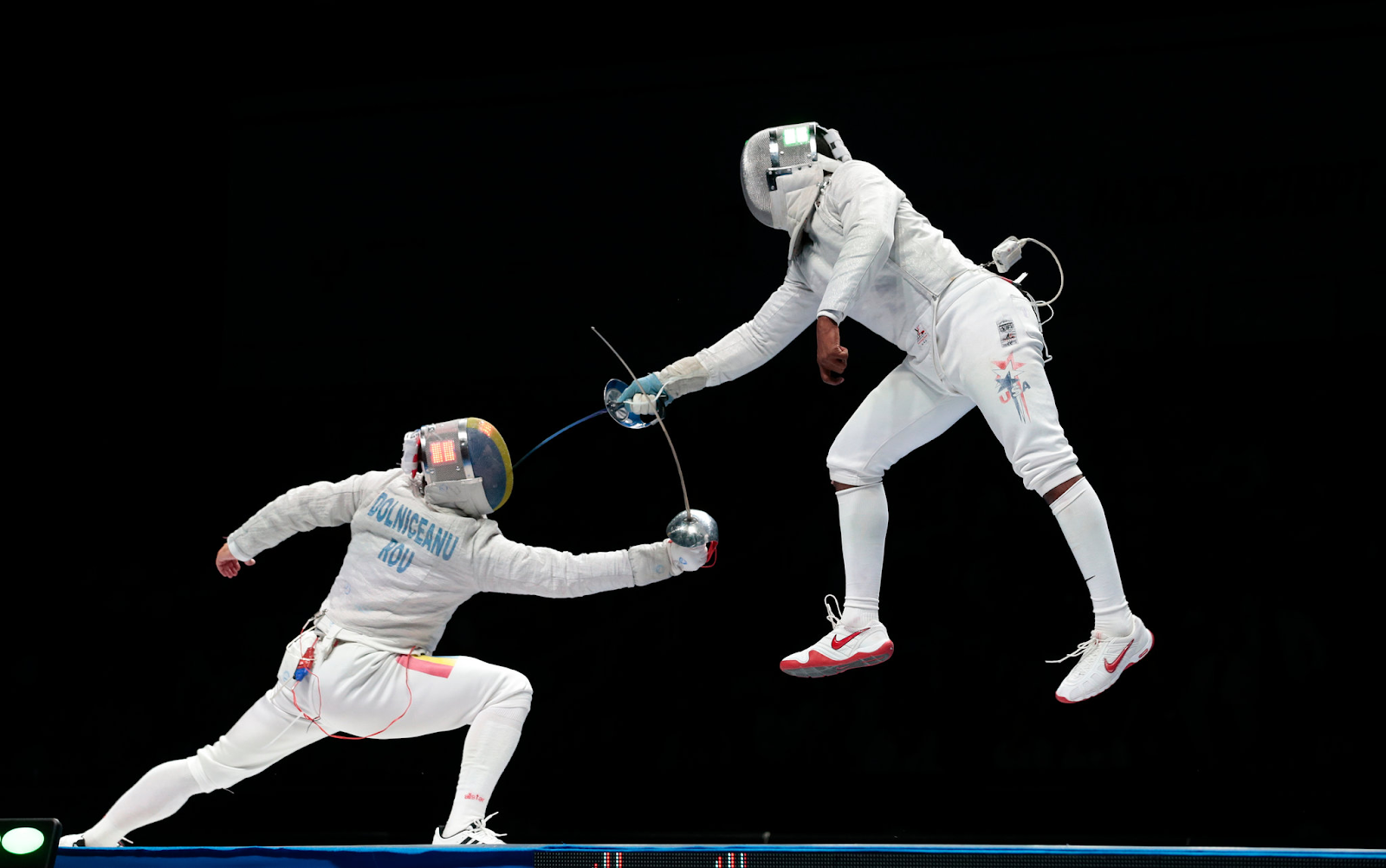
This is the weapon that my brother, Caleb, and my classmate Gil use. Instead of thrusting and stabbing your opponent, sabre fencers must hit their opponent to score a point. They slash instead of poke. They sword fight instead of joust. In sabre fencing, the entire upper body is the target, including the head. What aren’t parts of the target are the hands, legs, and feet. Instead of a pressure plate attached to the tip of the blade that signifies a scored point, sabre fencers use the entire weapon. They cut across (not literally) their opponents with the long side of the blade, which means that sabre fencers must wear an additional piece of gear called the lamé which goes off if someone gets hit (the lamé is electrified, and when the sabre hits the lamé, the circuit is complete–signifying a point earned). The right of way rule also applies to sabre, so it is the referee’s call as to who gets the point if they have a double touch. 

A close encounter in an Olympic sabre bout (nytimes.com)

Épée

This is my personal favorite weapon, and the one I use. Contrary to all the restrictions of foil and sabre, there are barely any rules in épée. The whole body is the target with NO EXCEPTIONS, and there is no right of way. An opponent can counterattack, thus allowing both fencers to score a point if they hit at the same time. As a result, épée fencers are much more cautious in terms of attacking. In a given épée bout, fencers spend most of the time facing each other off and frantically analyzing their opponent. For the other weapons, fencers usually charge at each other as fast as possible because of right of way, but that’s a lot more dangerous in épée because the defender can counter attack and win the point. Parrys, because of the loose rules, are very important in épée fencing to guarantee that you don’t get touched. Disengages are almost as important, which are basically just maneuvers that free your épée from an incoming parry. Usually, a disengage maneuver is in the shape of a circle or semicircle.  

Épée fencer scores a point against their opponent (yahoo.com)

Fencing is a great way to relieve stress, at least for me. It forces you to focus solely on the battle, not leaving any room for thinking about an upcoming test or project. It grounds me in the moment, and it can get pretty hectic. Sometimes someone runs at their opponent with their sword extended, called the flèche attack, which usually results in someone getting hit. Sometimes people cross paths, getting behind each other’s back, which results in people flinging their swords behind their backs to try and win the point. Sometimes swords just snap as well. Overall, fencing is a great sport for people of all ages. My fencing coach’s oldest student is in his 90s! And, we are looking into starting a fencing club at the school. Show your support in the comments!

Filed Under: Learned Something New, Sports Tagged With: Levi Kassinove, The Art of Fencing

  • « Previous Page
  • 1
  • …
  • 25
  • 26
  • 27
  • 28
  • 29
  • …
  • 128
  • Next Page »

About

We are the Palm Valley Firebirds of Rancho Mirage, California. Join us in our endeavors. Venture through the school year with us, perusing the artwork of our students, community, and staff. Our goal is to share the poems, stories, drawings and photographs, essays and parodies that come out of our school. Welcome aboard!