the bird on fire

The Palm Valley School Student Blog

Subscribe to Blog via Email

Enter your email address to subscribe to this blog and receive notifications of new posts by email.

Powered by Genesis

What is Morality?

March 31, 2020 by szachik@pvs.org Leave a Comment

Co-written by Renée and Chelsea

Is morality strictly a code of conduct, or ¨standards by which one decides what’s right and wrong,¨ as one of our anonymous sources put it? This is what we tasked our student populace to decide. . . .  Is morality always rational? How does one determine what’s right or wrong? How does one know what’s good or bad? Nature does not seem to bother itself with these questions, but we humans do. Morality isn’t clear cut in our world. There are layers and layers of circumstance to try and factor in. How do we choose between beliefs when we are stuck between two…? Most of us would agree that something such as killing is wrong. But, what is the “right” decision, if there even is a right decision? To test your morality, we presented a paraphrased version of the famous “Trolley Problem” and other moral quandaries.
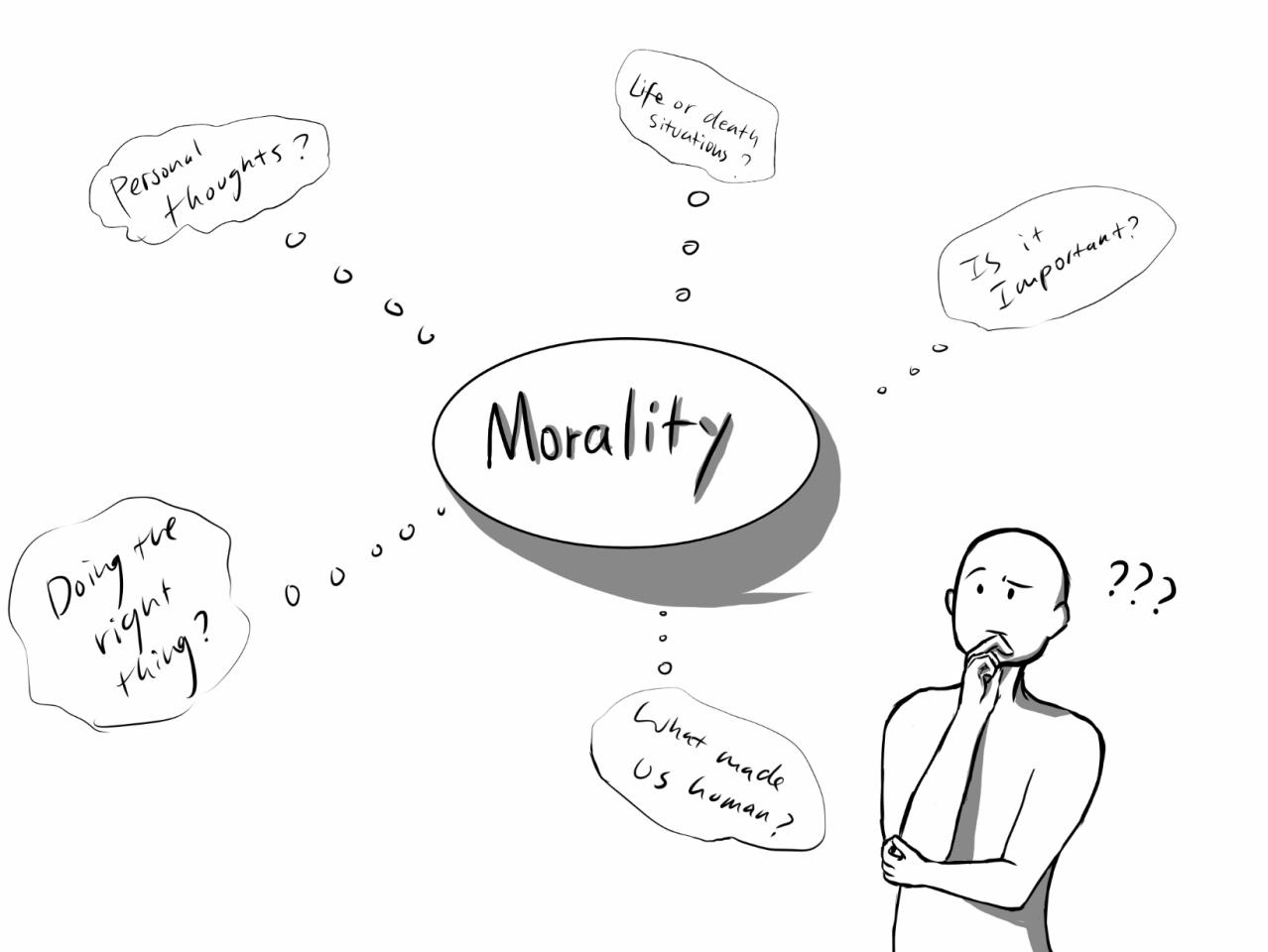
Survey Questions:

*What is morality (to you)?

*There is a runaway unmanned trolley barreling down the railway tracks. Ahead on the tracks, there are five people tied up and unable to move. The trolley is headed straight for them. You are standing some distance off in the train yard, next to a lever. If you pull this lever, the trolley will switch to a different set of tracks. However, you notice that there is one person tied down on the sidetrack. You have two options:  Do nothing and allow the trolley to kill the five people on the main track. Pull the lever, diverting the trolley onto the side track where it will kill one person. What is the right thing to do?

*As before, an unmanned trolley is hurtling down a track towards five people. You are on a bridge under which it will pass, and you can stop it by pushing a very fat man next to you onto the track, killing him to save five. What do you do?

*As before, a trolley is hurtling down a track towards five people. You can divert its path by colliding another trolley into it, but if you do, both will be derailed and go down a hill, and into a home where there is at least one person living there. Anyone in the home would die. What do you do?

*As before, a trolley is hurtling down a track towards five people. This time you are on it. You can divert its path, but if you do, you would be killed. What do you do?

*You’re a gifted transplant surgeon who has five patients, each in need of a different organ who will die without that organ. Unfortunately, there are no organs available to perform any of these five transplant operations. A healthy young vagabond, passing through the city, comes in for a routine checkup. In the course of doing the checkup, you discover that his organs are compatible with all five of your dying patients. If the young man were to disappear, no one would suspect you and he has no family left. Do you kill that tourist and provide his healthy organs to those five dying people and save their lives?

Aurora: Morality is someone’s personal beliefs. It depends on the person. Survey responses– pull the lever, no push, save the house, save self, no sacrifice patient.

Conner: I don’t know! — no pull, yes push, save the house, kill self, no sacrifice patient.

Leslie: I don’t know. — yes pull,  yes push, yes wipe out the house, kill self, no sacrifice patient. 

Leo: Morality involves the values that I hold subjectively (my value system). — no pull, no push, kill self, save the house, sacrifice the patient.

Anonymous: Morality is making an active choice between right and wrong. — yes pull, yes push, yes sacrifice the house, no don’t sacrifice the vagabond patient.

Josh: Morality is knowing right from wrong. — no pull no push, no don’t wipe out the house and occupants, kill self, no don’t sacrifice vagabond.

Sofia: I don’t know how to define morality. — yes pull, yes push, yes sacrifice house occupants? kill self, sacrifice vagabond (if there are no transplant patients if not, then no).

Dominic: Morality is having morals and would be the extent to which one knows right and wrong. — yes pull, yes push, no don’t sacrifice house occupants, no-kill self, sacrifice vagabond. 

Anonymous: I don’t know about morality. — yes pull, no push, no don’t sacrifice house occupants, kill self, sacrifice the vagabond. There are too many factors and in real life, I don’t know. There is no “right answer.”

Nathan: Morality is the idea of doing “good” things based on your own code. —  yes pull, no push, yes sacrifice the house occupants, kill self, no don’t sacrifice the vagabond.

Anonymous: Morality is the standards by which one decides what’s right and wrong. — pull the lever, no push, don’t sacrifice the house occupants, kill self, no don’t sacrifice the vagabond.

The “moral” of the story is . . . relative . . . .

Morality Editor: Luke Langlois

Filed Under: Morality Tagged With: Chelsea, Renée, What is Morality?

Can We Truly Admire Historical Figures?

March 26, 2020 by szachik@pvs.org Leave a Comment

By Luke Langlois

Image result for ronald reagan black and white

Blog readers, as I am writing this, the world is practically on lockdown due to COVID-19 and, although we are still practicing distance learning, I find myself with quite a bit of time on my hands. If you happen to find yourself stuck at home, this is an excellent time to think about big questions and self-reflect. For example: if you were to become a historical figure, would you be an admirable one? While I am sure you would like the answer to be “Yes, of course!” you probably have some skeletons in your closet that would make it real difficult to like you if they were presented in a history textbook. Whether it is something you have said, done, believed, or some other personal vice, there has got to be something that is not likable about yourself. 

I present this information not as a personal attack or something to lower your self-esteem, rather it is just a fact of the human condition. Nobody is perfect, and even if you believe you are, the definition of perfect varies by individual. But that’s a discussion for another time. Now, humans also have a tendency to admire other people. After all, we are social creatures. Furthermore, we tend to glorify people who have made their mark on our world and human history. The accomplishments of these historical figures are romanticized, and we make these people become “larger than life” with monuments, namings, movies, documentaries, etc. Yet, how are we supposed to look up to and, sometimes, even model ourselves after these figures if they are deeply flawed like the rest of us? 

We all know by now that just about every President we have had has had some sort of nasty side, even though streets and cities around the country are named after them. Washington, Jefferson, and almost every President up to Ulysses S. Grant owned slaves. Ronald Reagan was recently revealed to have made racially insensitive comments in a phone call with President Nixon, who also chuckled at the joke (although he’s already not a very well liked man). More contemporarily, Barack Obama stated that he was against same-sex marriage all the way up to the 2008 election, a position he would now be chastised for amongst his supporters. While it is true that the office of President of the United States has been held by a limited demographic, to say the least, the point still stands for other often admired historical figures: people who have done great things have also done some not-so-great things. Nowadays, it seems that we walk on eggshells when it comes to these matters. If you admire a figure with some not-so-admirable traits, many people would argue that you subscribe to these beliefs and even enable these actions by looking up to the said figure. 

One of the primary purposes of learning about history is to learn from our past mistakes. The problem many people have with history, though, is that it is difficult to make connections from past to present. It can be difficult to relate our modern information era to, say, the Gilded Age of the late 19th century. This is where historical figures come in. Although times may change, people have always been people. When we can relate to a figure and find a common point through our humanity, we can truly feel the enrichment of our history. If we scold ourselves for connecting with our historical figures, we risk severing ourselves from a meaningful connection with our past.  

“No one is entirely good or entirely bad. Everyone has some good and some bad in them. Look at Franklin Delano Roosevelt. He certainly helped the United States get out of the Great Depression and was the president the country needed at the time. However, he was not perfect: he signed off [Executive Order 9066] on the Japanese internment camps, for instance.”

— Palm Valley Student Charles Schnell

Historical Figures Editor: Renée Vazquez

Filed Under: Historical Figures, History Tagged With: Luke Langlois

The mind at war with the heart.

March 26, 2020 by szachik@pvs.org Leave a Comment

A poem. For humanity.

By Renée 

I know my emotions.

I know that you’re not sure about yours.

I know that words for you don’t mean the same thing as they do to me.

But they’re all that I’ve had for a long time.

I can’t let you go.

You give me hope for a future that used to seem bleak.

You make me want to scream at the world how amazing you are.

You make me want to be a better person.

You make me want to never let you go.

You are the one who I want to go through the bad times with.

Just let me tell you what I know.

Just let me enjoy you.

And even though I would like to hold you forever,

I’ll let you go when you want me to.

Humanity Editor: Doreen Yuan

Filed Under: Humanity Tagged With: Renée, The mind at war with the heart.

My Morality is being honest to myself forever

March 24, 2020 by szachik@pvs.org 1 Comment

“Very deep and insightful. It made me look into myself a little deeper. I loved it.”–Gerry Dobbins

By Quintus Ni

Time passes like flowing water and disappears silently. When I quiet down and look back, I find that people always sigh deeply at certain moments.

They sigh for some things, some people, or some little experiences……

Then, I come to the conclusion that actually life is not easy, and each person has their own embarrassments. When you try to understand the past and don’t mind your embarrassment anymore, something called compassion will appear in your heart. When you learn to accept your merits and demerits, it means that you are also making peace with the world.

“What does not kill you makes you stronger.”

I didn’t believe this sentence before. I thought it was just a typical motivational quote, until I experienced some things. I have to admit that some “bad” experiences are not necessarily bad, because they at least taught me something.

Every day is new because people experience different things. When you learn to consider and summarize what has happened in your life, your views will gradually become deeper and deeper, and naturally you will come to your own unique ideas of life and morality.

After you experience something, you will be rewarded with gains, feelings, and wisdom.

It is just like traveling. If you go out to see more, naturally you will have a broader vision and mind. Meanwhile, you will be more aware of what you long for most and what the things most worth cherishing and pursuing are. Therefore, it makes sense that senior citizens often say that the more you have experienced, the more you have gained.

I remember in my younger days, when I argued sharply if someone slandered me; I replied angrily if someone misunderstood me; I refuted with more vicious words if someone insulted me……

I was definitely an extremely direct person with sharp characteristics, successfully making myself the person I hate the most.

But later, I learned to adjust my mind positively, and finally understood that no matter how good you are, there are always some people who don’t like you. The world won’t reward you equitably for what you have paid, and it won’t treat you in the same way even if you did treat others kindly.

It is life and its experiences that has made me peaceful, setbacks and difficulties that made me positive, and the people of the world that made me tolerant.

I gradually learned to accept and face everything calmly, treat the people around me more kindly, and be undisturbed no matter what happens. In this way, I slowly taste life and settle myself in time.

Fairness and unfairness are common in life. But it’s uncommon that you can still remain humble, peaceful, kind, and optimistic after you experience much.

Someone once said that your calmness comes from your past innocence, and that your kindness comes from your past sadness and uneasiness. I look back and find this to be absolutely true.

Even the most irritable people will gradually become gentle and patient if they are polished by time. We’ll eventually grow from those years when we got angry and listened to no one’s advice. Then we will smile and accept it all, good or bad. An ancient saying says to remain indifferent and leisurely watch the flowers bloom and fade.

Eventually, we may no longer be as imperious, impulsive, and carefree as in our childhood days, but we’ve already known the width and thickness of life.

We have cried, laughed, lost, doubted, and hesitated along the way……But, finally, we have learned to regard everything as growth.

Maybe this is what life should be!

You live up to time, and time lives up to you.

Morality Editor Luke Langlois

Filed Under: Morality Tagged With: My Morality is being honest to myself forever, Quintus Ni

Morality, the Individual, & the Masses

March 20, 2020 by szachik@pvs.org Leave a Comment

 By James Zheng

Morality is just a fiction used by the herd of inferior human beings to hold back the few superior men.

— Friedrich Nietzsche 

There is inspiration that can be evoked from a single sentence. Nietzsche says that morality is a worthless concept. I think what he said is right and can’t be refuted. 

Nietzsche’s definition of morality in the quote is not referring to the “common” understanding of morality. That morality is not the Christian doctrine.

Before we continue into Nietzsche’s perplexing mind, briefly think about your definition of morality. Our accordant definition of it might just be the principles concerning right and wrong, or good and bad behavior, but Nietsche does not care about right or wrong. Does he even know what is right or wrong? [Quote Nietzsche?]

Although in Nietzsche’s time most of the objects and thoughts of his word were focused on Christianity, its scope was far beyond that. I think Nietzsche would say that even if he lived in the present.

Nietzsche’s philosophy is what is recognized as the thoughts derived by the “strong man” (how Nietzsche characterizes himself). Ordinary people always want to put the wisemen at the same level as them.

In case you don’t understand what I just said–the mentioned morality is an unspoken rule established by the majority in the society, such as what is allowed or when and how to do something. This is their system of consensus.

Something that seems to be off the topic but worth mentioning is that from Nietzsche’s vision, the strong are the individuals who pursue self-transcendence, so that they themselves become the standard of conduct of everything, breaking all the agreed norms of the secular world, and putting their own norms in the highest position in the world. Nietzsche sees conventional “Morality” as an excuse for the weak to “despise” the strong. The weak say, “Hum, those so-called strong people are just immoral people.” They want to popularize the vulgar norms of their own connection, so as to make the strong yield to them. Nietzsche characterizes himself as the strong and those who obey the social norms as weak.

For example, I used to see this type of phenomenon in middle school. A student is studying during the break while a group of other students would be messing around near that student. One of them couldn’t endure watching the studying student, so he said, “Why do you keep learning when you’re already really outstanding? You’ve got a stable situation, you can definitely get to Tsinghua or Peking (the two top universities in China)! You are making us so nervous!” Well, that’s the way they stop that classmate from continuing his study. His latent meaning is “Now we should be all enjoying our life for doing whatever we want. Why do you waste time on studying? Do you not know how to follow the public will?” Conformity becomes a type of morality.

I think that’s what Nietsche meant by “morality is of the weak.”

But here, the other students can be called “the weak,” but the student who studies can not be called “the strong.” The former is called “the weak” because they impose their own kind of “morality” on others and destroy their transcendence. If the student gives in, he can only wait to be the next “weak.” If he carefully considers the meaning behind other students’ words and decides whether “conformity” is his own “morality,” then he is a strong one. The logic is quite simple. 

As for why Nietzsche said morality was a “fiction,” Nietzsche believed that this kind of social conforming “morality” is false. The real morality of a man can only come from himself rather than from others.

Consider one of Immanuel Kant’s books named Groundwork of the Metaphysic of Morals. He denies the moral command of God but affirms the moral absolute command in the human heart. Why? Because the former is from the outside world, the latter is from his own. Kant found no reason for others to force you to do anything. Nietzsche agrees with this point. 

Your self-discipline can’t come from the outside world. Morality from the outside world needs you as the judge. If you think it’s rotten, then it’s rotten. The strong is the one who constructs his own moral values. Those values will inevitably conflict with the moral values produced by the weak. In the perception of the strong, this kind of “morality” is fiction.

Nietzsche’s ideas are subjective and can be considered as “offensive” to our normally conventional thought. But his primary advocacy concentrates on the crucial word “innovation” rather than “convention.” Coming back to morality, at last, we do have an agreement on what morality is and know the prohibition of certain behaviors, but by hearing the intriguing thoughts from Nietzsche, I hope you learned something new from it.

I asked PVS junior Nathan Bosworth what he thought about Nietzsche’s points. He replied, “I believe with all my being that this quote from my boy [Nietzsche] is the meaning of capitalism, because social norms need to be suppressed to get what you want. In other words, to acquire what you want, you have to do something unethical.” I actually had a long talk with Nathan about what morality really is. We finally came to a vague conclusion that true morality might not even exist. After that, I came to our notable scholar Mr. Griffin who had something deeper to say: “I think [Nietzsche’s] quote is really narcissistic, and it reminds me of the character Raskolnikov in Crime and Punishment.” Mr. Griffin went on to point out that Raskolnikov commits misdeeds to prove himself a superior person. He continues, “If you think about it more, it applies to The Picture of Dorian Gray as well.” To me, this became even more edifying as I recalled the contents of the book. 

Nietzsche’s definition of morality revolves around unreasonable social norms. What is your definition of morality? If you simply look up the word in Google’s dictionary, it just shows you “the distinction between right or wrong, good or bad.” But that raises a bigger question: how do you distinguish between right and wrong or good and bad? Do you follow the law of nature? Do you follow your own heart? Or do you follow the herd. . .   

Minor ideas of this post regarding the conventions of morality were originally proposed by Blogger Sizhe Chen

https://www.zhihu.com/question/330764652/answer/747464096

Morality Editor: Luke Langlois 

Filed Under: Morality Tagged With: and the Masses, James Zheng, Morality, the Individual

These Quotes May Inspire You To “Seize the Moment”

March 18, 2020 by szachik@pvs.org 2 Comments

By Student of Philosophy James Zheng

The philosophers we have known are often classified as pessimists due to their cynical criticism. But, I’ve found, when things appear in life that give them a positive mood, they intend to write something contrary to their usual negative and realistic statement. So, for “Carpe Diem” theme week, I picked some typically pessimistic philosophers who proffered some intriguing quotes. And, I thought to share them with you in these challenging times.

Whoever has much to proclaim one day, Must long remain silent unto himself: Whoever intends to ignite lightning one day, Must long — be a cloud. – Friedrich Nietsche 

And we should consider every day lost on which we have not danced at least once.

And we should call every truth false which was not accompanied by at least one laugh. – Friedrich Nietsche

Ordinary people merely think how they shall “spend” their time; a man of talent tries to “use’”it.- Arthur Schopenhauer.

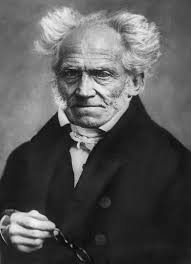
Schopenhauer

A man is never happy, but spends his whole life in striving after something that he thinks will make him so; he seldom attains his goal, and when he does, it is only to be disappointed; he is mostly shipwrecked in the end, and comes into harbour with mast and rigging gone. And then, it is all one whether he is happy or miserable; for his life was never anything more than a present moment always vanishing; and now it is over.- Arthur Schopenhauer

Isn’t life meant to change something short into something permanent? To do this, we need to know how to cherish the short and permanent- Johann von Goethe

von Goethe

*Nothing is more worth than this day, You cannot relive yesterday. Tomorrow is still beyond your reach.- Johann von Goethe

Depending on how you understand these quotes, you will harvest different meanings. But, I hope you enjoy reading these refreshing contents as well as helping you to perceive more deeply about “Seizing the Moment.”

*Indicates this quote has been paraphrased.

The quotes are from http://www.ruiwen.com/mingyan/1415384.html

https://www.zybang.com/question/8877bb836d82b1dd1f00a10c55f11f10.html
https://www.zhihu.com/question/21615908/answer/424800878

Carpe Diem Editor: Quintus Ni

Filed Under: Carpe Diem Tagged With: James Zheng, schopenhauer, These Quotes May Inspire You to "Seize the Moment"

How to live in the moment

March 16, 2020 by szachik@pvs.org Leave a Comment

In these trying times, Chelsea reminds us to Seize the Day and grab on to what is positive.

By Chelsea

Hello everyone!! Are you having an amazing day? If so, then you are living in the moment! You are experiencing probably some of your happiest and most memorable memories that you’ll forever remember in your brain.

Here are some tips on how to live in the moment:

  • Try to relax and enjoy nature’s scenery without the distractions of technology.
  • Go on fun field trips with your family and friends. Then you’ll leave your stress behind and enjoy the moments filled with happiness and joy.
  • Do something you enjoy doing, like singing, drawing, playing sports, playing instruments –all to relax your mind and live in the moment.
  • Talk to people. Some conversations will lead to the best moments of your life, and you’ll never know–unless you engage.
  • Accomplish something that you are proud of.  That will fill your heart with confidence and pride.

These are some simple steps for you to live some of the best times of your life! Look for the happiness and the gratitude even when times are challenging around you.

Carpe Diem Editor: Quintus Ni

Filed Under: Carpe Diem Tagged With: Chelsea, How to live in the moment

Best o’ the Blog

March 16, 2020 by szachik@pvs.org Leave a Comment

See what’s happening recently at thebirdonfire.org.

Views: 24,564
Followers: 161 Subscribed
Published 634 posts
Comments: 950

A small green rectangle to divide sections of the document

FIREBIRD Letter to Palm Valley Community by Charles Schnell

Dear Palm Valley Community, 

If someone asked you, “Who are you,” how would you respond? “I’m a. . .” Student? Parent? Teacher? Social worker? Musician? Politician? Doctor? Athlete? Farmer? Architect? Clown? . . . .

A small green rectangle to divide sections of the document

Ghost Hunting?!

By Luke Langlois Have you ever been trying to fall asleep at night when, suddenly, you hear a chilling whoooosh or an eerie creaking? Being the mature and fearless person you are, perhaps you brush these noises off as your cat doing cat things or the refrigerator… refrigerating. . . .

A small green rectangle to divide sections of the document

The Enchantment of Snowboarding

By James Zheng SYMPTOMS OF SNOWBOARDITIS

  • Being excessively elated over words associated with snow.
  • Desperately waiting for winter, not caring about the other 3 seasons.
  • Spending all time watching videos and reading articles about Snowboarding. (Symptoms worsen during winter.) . . . .

Filed Under: Best o' the Blog, Uncategorized Tagged With: Charles Schnell, FIREBIRD Letter to Palm Valley Community by Charles Schnell, Ghost Hunting?!, James Zheng, Luke Langlois, The Enchantment of Snowboarding

On the Imperfection of Humanity

March 12, 2020 by szachik@pvs.org Leave a Comment

By James Zheng

As a madman philosopher who brings shiver to Western philosophy and innovates the philosophical cognition of the world, and as a sheer critic of traditional philosophical theory, he is a celebrity in the history of philosophy who made the dreadful claim that “God is dead”: this is Friedrich Nietzsche.

In one of his works, Human, all too Human, he explores human nature from two aspects of potential and fatal defects. Despite his criticism of humankind as being “merciless,” the author finally expresses the hope that human nature can break free of social norms and become a person of free thought. His ultimate goal is summarized as what he calls the Free Spirit.

The writing structure of Human, all too Human is a collection of essays. I choose some quotations that I appreciate and think are worth analyzing.

“Shared joys make a friend, not shared sufferings.” (It is pleasure, not adversity, that makes friends.) Nietzsche put forward that what makes people have a common cognition is not the same suffering but the sharing of interests. Even though it was generally believed that “adversity for individuals forges love,” Nietzsche didn’t take it.

“Not everyone likes to hear the truth being told in a pleasant way. I hope that at least no one will think that by speaking falsehood in an unpleasant way, falsehood will become truth.” The beginnings of these two sentences doesn’t match their endings, and it feels that the former part should change its meaning with the latter part, so the correct statement should be that the truth is said in an unpleasant way and the fallacy is said in the opposite. He reverses and satirizes this thought intentionally. People reject truth because truth is told in an unpleasant way since truth exposes things people wish to hide and are unwilling to admit, and falsehood is readily accepted by people since it is told in a pleasant way and is often what people wish to hear. Nietzsche expresses that people might confound the nature and substance of falsehood and truth. He pointed out that in society, truths are denied because truth itself is very difficult to say in a pleasant way; if it is said in a pleasant way, it will lose its uniqueness and make some people unhappy. On the basis of this, Nietzsche stated that he is afraid that those fallacies that would make people unhappy would be turned into truth.

“For an outright knower, knowledge is irrelevant.” There are two possibilities for Nietzsche to express his meaning: 1. For a person who can see through or fully grasp a certain ability, he no longer approves of the importance of this ability. 2. For a person who sees through everything, knowledge (in this case, knowledge presented by the outside world) is of no importance. There is transparently a contradiction, though the sentence still flows well. 

From the three quotes, Nietzsche criticizes the major imperfections as the property of being egoistic, ignorant, and misguided. I like his destructive honesty. And though I cannot fully interpret his quotes in a most satisfying way, we can all be open-minded about what he originally meant by these quotes. At last, I hope these quotes could be edifying to you.

Humanity Editor: Doreen Yuan

Filed Under: Humanity Tagged With: James Zheng, On the Imperfection of Humanity

Ghost Hunting?!

March 6, 2020 by szachik@pvs.org 1 Comment

Editor Katelin assigned the Blog Staff to explore “Spirits.” Luke, with plans to go to college, has a Plan B–Ghost Hunting.–S.Z.

By Luke Langlois

Have you ever been trying to fall asleep at night when, suddenly, you hear a chilling whoooosh or an eerie creaking? Being the mature and fearless person you are, perhaps you brush these noises off as your cat doing cat things or the refrigerator… refrigerating. But, let’s be real. The thought has passed through your mind that these mysterious noises originate from a much more sinister source: spirits and ghosts. Although we may not know the intentions of these lost souls, do we want to be taking any risks that could land us on a one-way train to a similar state of being? Don’t just sit around and wait for the ghosts to get you; get up and go ghost hunting! In honor of the “spirit” theme, here are some basic tips for hunting the specters and phantoms creepily whirling around our mortal plane of existence.

  1. Always Bring a Friend: Before you do anything, you must find a buddy to assist you in this ghost hunting endeavor. Working alone may sound appealing because, after all, it is what Batman does, but you are not Batman. If you’ve ever seen a horror movie, you would know that if you hunt alone, you may end up becoming the hunted. . .  So, whether it’s your puppy, your goldfish, your ant colony, or your best friend Joe, you can find your strength in numbers, as long as you all are brave. 
  2. Do Your Research: When dealing with spirits, the element of surprise is on their side. You have no idea what the spirits may manifest themselves as! If you go hunting without knowing what threats the spirits pose, you may find yourself in a lethal situation. Ghosts were once living creatures themselves, and, like living creatures, each ghost is unique. Depending on your location, the type of ghost you encounter may be different. If your house was built on the site of a Mafia shootout, for example, you must be prepared for an aggressive and vengeful spirit. 
  3. Bring the Proper Equipment: Fending off the paranormal is not something you can do with just your hands and mental fortitude. Just like with any other activity, you will have more success hunting ghosts if you have the proper equipment, especially if that equipment is of a high-tier quality. For a ghost hunt, you will need a pen, paper, camera, flashlight, and a mobile phone. You will want concrete evidence when you find your ghost, and if you are unable to ward the ghost off the first time, you will have more information for your next attack. If you’re dealing with a more advanced ghost, you will want to look into digital laser thermometers to detect their spectral energy. Spooky! 
  4. Movies Are Not Reality: Just like with anything else, movies are not reality. Don’t believe that one viewing of Ghostbusters makes you an experienced ghost hunter. All of the ghosts in that movie are heavily exaggerated. The ghosts won’t typically be giant ectoplasmic monsters. Real ghost hunting can be boring, and sometimes you won’t find anything. Look, practicing your ghost hunting isn’t an exciting process ALL the time, but it is just so rewarding when it does pay off. Patience is key when hunting ghosts.  

If you are afraid of ghosts, today is the best day to begin conquering your fear. If you learn to conquer the unseen, is there anything that could stop you? I think not! Begin your ghost hunting journey today…  

*Luke does not condone hunting ghosts, nor does he hunt ghosts himself. 

Image result for haunted mansion

Spirit Editor: Katelin

Filed Under: Spirits Tagged With: Ghost Hunting?!, Luke Langlois

  • « Previous Page
  • 1
  • …
  • 63
  • 64
  • 65
  • 66
  • 67
  • …
  • 128
  • Next Page »

About

We are the Palm Valley Firebirds of Rancho Mirage, California. Join us in our endeavors. Venture through the school year with us, perusing the artwork of our students, community, and staff. Our goal is to share the poems, stories, drawings and photographs, essays and parodies that come out of our school. Welcome aboard!