
the bird on fire

The Palm Valley School Student Blog

Subscribe to Blog via Email

Enter your email address to subscribe to this blog and receive notifications of new posts by email.

Powered by Genesis

Rethinking Speed Limits

May 5, 2021 by szachik@pvs.org 1 Comment

Speed limits are frustrating obstacles us drivers have to face. Roman offers an alternative solution by promoting decriminalizing city speed limits.

By Roman Rickwood

Speeding is the number one traffic violation in the United States (blinetrafficschools.com).  For me, speed limits within the city are pretty much necessary because of the amount of cars on the road, as well as the numerous amounts of pedestrians, commuters, and cyclists. Thus, when I first began thinking about decriminalizing speed limits, I quickly ruled out decriminalizing city speed limits. Speed limits in and around city streets make sense to me. As someone who has been a licensed driver since December, I am just now learning how to judge when the light will change. So, speed limits should be based on how long it would take someone to safely decelerate and come to a complete stop. In my opinion, when speed limits are being set it is based on a few things. These include 1) the condition the street is in, 2) the number of stoplights, 3) foot traffic, of course, 4) congestion. I inevitably came to the conclusion that speed limits on roads with street lights and pedestrians are necessary. With all that being said, let’s talk about highways. 
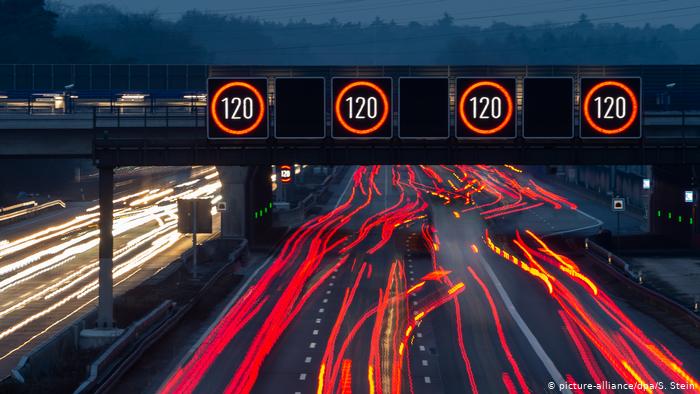
Germans at loggerheads over autobahn speed limits | News | DW | 27.01.2019
Germany’s autobahn

Most highways in California have speed limits from 60 mph to sometimes 75 mph.  I will be blunt when I say that these limits are far too slow. Most major highways within California have four lanes. It is generally known amongst drivers that the furthest left lane is known as the fast lane, and the three right lanes are generally going to be for slower traffic. When you go down the highway you see almost all the semis in the first two right lanes. This is because the majority of semis are governed at 60-65 mph, so, for example, on the I-10 the only vehicles you see in the first two right lanes are either semis, or people that are hauling trailers. This system works well because it allows these massive machines to be more safe and they have less worry about being cut off and having to brake rapidly. However, if we go two lanes over, we see a completely different story. We see people going with “the flow of traffic.” To see a different model of traffic flow, I looked at the autobahn between Berlin and Hamburg in Germany. This is famously known as the “Highway with no speed limit.” There have even been records of 300 kph hit on the autobahn. As it is explained, it seems that there are certain lanes with speed limits that are done for the protection of 18 wheelers and regular commuters who don’t have cars capable of hitting these incredible speeds. The autobahn has a 26% lower chance of having a deadly accident than other roads and highways with speed limits, a 2017 study shows (motorbiscuit.com). Knowing all this, I think we can all come to the conclusion that while decriminalizing speed limits sounds radical and dangerous, once you look deeper into it it makes more sense. 

If I still don’t have you convinced that an unregulated lane on major highways is a good idea, then this argument might.

Even with speed limits in place, people will still speed and drive recklessly, so you could think of this lane as a place where reckless and fast drivers can perform these actions without putting the lives of everyday commuters at risk. While there are a million gray areas, the main idea is this. There can be one or two lanes where people can drive as fast as they want without having fear of being pulled over. Here, people may take risks. Those adverse to risk can drive in the other lanes. I justify all of this with the argument of personal freedom and free will. After all, this is America. 

Decriminalize/Criminalize Editor: Evan Spry

Sources:

Is the Autobahn Safer Than U.S. Highways?

https://www.idrivesafely.com/defensive-driving/trending/it-time-american-autobahn

https://www.blinetrafficschools.com/top-10-moving-traffic-violations-and-how-to-avoid-them/#:~:text=1.,where%20they%20may%20change%20frequently.

Filed Under: Laws Tagged With: Rethinking Speed Limits, Roman Rickwood

A “reality” that may be closer than you think

April 12, 2021 by szachik@pvs.org Leave a Comment

Blogger Roman takes inspiration from futuristic flicks as he peers into alternate realities. This future is full of safer and more advanced modes of transportation. Interested? Take a read, and find out more. –Alternate Realities Editor Hannah Hall

By Roman Rickwood

When you think of alternate realities, a common thought that comes to mind is virtual reality or sci-fi movies where life as we know it is unrecognizable. However, if we took certain aspects of life and advanced them even 50 years, much of how we live would change. For example, in most “alternate reality” movies, transportation is often the most advanced feature in the made-up world. However, what if we took the portrayal of transportation in these movies and implemented them into real life? 

The Future of Transportation businessinsider.com

Think of our society today; the large majority of our society owns or has easy access to a car, motorcycle, or some form of transportation. However, when we watch these sci-fi and alternate-reality movies, we see very efficient methods of transportation such as air tubes, aerial mass transport vehicles, as well as connecting walking tunnels. All of these things have the same goal–mass transportation in the quickest and most efficient way possible. Living in Southern California, we all know and understand the horror of traffic and congested roads. Seriously, how many times have you been late or even missed something because of the traffic or congested roads??! Now, we do have mass transport systems in place in our world today such as subways, buses, trains, and planes. Most people, specifically people in California, do not rely on these systems of transportation because they are all too often late and inefficient. The culture in most parts of the United States is that each household has access to a form of transportation. With all that being said, try and even imagine our society and how we transport ourselves with even half of the technology shown in movies. Imagine a world where traffic did not exist and where you could rely on mass transportation to be both quick, effective, and most importantly reliable. A few major societal changes that could occur would be decrease in emissions and gasses, decrease of people on the roads, which would inevitably lead to a decrease in traffic-related accidents. 

When you break down all these factors and see how many issues and accidents are caused by “outdated” modes of transportation, we see just how much an alternate reality of transportation would improve and help our world. We need a change, and we need it now.

Alternate Realities Editor: Hannah Hall

Filed Under: Alternate Realities Tagged With: A “reality” that may be closer than you think, Roman Rickwood

Don’t Give Up the Ship.

March 19, 2021 by szachik@pvs.org 1 Comment

By Roman Rickwood

Nowadays, we all need to be reminded of the importance of persistence. Life is hard. We need to persevere. For this week’s theme, Blogger Roman writes about a motto that highlights the importance of determination. 

My motto to live by is “Don’t Give Up the Ship.” For as long as I can remember, I have had a piece of art hanging on my bedroom wall that says “Don’t Give Up the Ship.” When my mom bought it, she told me the motto reminded her of me and that it has deeper meaning for how we should live our lives. 

New York Historical Society: “Don’t Give Up the Ship”

To me Don’t give up the ship means be persistent, work through it, be strong, and stay the course regardless of what happens. As I’m writing this now, I think if I were to hear someone say “Don’t Give Up the Ship,” I would immediately think of an actual ship and a captain sailing through rough weather in order to complete his voyage. In the maritime world, it is an unwritten rule that the captain should always go down with the ship; this makes sense to me because it would mean that hypothetically the captain was so focused on getting others to safety that he would disregard his own. He has the responsibility of all others and the ship. I really think that this is the attitude you must have to be a captain, whether you are the captain of a football team, a captain of an airplane, or a captain of a ship. You should always put the people you are guiding above yourself. I believe this is the virtue of selflessness, leadership, and sacrifice. 

To me, these are the three virtues that I strive to follow. In my opinion, it is important to make the most rational decisions possible–which is why I sometimes struggle with the interpretation of a captain going down with his ship. Obviously it is reckless to put yourself in harm’s way; however, it is the right thing to do. 

As I’m getting older, I am learning valuable life lessons and realizing how hard life can really be. I think that at the end of the day, as long as you are willing to work hard, be selfless, and make sacrifices, we can accomplish any goal that we seek.

Motto Editor: Sara Habibipour 

Filed Under: Mottos Tagged With: Don’t Give up the Ship., Roman Rickwood

Do You Know the Difference Between the Greek and Roman Gods?

March 15, 2021 by szachik@pvs.org Leave a Comment

The mythologies of Greece and Rome are often confused. Blogger Roman compares the two, diving into the differences in the names of Roman and Greek gods and goddesses as well as what they represent.

By Roman Rickwood

Names and Appearance

Greek gods

The largest difference between Roman and Greek mythology lies in the gods. Greek gods and goddesses are named after people and are assigned genders; whereas in Roman mythology gods and goddesses were named after objects and characteristics and do not technically possess a gender (theoi.com). For example, Zeus, Hera, Athena, and Hermes all are common names in ancient Greek culture. Since Greek mythology predates Roman, the Romans borrowed liberally from the Greek gods. The gods of the Greeks and the Romans are presented and drawn differently. Greek gods were portrayed with heavy emphasis placed on their physical traits and attributes. Meanwhile Roman gods had a strong emphasis on characteristics such as morals and villainy and were not so clearly portrayed physically. 

Worship and Beliefs

Roman gods

Another way that Greek and Roman gods differ lies in who they chose to worship. The Roman gods chose to hail Jupiter meanwhile the Greek gods chose to hail Zeus. In Greek mythology, morals played a vital and important role in the lives of the Greek gods. Greek mythology emphasizes the importance of good deeds and morals and learning important lessons through living life. The gods also teach mortals the lessons that they have learned. Every Greek myth included a teaching. Roman mythology was not so instructive. The Romans did not place as much stock in mythological teaching because of their strong belief in an afterlife. They believed they had time for redemption.

While researching this topic, I was astonished to read just how different the two mythological structures are, from how their respective gods look to how they are revered. 

Source:

https://www.theoi.com/articles/roman-gods-vs-greek-gods-know-the-difference/

Mythology Editor: Elizabeth Shay

Filed Under: Mythology Tagged With: Do You Know the Difference Between Greek and Roman Gods?, Roman Rickwood

  • « Previous Page
  • 1
  • 2

About

We are the Palm Valley Firebirds of Rancho Mirage, California. Join us in our endeavors. Venture through the school year with us, perusing the artwork of our students, community, and staff. Our goal is to share the poems, stories, drawings and photographs, essays and parodies that come out of our school. Welcome aboard!