the bird on fire

The Palm Valley School Student Blog

Subscribe to Blog via Email

Enter your email address to subscribe to this blog and receive notifications of new posts by email.

Powered by Genesis

The Coolest Small-Business Restaurants in Palm Springs

January 29, 2021 by szachik@pvs.org 1 Comment

Within the past few years, Palm Springs has become a small business hotspot, especially for new restaurants. In response to Editor Jake’s prompt, Blogger Sara decided to share, in her opinion, the coolest small business restaurants in her hometown of Palm Springs.

By Sara Habibipour

Kreem Ice Cream + Coffee

170 E Palm Canyon Dr #8822, Palm Springs, CA

Kreem Ice Cream

If I was given the choice on where to go out for ice cream, my number one choice would be Kreem, a small, in-house creamery a few minutes away from the Ace Hotel. What I like about their ice cream is that it’s refreshing and that they offer vegan coconut-milk based options as well. They rotate their flavors, but some of them include lemon meringue pie, rosemary, ube, and turmeric-ginger. They also serve coffee and soda floats! I think this unique variety of flavors and options–that you can’t get at Ben and Jerry’s or Cold Stone–is what makes Kreem a stand-out destination.

Gabino’s Creperie

170 E Palm Canyon Dr #4, Palm Springs, CA 92264

Gabino’s Creperie

I’ve never been to Gabino’s Creperie, but it seems to be such an interesting place! It’s a small, family-owned business that serves savory crepes. For example, Chicken Pesto Crepes and BBQ Chicken crepes. It also appears to be next to Kreem, so, hey, get a crepe and go get some ice cream one day. This business seems to appeal to the innovative and aesthetic foods that the younger generation is so interested in nowadays, so I see them becoming more and more popular in the valley. 

Aspen Mills

555 S Sunrise Way # 101, Palm Springs, CA 92264

Aspen Mills, Sunrise Way

I. LOVE. ASPEN. MILLS. 

If you’re ever craving a sandwich, go to this place! All the sandwiches are delicious. If you like tuna go for the Newporter! They also have a bakery, so you can buy fresh bread and baked goods. In addition to being hit by COVID, they actually suffered from a fire and had to renovate their kitchen and restaurant. So, if you’re looking to go support a local business, head to Aspen Mills! All of the Palm Springs locals love it. And, the staff is so kind!

Nature’s Cafe

555 S Sunrise Way UNIT 301, Palm Springs, CA 92264

Nature’s Cafe

Are you vegan or vegetarian (or maybe not and you still like that kind of food)? If so, you have to visit Nature’s Cafe. It’s an exclusively vegetarian/vegan cafe and juice bar that serves just about anything you could desire. Veggie burgers, stir fry, protein shakes, blue algae juices…they have it all! I’ve been going there for the past few years, and every time I go there seems to be more and more people! It’s definitely a booming business in Palm Springs that’s worth checking out! It’s also in a vegetarian/vegan health store, so you can pick up groceries while you wait for your food! 

Great Shakes

160 S Palm Canyon Dr A, Palm Springs, CA 92262

Great Shakes

Last but certainly not least… 

Great Shakes. 

Pure awesomeness (if you have a sweet tooth, that is). 

Located in Downtown Palm Springs, this business has been growing greatly within the past couple years, especially during the summer heat when tourists and locals look for a refresher. They even have tiny signature donuts around the straws!

Up-and-Coming Businesses Editor: Jake Sonderman

Filed Under: Business Tagged With: Sara Habibipour, The Coolest Small-Business Restaurants in Palm Springs

The Beauty of Dance Festivals

January 13, 2021 by szachik@pvs.org 1 Comment

While there’s light at the end of our Coronavirus tunnel, we are still under stay-at-home orders here in Riverside County. Editor Hannah heartily misses gatherings and festivals. She asks, “If you could get out and gather, what would be your festivity of choice?” What will our festivities look like in a post-Coronavirus time? Blogger Sara dreams of dance festivals.

By Sara Habibipour

Something that all performance artists have missed through these COVID times is not being able to perform on a stage. As artists, we come up with creative ways to continue sharing our gifts with the world, but there’s something about the adrenaline rush you get in the wings, the warmth of the lights, and the dressing room hustle that we can’t live without. 

Palm Springs Dance Festival

A gathering that I will be excited to take part in once COVID-times are over is the Palm Springs Dance Festival. The last time I performed in a theater was during this festival, and it was memorable. Our studio had the opportunity to perform a couple pieces alongside other dance studios and even professionals from LA companies. I look forward to this festival because it allows a space for young dancers from all different schools to come together, share their talents, and watch dancers from other studios perform–which we don’t often do. We also had the opportunity to watch these professionals perform in their own showcase. I was fascinated that their energy was able to touch me even though I was sitting all the way in the back row of the theater.

Jacob’s Pillow Dance Festival

I would also like to travel and visit more dance festivals, for example, the Jacob’s Pillow Dance Festival. Known as the “hub and mecca of dancing,” the Pillow is the longest running international dance festival. It’s held on a 220-acre farm in the middle of the Western Massachusetts woods, and as you can see in the image below, the view is quite stunning. I can’t even begin to imagine how powerful it must feel to be dancing in the woods. 

What I love most about these festivals is that you don’t just get your classical ballet variations that we’ve all seen and performed five hundred times. There’s so much new and contemporary choreography and music you’ve never seen and heard before. There are so many innovative props and costumes. It’s art in its truest form. It has you leaving the theater like, “I want to watch that again! What was that music?! I want to learn that dance!”

Hopefully when Corona-times are over, I’ll be able to participate in and watch more dance festivals. Luckily, there’s plenty of virtual events to keep me satisfied for now.

Festivities (in-a-post-Coronavirus-time) Editor: Hannah Hall

Filed Under: Festivities Tagged With: Sara Habibipour, The Beauty of Dance Festivals

The Academia Aesthetic

January 6, 2021 by szachik@pvs.org 1 Comment

Social media, especially TikTok, has popularized the term “aesthetic” in recent years. There are hundreds of aesthetics, and in her post, Blogger Sara Habibipour addresses one of the most popular ones.

By Sara Habibipour

Perhaps one of the most famous trending aesthetics on TikTok and Instagram is the “Academia” aesthetic, characterized by “…classic literature, the pursuit of self-discovery, and a general passion for knowledge and learning” (Aesthetics.Fandom.Com). 

Some of the key motifs of this aesthetic are books, darkness, history, and old architecture. 

But wait…there’s more. 

There’s actually a never-ending list of sub-academia aesthetics. Anything you can think of, there’s probably an academia aesthetic for it. Theater Academia, Chaotic Academia, Fairy Academia…it all exists. Here’s a list of the most famous, and, in my opinion, the most pleasant-to-look-at academia aesthetics.

Dark Academia

The Dark Academia aesthetic is heavily centered around classic Greek and Gothic architecture. Imagine attending a prep school in Europe, spending late nights in a Gothic-style library while sipping a cup of coffee as you watch the rain pouring down outside; that would be a perfect example of the Dark Academia lifestyle. 

Dark Academia is heavily characterized by its distinct fashion as well, with a color palette mostly consisting of earth tones (browns, dark greens, grays, etc.). As far as the style, it’s very “preppy”; brown cardigans, vintage plaid skirts/pants, and leather satchels are the staples of the Dark Academia look.


Not “dark” enough for your taste? Well, there’s actually a subcategory of Dark Academia. And can you guess what it’s called? 

…Darkest Academia

Here’s a photo that pretty much sums up the Darkest Academia aesthetic.

Darkest Academia Aesthetic

Light Academia

For those of you who don’t particularly care for darker colors but still like the Academic style, maybe Light Academia is your aesthetic. 

Characterized by beige, cream, white, and light brown shades, the Light Academia fashion still is “preppy” but definitely distinct from its counterpart, Dark Academia. The architecture preferences are also less Gothic and more classic Greek, and there’s more of an emphasis on the arts and romance. 

Light Academia Aesthetic

Green and Blue Academia 

There are also more color-specific academia aesthetics. 

For example, there’s Green Academia which fosters things like reading books in nature surrounded by greenery and earthy-green colors. There’s Blue Academia which appreciates the beauty of the night sky and royal blue (a Ravenclaw aesthetic, if you will). 

Green Academia Aesthetic
Blue Academia Aesthetic

***

Out of all the aesthetics mentioned above, I would have to say that Dark Academia is my personal favorite. What do you think of these aesthetics? Let us know in the comments!

Sources: 

https://aesthetics.fandom.com/wiki/Dark_Academia

Image Sources: 

https://images.app.goo.gl/Lmk2frB8aZv845tZA

https://images.app.goo.gl/uuSi8MTu3S7sGEeH7

https://images.app.goo.gl/hhMVC5FLBJ6DrzBm7

https://images.app.goo.gl/sPHdKyRyea6Hm3wW9

Aesthetic Editor: Elizabeth Shay

Filed Under: Aesthetic Tagged With: Sara Habibipour, The Academia Aesthetic

Sara’s Top 3 Things She’s Grateful For

December 16, 2020 by szachik@pvs.org 1 Comment

While things are looking bleak, it’s healthy to remind ourselves about and be grateful for the things we do have. Blog writer Sara shares  her top three gratitudes.

By Sara Habibipour

Gratitude #1: The Unknown

Imagine a world where you already knew everything. It might sound nice to know all of the answers to the universe’s biggest questions, but where would the fun be? As much as I hate being unaware of what’s going to happen, I can’t imagine a world without burning questions. Having no questions would mean no staring at the ceiling for hours–wondering why time flows in one direction, wondering how to cure cancer, wondering if there’s life on other planets. 

If we knew everything, there would be no debate; there would be no need for opinion. That sounds absolutely BORING to me. I’m grateful for the unknown because it encourages us to use our human ability to ask questions, and it fosters our curiosity. It allows us to find what we’re passionate about and spend our life seeking answers. The unknown allows us to live the questions rather than already know them. 

Gratitude #2: When you laugh so hard you start crying 

This is perhaps my favorite feeling in the world. And, oftentimes, it’s a result of me laughing at myself! To me, it’s just refreshing to laugh until I start crying, especially with others. Laughter truly is the best medicine.

Gratitude #3: Dancing

As someone who’s been training in dance for thirteen years, my list of things I’m grateful for wouldn’t be complete without “Dance.” To me, dance provides an escape from the stresses of school and allows me to express an artistic side of myself that I don’t often express during the school day. And, as someone who tends to obsess over details, dance and ballet allow me to focus those tendencies on something I enjoy. 

I urge you all to dance more. For some reason society seems to find dancing (especially dancing in public) embarrassing. Forget that: turn on your favorite music and allow your body to move. Allow yourself to be free. Freedom is a very handsome thing to wear. Dance can allow you to have an outlet of expression (even if you say you’re not good at it). Dance, and be grateful for dance. 

What are you grateful for? Editor: Evan Spry

Filed Under: Gratitude Tagged With: Sara Habibipour, Sara’s Top 3 Things She’s Grateful For

Why Do We Obsess over the Apocalypse?

December 9, 2020 by szachik@pvs.org Leave a Comment

Our fears may actually be a survival technique. When Editor Erik instructed the Blog Staff to explore the Apocalypse as a theme, Sara looked into the psychology of why we invent apocalyptic scenarios.

By Sara Habibipour

Believe it or not, “Apocalypse Anxiety” is a real condition, and it has presented itself lately with fears of the Apocalypse higher than ever. But, why are we attracted to ideas of our doom? From viruses, to zombies, to environmental destruction, these ideas all stem from our psychology.

While there are many factors that influence a person’s fears and ideas of the Apocalypse, it all starts from the fact that our brains are “pattern-seeking belief engines” (New Scientist). There is actually a really interesting evolutionary thought experiment that ties into this idea. 

Imagine this:

You hear a rustle in the grass, but you’re unsure if it’s just the wind or something that could possibly hurt you, for example a venomous snake. If you first assume that it is the snake but it turns out that it is just the wind, you have made what is called a Type I error in cognition. This is when you believe something is real when it is not. You connected A, the rustle in the grass, to B, a snake, but found out eventually that you were safe. On the other hand, if you assume that the rustle in the grass is just the wind but it turns out to be a dangerous snake, you have made a Type II error in cognition, which is where you believe something is not real when it is. In this case, you failed to connect A to B, leading you to your death (New Scientist). 

Because of evolution and natural selection, the default position is to “…assume that all patterns are real; in other words, assume that all rustles in the grass are predators” (New Scientist). Thus, our brains favor the cognitive process of assuming that all patterns and the worst possible outcomes are real as a survival mechanism. Apocalypse thinking is just one of these pattern-seeking tendencies; these thoughts just naturally fill our mind due to evolutionary habits that started years and years ago. 

Apocalyptic visions also help us make sense of our crazy world. We want to feel that no matter how chaotic the world is, there will be a new beginning after the Apocalypse of this world, which is something that many religions embrace. The idea of a zombie apocalypse, specifically, is also appealing to us because it combines this evolutionary trait with horror, something that gives us a thrill we crave (Psychology Today). 

So, next time you find yourself ready to go hide in an underground bunker in preparation for the Apocalypse, you’ll know where your thoughts are coming from. 

Apocalypse Editor: Erik Bearman

Sources:

https://www.newscientist.com/article/mg21028156-300-the-end-is-always-nigh-in-the-human-mind/#:~:text=What%20is%20the%20underlying%20psychology,a%20better%20life%20to%20come

https://www.psychologytoday.com/us/blog/out-the-ooze/201810/why-we-fear-the-zombie-apocalypse

Image Source: 

https://images.app.goo.gl/JFRmN5M4MwLeZLKGA

Filed Under: Apocalypse Tagged With: Sara Habibipour, Why Do We Obsess over the Apocalypse?

The Squad: Who Are They and What Future Do They Represent in American Politics?

November 18, 2020 by szachik@pvs.org 2 Comments

The election has just (almost) concluded. Although we appear focused currently on the here and now, Editor Jake Sonderman chooses to look to the future of American politics. He’s assigned the Blog Staff to investigate and ruminate. Sara looks at an important up-and-coming group and ideology in American politics.

By Sara Habibipour

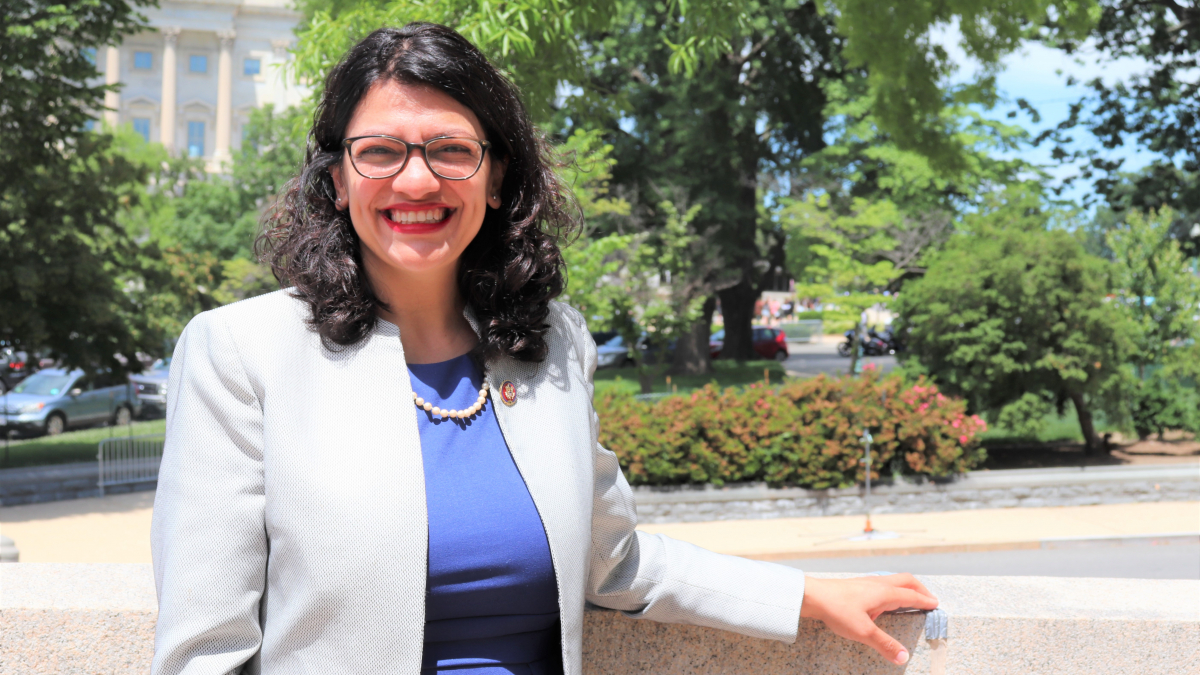
The Squad is a group of four women of color in the House of Representatives known for their efforts to push Washington Democrats towards more progressive policies. The four Congresswomen–Reps. Ilhan Omar of Minnesota, Alexandria Ocasio-Cortez of New York, Rashida Tlaib of Michigan, and Ayanna Pressley of Massachusetts–seemed to gain more popularity on social media after their comebacks to Trump’s derogatory remarks regarding their heritage. He falsely implied that they weren’t American and suggested they “go back and help fix the totally broken and crime infested places from which they came” (CNN). 

But, these women have made it clear they aren’t going anywhere. In fact, all four were recently re-elected.

Who Are They?

Alexandria Ocasio-Cortez (AOC) (Rep. of New York’s 14th Congressional District–the Bronx, Queens, and Rikers Island)

AOC became the youngest woman (and youngest Latina) ever elected to Congress after defeating ten-term incumbent Democratic Rep. Joe Crowley (CNN). 

In addition to being a member of the Democratic Socialists of America, she introduced the Green New Deal, which “outlines the framework for combating climate change by creating millions of jobs in new green industries as well as transitioning to new energy sources and building new infrastructure” (Ocasio-Cortez.House.Gov). 

She has also worked with others, such as Bernie Sanders, on more progressive ideas like Medicare for All, a $15 minimum wage, and student loan forgiveness. She has called for abolishing Immigration and Customs Enforcement (ICE) due to the harsh conditions in our southern borders’s detention centers (CNN). 

Rashida Tlaib (Rep. of Michigan’s 13th Congressional District–Detroit and its surrounding areas)

Tlaib is the first Palestinian-American woman to serve in Congress. Like AOC, Tlaib has embraced Progressive ideas like Medicare for All, a $15 minimum wage, debt-free college, and the abolishment of ICE. 

She has also gained a significant amount of social media attention after her controversial comments regarding sanctions and boycotts on Israel. 

Ilhan Omar (Rep. of Minnesota’s 5th Congressional District–Minneapolis and its surrounding areas)

Ilhan Omar is the first Somali-American ever elected to Congress. She and Tlaib are also the first two Muslim women ever elected to Congress. She came to the United States two decades ago after fleeing her homeland as a refugee. She then became a US Citizen at the age of 17 (CNN). 

Similar to AOC’s journey to politics, she ran with the support of the Justice Democrats (a Progressive political-action committee). She is also a proponent of Medicare for All, abolishing ICE, tuition-free college, and $15 minimum wage. 

Ayanna Presley (Rep. Massachusetts’s 7th Congressional District–Boston, Cambridge, and surrounding areas)

Pressley is the first black congresswoman to represent Massachusetts after defeating twenty-year incumbent Rep. Mike Capuano (CNN). 

Pressley’s passion for politics greatly stems from personal experiences. For example, she often speaks about her father being incarcerated for much of her childhood and how she is a rape survivor. 

Pressley is also known for speaking out about the poor conditions of detained migrants at the Texas border, and she has called upon Democratic lawmakers to take action. 

How Do These Women Represent the Future of Politics?

According to the New York Times, the Squad represents a more inclusive and representative future of politics. “The Squad understands that ‘diversity’ is meaningless if the measure of success is ‘sameness.’ The Congresswomen are choosing to do politics a different way because they recognize that Congress has never worked for their communities.” By bringing in voices from communities Congress has never heard from before, it is possible that the future of politics will finally serve communities of color rather than silence them; “…inclusivity means that people from different communities, backgrounds and ideological traditions will do their jobs differently and will bring new sensibilities, commitments and understanding with them when they sit at the tables of power. If they are doing their jobs, they will be accountable to people who sent them there, not maintaining the status quo” (The New York Times). 

The Squad also greatly represents the visions of the young people of our nation who tend to prioritize equality and climate change. Many say that the Squad’s ideas for Progressive policies represent the future of the Democratic party, even though the party seems to look more moderate at the moment. This is obviously frustrating for these Progressives, but according to Conor Lamb (Democrat Representative of Pennsylvania), more moderate policies are needed to unify the country in its current state (New York Times). The future could possess these ideals, especially as the younger generation starts to fill seats in Congress.

Sources:

https://www.cnn.com/2019/07/15/politics/who-are-the-squad/index.html

Image Sources: 

https://apnews.com/article/f80a96ce79934860936ebdc2127c28fc

https://i.insider.com/5fa2a2a469331a0011bc731c?width=1000&format=jpeg&auto=webp

https://tlaib.house.gov/about

https://www.theatlantic.com/ideas/archive/2019/08/where-ilhan-omar-failed/596743/

https://www.wbur.org/news/2019/03/30/ayanna-pressley-democrat-committee

Future of Politics Editor: Jake Sonderman

Filed Under: Politics Tagged With: Sara Habibipour, The Squad: Who Are They and What Future Do They Represent in American Politics?

A Review of Braiding Sweetgrass

November 17, 2020 by szachik@pvs.org 3 Comments

For this week’s theme of “Wilderness,” Sara shares a favorite read that encompasses the beauty of nature, the learning of science, and the wisdom of indigenous people.

By Sara Habibipour

Braiding Sweetgrass: Indigenous Wisdom, Scientific Knowledge, and the Teachings of Plants is one of my new favorite books. It is written by Robin Wall Kimmerer, a Native American woman and biologist. As a botanist, the author has been trained to view the world and its inhabitants through a scientific lens. But, as a member of the Potawatomi nation, she teaches her students that there’s more to plants than just bodies; they have spirits. 

Plants have been on this earth longer than we have, so we must listen to them, especially if we want to save our earth from the destruction we humans have inflicted through our selfish activities. It’s not too late yet to reverse the damage we’ve done to nature. But, if we want to make positive progress, we must learn from those who don’t take nature for granted: the Natives. 

In the book, Kimmerer draws on her experiences as an indigenous woman and scientist to show how other living creatures all share their gifts with us. In order to gain a wider scientific and ecological understanding of what must be done to save our earth, we must learn to appreciate each being’s gifts. Not only that, but we must show appreciation for these gifts by giving back and establishing a reciprocal relationship with the earth. It is only then that we can restore our lost relationship with nature. 

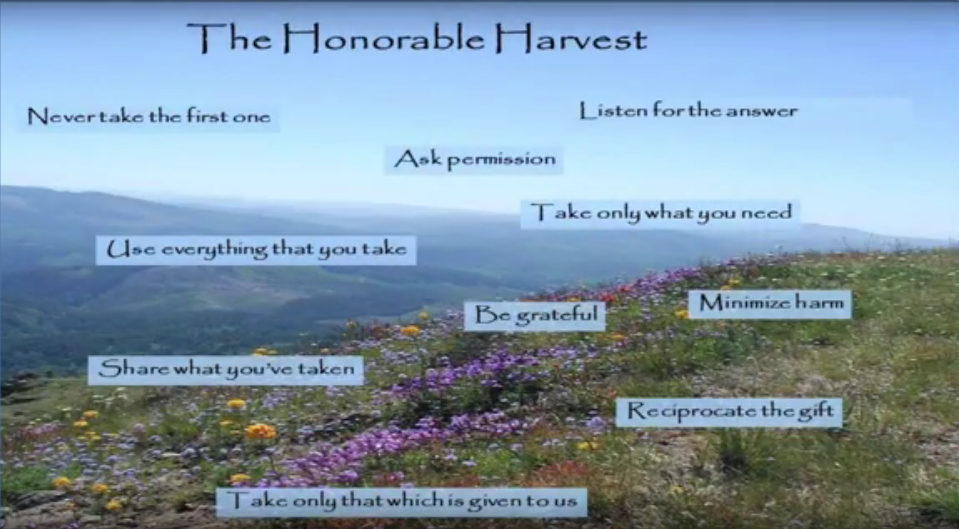
In Potawatomi culture, there is a practice called The Honorable Harvest. It is a set of unwritten rules that guide how much to take from the earth so as to not deplenish all of its resources for future generations. 

In the culture, before taking anything from nature (a plant, a deer, etc.), one must not take the first creature they see; this ensures that an endangered species is not being killed. One must also ask the being if it’s okay to take its life. If there’s no sign or gut feeling that it should not be taken, then it’s okay to use. Finally, you must use all of what you take and share it with others so as to not waste any part of it. 

In a capitalist society, we are raised to believe that taking from the earth is normal. But, this book is trying to tell us that if we can just recognize the destructiveness of our greedy nature, then we can all “become indigenous” and save our earth. We can all give back.

If you love nature, and if you appreciate science, I highly recommend that you read this book. I’d love to discuss it with you!

Wilderness Editor: Hannah Hall

Image Source: 

The Honorable Harvest: thinking more mindfully about what it means to be a consumer, forager, hunter, human

Filed Under: The Outdoors Tagged With: A Review of Braiding Sweetgrass, Sara Habibipour

Must-Eat Persian Food

October 27, 2020 by szachik@pvs.org 3 Comments

When asked to come up with a theme, Editor Elizabeth tasked the Blog Staff with writing food and drink-themed posts. She said of food, “Everybody needs it, so everybody eats it.” When pressed for her favorite food, she said, “Sushi.” Our bloggers share what brings them to the table.

By Sara Habibipour

If you’re a foodie and haven’t had a taste of Persian cuisine, you are missing out! To be fair, there aren’t really any authentic Persian restaurants here in the Coachella Valley, but if you’re ever in LA or Anaheim, be sure to “Yelp” the nearest Persian restaurant. Or, just come to my house! 

Here are my personal favorite Persian dishes: 


Salad Shirazi and Mast O Khiar: 

These two appetizers can be eaten separately or with the main meal, but I prefer to eat them together with lavash bread–a thin flat bread.

Salad Shirazi is a simple combination of chopped tomatoes, cucumbers, and onions–seasoned with dry mint and lemon juice. 

The Mast o Khiar is plain yogurt, chopped cucumbers, and dry mint mixed together. I suppose you could say it’s similar to Greek Tzatziki, but it’s also very distinct in consistency and flavor.

These dishes are extremely refreshing!

Tahdig: 

Tahdig is one of the most popular Persian foods. 

Persian rice is cooked with a lot of butter and oil so it isn’t sticky as other rices may be. This allows for the rice at the bottom of the pan to become golden and crunchy, as seen in the picture above. It’s the best. 

Ghormeh Sabzi: 

Aside from kabobs, stews are a staple of Persian cuisine. 

This stew in particular consists of various greens, kidney beans, and lamb (although, if you’re vegetarian, the meat is optional). The unique flavor of this stew comes from the limoo amani, or dried limes. You don’t eat them; you just put them in the pot with the stew while it cooks. It gives the stew a bit of a tang and a spike of flavor. 

Fesenjan: 

Fesenjan is a stew made of pomegranate paste and walnuts, seasoned with turmeric and cinnamon. This may not sound like the best-tasting dish, but it’s the perfect combination!

At a restaurant, one time, I tried the fesenjoon on top of tahdig, and it was glorious. 

Fesenjan is a very rich-tasting dish. So, if you aren’t afraid of flavor, I highly recommend that you try this. 

***

You can see, Persian cuisine is very colorful, fresh, and flavorful. There are, of course, many other dishes, but these are a few of my favorites! If you ever feel like trying to make these dishes for yourself, there’s several Youtube videos that can help you out!

Image Sources:

Mast-o Khiar – Persian Cucumber Yogurt Dip

https://www.thedeliciouscrescent.com/tomato-cucumber-salad-with-fresh-herbs/

Persian food: A foodie’s experience in Iran

https://www.foodnetwork.com/recipes/food-network-kitchen/saffron-rice-with-tahdig-5609026

https://www.thedeliciouscrescent.com/persian-fresh-herb-stew-with-meat-and-kidney-beans/

KHORESH FESENJAN خورش فسنجون|FESENJOON

Food & Drink Editor: Elizabeth Shay

Filed Under: Food Tagged With: Must-Eat Persian Food, Sara Habibipour

Chief Issues in America’s High Schools

October 23, 2020 by szachik@pvs.org 1 Comment

Academic Spotlight

As teachers, very often student essays, projects, creative pieces cross our desks and we think, “This should be shared with the masses.” Sara wrote a synthesis essay for AP English Language & Composition on educational issues facing high schools today. It felt relevant and certainly worth sharing.

By Sara Habibipour

With evolving standards of economic, cultural, and societal situations, it is no surprise that some aspects of the American high school system are problematic and outdated. However, they often go unaddressed among the adult administrators who continue to implement the norms of the traditional system. In order to address these issues, we must first recognize what they are. Chief issues in the American high school system include the lack of proper education due to socioeconomic disadvantages, the mandatory community service requirements, and the culture of high school that does not prepare students for the real world. 

Firstly, the current high school education system does not favor students of lower socioeconomic status. According to Horace Man, education is “the great equalizer of the conditions of men”; however, there is a “distance between the two extremes of society” due to the lack of equal and proper educational opportunities for students. He explains, “With every generation, fortunes increase on the one hand, and some new privation is added to poverty on the other.” Although there have been improvements since Mann’s time, such as the implementation of mandatory universal education, there are still major disparities among low-income schools. But, as seen in a school in Union City, New Jersey, these problems can be addressed. Union City’s students are mostly immigrants, undocumented, bilingual, and of low socioeconomic status, yet “they boast a graduation rate of 89.5 percent–roughly 10 percentage points higher than the national average” (Kirp). What differentiates Union City schools from others in America? School officials explain that they “[enroll] almost every 3- and 4-year-old. There’s abundant research showing the lifetime benefits of early education” (Kirp). These schools also exhibit what Harvard professors call the “institutional core” which teaches students to “become thinkers, not just test-takers” (Kirp). Teachers “raise their expectations” and prepare students from low socioeconomic communities for college by not “simply [giving them] more work, but higher-quality work” (Kirp). The chief issue among the majority of America’s high schools is that even though these issues can be addressed with a rearranged set of ideals and practices as seen in Union City, they are not being implemented. Instead of implementing “old-school” strategies such as giving excessive amounts of work and strictly teaching content, we should follow the paths of these few successful schools so that “education can be a ticket out of poverty” (Kirp). If American high schools in low-income neighborhoods can address this, we would be one step closer to improving America’s high schools. 

Secondly, although the community-service requirements may seem beneficial to the students’ morals and their communities on the surface, it can ultimately have negative effects on their willingness to continue these deeds into their futures. The Dalton School, a small private school in Manhattan, claims that they enforce mandatory community service because it heightens the student’s “moral center,” gives them “a sense of accomplishment,” and “[makes] the world a better place.” However, the negative effects seem to outweigh the benefits. According to Psychological Science, “[C]ommunity service requirements can have negative effects on students’ intentions to volunteer in their future.” This statement particularly applies to students who do not feel “ready” to volunteer. However, research shows that when these students were given free choice, they were more likely to want to volunteer than if they were forced to do so.  In order to address this flaw in the American high school system, “institutions should design these programs to contain an element of free choice and to offer programs that allow students to choose the type of volunteer activity they engage in or allow them to combine personal interests and skills with their service requirements” (Psychological Science). We should not get rid of community-service requirements completely; the Dalton School is correct that community service can have several benefits for students. But, making community service mandatory discourages students from participating in community service in the first place, leading them not to experience the benefits that it can have. If schools could make opportunities more accessible and interesting for students, then that would be one of America’s educational issues solved.

Lastly, high school culture doesn’t prepare students for the real world, and administrators don’t put enough effort into changing that. Leon Botstein, President of Bard College, proposed that high school as we know it should be abolished, particularly because of the toxic culture of high school that doesn’t work to prepare students for their adulthood. This culture can be defined as “…the artificial intensity of a world defined by insiders and outsiders, in which the insiders hold sway because of superficial definitions of good looks and attractiveness, popularity and sports prowess” (Botstein). Although high school may have certain norms and “rules,” those rules do not translate to those of life. Students spend their energy trying to fit into an “age-segregated environment, much like a gang…” rather than spending time pursuing their interests (Botstein). In Botstein’s words, “By the time those who graduate from high school go on to college and realize what really is at stake in becoming an adult, too many opportunities have been lost and too much time has been wasted.” Why is this a chief problem of the American high school system? Botstein would say it’s because “…the culture of the inside elite is not contested by the adults in the school.” Although this is a curable problem, it is too often ignored by adult administrators stuck in traditional ways, leading to the decline of generations of American high school students. According to Botstein, to fix this, “Young people should graduate at age 16 rather than 18. They could then enter the real world…in which they could take a place of responsibility alongside other adults mixed in the company.” From a young age, students would be prepared to pursue their interests and serve their communities rather than dwelling in petty high school culture. 

In conclusion, the chief issues in the American high school system include the lack of proper education due to socioeconomic disadvantages, the mandatory community service requirements, and the culture of high school that does not prepare students for the real world. In a rapidly evolving society culturally, economically, and even biologically, we need to recognize the flaws in our high schools. Rather than abiding by tradition, we should frequently address what needs to be changed, starting with easier tasks such as changing community-service requirements than graduate to addressing education inequalities rooted in systemic disadvantages in our country. 

Sources:

Botstein, Leon. “Let Teenagers Try Adulthood.” The New York Times, 1999. Reprinted in The Language of Composition.

“Community Service Mission Statement.” The Dalton School. Reprinted in The Language of Composition.

Kirp, David. “The Secret to Fixing Bad Schools.” Strategy for America’s Schools. The New York Times, February 2013. Reprinted in The Language of Composition.

Mann, Horace. “Report of the Massachusetts Board of Education.” (1796-1859). Reprinted in The Language of Composition.

Stukas, Arthur, Mark Snyder, and C. Gil Clary. “The Effects of ‘Mandatory Volunteerism’ on Intentions to Volunteer.” Psychology Science. 1999. Reprinted in The Language of Composition.

Filed Under: Academic Spotlight Tagged With: Sara Habibipour

There Were Three Popes…And They All Excommunicated Each Other

October 20, 2020 by szachik@pvs.org 1 Comment

In looking for Funny Stories in History, as directed by Editor Evan, Sara looked to the Catholic Church and its intriguing papal history.

By Sara Habibipour

The history of the Catholic Church is a lengthy one (said every history student ever). But, hidden in this history is a pretty ironic story that’s worth sharing. It all takes place during the Western Schism.

After the death of Pope Gregory XI in 1378, the open position in the papacy led to the Western Schism. Urban VI was elected as pope but soon became very unpopular among the Roman people because he was known for being “temperamental, suspicious, and reformist” (History 101).

Where did the second pope come from? “Many of the cardinals under Urban VI left Rome and appointed Robert of Geneva (who took the name Clement VII) as a rival pope in Avignon” (History 101).

The council of Pisa was held in 1409 to resolve the question of the true heir. But, wait! There’s more! Alexander V established a third papacy in Northern Italy, leading to more drastic tensions within the Catholic Church; the followers of the three popes were greatly divided along national lines and “political antagonisms arose” (Medium). All three popes claimed legitimacy to the throne of St. Peter. In an attempt to resolve this issue and claim power, they all excommunicated each other! In other words, they exiled each other from the Church; this is the worst punishment a member could possibly receive because it dooms a follower to Hell! Rather than leading to resolved conflict, this event only led to an ironic and funny story. Never before in history had three popes deemed each other as disgraces to the Church! 

After three excommunications and eight years of the Council of Constance to elect a recognized pope by all, Pope Martin was elected to the papacy, effectively ending the Western Schism; there were no more arguments over who the true pope was. 

Sources:

https://www.britannica.com/event/Western-Schism

View at Medium.com

https://www.history101.com/one-time-there-were-three-popes-and-they-all-excommunicated-each-other/

Image Source: 

https://alchetron.com/Western-Schism

Funny Stories in History Editor: Evan Spry

Filed Under: Historical Figures, History, Humor Tagged With: Sara Habibipour

  • « Previous Page
  • 1
  • 2
  • 3
  • Next Page »

About

We are the Palm Valley Firebirds of Rancho Mirage, California. Join us in our endeavors. Venture through the school year with us, perusing the artwork of our students, community, and staff. Our goal is to share the poems, stories, drawings and photographs, essays and parodies that come out of our school. Welcome aboard!