the bird on fire

The Palm Valley School Student Blog

Subscribe to Blog via Email

Enter your email address to subscribe to this blog and receive notifications of new posts by email.

Powered by Genesis

EV vs Combustion Power

September 6, 2022 by szachik@pvs.org 1 Comment

When I asked our bloggers to illuminate a cause, I didn’t really expect muscle cars to be of focus. But, I was forgetting Mustang fanatic Luke Sonderman was in the house.

Blog Advisor Zachik

By Luke Sonderman

Electric cars are taking the world by storm with some of the highest performing vehicles on the market for extremely low prices. Are these cars worth getting, or should you ride in style in a classic combustion?

Tesla Model S Plaid

The Tesla Model S Plaid is a piece of straight-up raw performance. With a 0-60 (mph) of just under 2 seconds, a top speed of 200mph, and over 1000 horsepower, the Model S Plaid is the definition of speed (tesla.com). Starting at only $140,000, you will not find a car with these specs in this price range or even at all! Yes, I know $140,000 is a lot of dough, but hear me out. The 2023 Ferrari 296 is one of the highest performing super cars on the market. With a 0-60 (mph) in 2.9 seconds and a top speed of 205mph, this thing is a monster (motortrend.com). With similar specs to the Model S, the 2023 Ferrari 296 starting price is $317,000. I think that anyone could agree that the Tesla Model S Plaid is without a doubt the highest performing car of 2022 and is also the best deal. 

Now let’s get into why the Tesla Model S Plaid is not worth your 140 grand. First of all, it is absolutely no fun. The most thrilling parts of owning a high performance sports car is the sound, the look, the interior, and then of course the actual performance. Yes, the Model S passes the performance test, but it’s like driving a really fast golf cart. The interior looks like an Ikea design, and the exterior looks like an Apple Magic Mouse. When it comes to sound, well, there really isn’t any. 

Ford Mustang Mach-E GT

One of my least favorite electric vehicles that is rising on the charts is the 2022 Mustang Mach-E GT. This hunk of junk has 480 horsepower, a 0-60 (mph) of 3.5 seconds, and a top speed of 124mph. The specs aren’t nearly what the Model S Plaid’s are, but this car starts at $65,000 so don’t expect a supercar. Still, a 3.5 0-60 is very quick, and it is still a high performance vehicle.

caranddriver.com

The real reason I hate this car so much is because they named it a Mustang. The name Mustang has been reserved for Ford’s muscle cars since the 60s. Mustangs are my favorite cars, and I was so disappointed when they made this ugly EV SUV a Mustang when it is not. It looks very, very weird on the exterior, but the interior is alright. Is it worth $65,000? Absolutely not! Get a REAL Mustang GT. A loud piece of muscle. 

Chevrolet Corvette C8

As a Ford fanatic, I hate to give Chevy any credit for anything… but the 2022 C8 Corvette is a pretty sick car. This 8-cylinder monster comes equipped with 490 horsepower, a 0-60 (mph) of 2.9 seconds, and a top speed of 194mph (stingraychevrolet.com). Corvettes are known for their lightweight body and power-packed engines that make them so fast. Starting at only $61,000, this car is definitely the best bang for your buck when it comes to sports cars (roadandtrack.com).

Now, this car not only has the performance of a supercar, but it has a fighter jet style interior. If I bought a sports car, I would want it to look like a fighter jet. Now the exterior is cool, don’t get me wrong, but I favor the older model exteriors such as the 2017. When it comes to what I’m looking for in a sports car, it has the noise, it has the performance, it has the interior, and it has the coolness factor. When it really comes down to it, I would probably spend my 60g’s on a Mustang, but if you are looking for a speedy, quick car, then I would totally go with the 2022 Corvette C8. 

(thecarconnection.com)

(thecarconnection.com)

Mustang Shelby GT-500

Now the car I have been waiting for… the Mustang Shelby GT-500. This is definitely my favorite car, and I believe it is the coolest car on the market. This supercharged 5.2 liter 8-cylinder muscle car comes packed with 760 horsepower, 180mph top speed, and a 0-60 (mph) of 3.5 seconds (guideautoweb.com). I know what you’re going to say…. I know it has way more horsepower than the Corvette, and it is still a bit slower. But, this car is a powerhouse. The wow factor of this engine will blow your mind. It is loud, powerful, and very pretty. As a muscle car, Mustangs have a generally heavier body than most every sports car, which is why they tend to be slower than cars like Corvettes and Teslas. But the power you feel under the hood of a 2022 Mustang Shelby GT-500 is nothing like a little Tesla or 400-horsepower Corvette. 

Of any of the cars on this list, this one would be the one I would get. The GT-500 has everything I look for in a sports car. It has impeccable performance, a crazy engine, a very loud exhaust, and it has a beautiful interior and exterior. Although I may be biased as a Mustang owner, I believe that this is the best car money can buy. Starting at $70,000, the GT-500 is the epitome of style, power, and fun. 

(motortrend.com)

In the end when it comes to gas vs. electric, I would go with gas. I’m a junkie for speed, noise, style, and power, and electric vehicles do not have all of those characteristics. If all you care about is a minimalistic aesthetic and a quick little golf cart, then I would get a Tesla.  But if you want some real power and muscle, go with a Mustang. 

Filed Under: Advice, Aesthetic, Technology Tagged With: EV vs Combustion Power, Luke Sonderman

Удалять*

September 1, 2022 by szachik@pvs.org Leave a Comment

Junior Remy Haring continues with his second installment of his serial fiction inspired by The New Order–a mod for Hearts of Iron IV. If you recall, Remy visits an alternate dark history here, where, in WWII,  the Axis powers have won.

Zeya, Amur, the Russian Far East, January 23, 1962

Rodzaevsky was sitting at his mahogany desk in his office. Behind him two flags flanked him — horizontal, yellow, black and white tricolor with a double-eagle grasping a bundle of sticks on each. To his left was an ashtray; to his right was a pile of photos of dissidents. Some had a red X drawn over their faces; others didn’t. Their occupations ranged drastically from those of lowly citizens to bureaucrats to the most trusted officials of his own cabinet. One photo in particular stood out to him.

It was an old black and white group photo from the beginning days of the Russian Fascist Party (RFP). Rodzaevsky was in the center with Grigory Semyonov on his left and Mikhail Matkovsky on his right. In each of their hands was a raised shot glass of vodka. None of them had a red cross marked over their faces. The photo was marked, “Harbin, Manchuria, September 13, 1932.” As Rodzaevsky was looking down at this photo, he heard a knock at his door.

“Enter,” Rodzaevsky ordered.

A Blackshirt entered the room. His uniform was pristine, all black snow gear with the only splash of color being his medal of the double-eagle grasping a bundle of sticks.

“The dissident Vlodimir Kozlov has been eliminated,” reported the Blackshirt. “He was hiding out in a forested neighborhood a few kilometers away from Zeya. He was… difficult but has been pacified. Given the remote area and that I was under the cover of night, I doubt anyone saw.”

Without another word, Rodzaevsky dismissed him with a wave of his hand. After the door shut, Rodzaevsky took a red marker from his drawer and crossed out the face of the most recent victim. Kozlov had been a middle–aged woodsman and a father of two. It was his youngest child who had reported him for the crime of freemasonry.

Rodzaevsky leaned back into his chair and turned on the radio:

“This morning, at 4:00 a.m. CET, the Swiss Seismological Service detected a seismic event from southern Burgundy that reached a 4.6 on the Richter scale before suddenly ending with no aftershock. The Swiss government has come to one terrifying conclusion: the SS State of Burgundy has successfully tested its first nuclear device.”

Radio Free Alps

*Purge

Filed Under: 1960s, Alternate Realities, Apocalypse, Fiction, Politics, The World, Video Games Tagged With: Remy Haring

That Feeling

September 1, 2022 by szachik@pvs.org Leave a Comment

The Blog staff’s second assignment was to “Find a cause” and share it with us, The Bird on Fire readers. Some student bloggers chose to champion their own causes, explain causes going viral, or causes brought about through environmental, political, or social change. Penny, in verse form, chose to illuminate the importance of reaching out to another.

Blog Advisor Zachik

By 7th-Grader Penny Andreas 

The school bell rings

Kids come out of the doors

I sit there waiting

Thinking had anybody come

I come back to my house

Nobody wondering if I am okay

Nobody even noticing

I sit alone with my doubts

I take a walk

By myself

Thinking would anybody notice

If I was gone

Next day I consider not waking up

Still I come to school

Then she walked up to me 

And said she wanted to talk

My classmate guided me out to the hall

She asked if I was okay

I started to cry

I started to bawl 

I told her everything

My struggles at home

I told her the feeling

Of being alone

At first she just looked at me

Then took my hand

She said it would be okay

And she understands

She helped me to my feet

And said she was sorry

She said I have felt that feeling

Of feeling solitary

I will forever thank her

For getting me to my feet

For listening to what I said

For accepting me

For somehow seeing

That feeling

Filed Under: Gratitude, Health and Disease, Humanity, Introspection, Poetry Tagged With: Penny Andreas, That Feeling

Succ it up 

August 31, 2022 by szachik@pvs.org Leave a Comment

In our last post on hobbies to consider, we look at Penny’s newly adopted hobby of growing succulents. This is a perfect activity for our desert landscape. 

–Blog Advisor Zachik

By Penny Andreas, Middle-School Blog Correspondent

Apus echeveria

Through these months of a very hot summer, I’ve done pretty much nothing but stay inside all day. I eventually (it took me three hours of sitting on the couch on a long summer day) came up with an idea of a hobby to keep me busy. I did a little research, and I found an interesting little plant called a succulent. There are over 60 species of succulents and about 1,000 different colors, textures, and sizes (ftd.com). Many succulents grow happily in the desert such as Graptopetalum paraguayense, or the ghost plant, and the pencil plant, which mainly grows in high drought landscapes. One of my favorite succulents is the Apus echeveria. which is pictured here.  

Apus echeveria rely on a lot of sunshine, so they like to live near a window. If they are not getting sun, they will grow towards any light they see, and that will lead to a weak stem and poor growth. Make sure to give a succulent the right amount of water; if they are overwatered, their leaves will start to look like shriveled fingers that have been in a hot tub for too long. If they don’t get enough water, their bottom leaves will start to shrivel, so pay attention just in case your succulent starts to die. Apus echeveria can live anywhere as long as three years up to a couple decades! Hobbies are very important, so go find one yourself! 

Filed Under: Green, Plants & Opinions Tagged With: Penny Andreas, Succ it up

Why Making Coffee is My Favorite Part of the Day

August 30, 2022 by szachik@pvs.org 4 Comments

By Junior Indy Behr

The top shelf has my kettle, grinder, Chemex brewer, scale, and filters. On the bottom is my V60, moka pot, and a collection of single-origin coffee beans.

Indy Behr

I am a coffee fanatic. I believe making coffee is a form of art, and I think you might feel the same way by the end of this. The brewing of coffee is a blank canvas for creativity. There are so many variables that change the outcome of what ends up in your mug, including grind, roast level, and temperature. I think that when you get your coffee just right, there is no longer a need for additions like sugar, cream, or pumpkin-spice syrup.

There is a whole world to explore in the brewing of espresso–which is the base for things like lattes, cappuccinos, and flat whites,–but that is an incredibly expensive hobby for true purists. Classic drip coffee is a great starting point that requires a much smaller investment. Though some may prefer to stick with their electric brewers, I enjoy brewing by hand. There are many methods that I enjoy, but I have narrowed it down to two.

Why I Love Making Coffee

I first began enjoying coffee several years ago, and it has been one of my favorite hobbies since then. A lot of my motivation for making coffee at home was my observation that there were not any great coffee shops near my house, and making coffee at home was cheaper anyway. Over time, it has almost become a mindfulness technique for me. It is a time where I can focus simply on pouring technique or grind level, with no distractions from the outside world being present. It is undoubtedly one of the most peaceful parts of my day. It takes a little trial and error sometimes. Some days my grind is a little too fine and my coffee is a little bitter; or sometimes my water is too hot. However, once I mess with the variables a few times, I consistently end up with delicious coffee. 

Bean Purchasing and Storage

When it comes to coffee beans, some good sources are Verve Coffee, Square Mile Coffee, Blue Bottle Coffee, or just visit your local coffee shops, almost all of them will sell you whole beans. I really enjoy single origins, meaning it is one type of bean from one region rather than a blend of multiple beans, and my preference tends to be lighter roasts so unique flavors won’t be masked by an ashy flavor. Personally, my favorite coffees are Ethiopian-grown coffees as they often have a very strong scent and flavor that resemble several types of berries. I always make sure to put my beans in an airtight container to maintain freshness. Roasted coffee can get very stale very quickly when exposed to air for long periods of time. 

AeroPress

When it comes to brewing, one of my favorite brewers is the AeroPress. This device is incredibly fun to use. It is also very popular among people who camp regularly due to its portability and light weight; however, coffee enthusiasts who have dedicated their lives to this craft appreciate it as well, and in fact there is now a World AeroPress Championship that occurs annually, and all winning recipes are viewable online. There is also a whole world of third-party modifications that people use to make their AeroPress better for their needs, such as metal filters and devices that increase the brewing pressure. The only change I make is one that I found from several AeroPress Championship winning recipes, and that is using an Aesir brand paper filter, which is thicker and does a better job of catching fine grinds compared to the filters made by the manufacturer. 

The recipe I often use is the AeroPress recipe by Square Mile Coffee owner James Hoffman, which I like because it does not use very much coffee. This was a major issue for those who wanted to deviate from the very basic recipe included in the user manual, as most specialty recipes used an obscene amount of grounds to increase the amount of coffee extracted from the water. This was so criticized in the coffee community that the AeroPress Championship recently capped the amount of coffee a recipe can use. For example, the 2019 winner used 35 grams of coffee, when most other methods use around 10g for a cup. This got very expensive for AeroPress fans as specialty coffee beans are not cheap. Hoffman uses 11g and 200 milliliters of water, almost a cup. A very simple recipe, all I have to do is add the water, add the plunger to create a seal, wait two minutes, stir the liquid, and then you press the plunger pushing the coffee through the filter directly into your cup. You get a delicious, smooth cup thanks to the Aesir filter, and it took almost no effort.

Hario V60

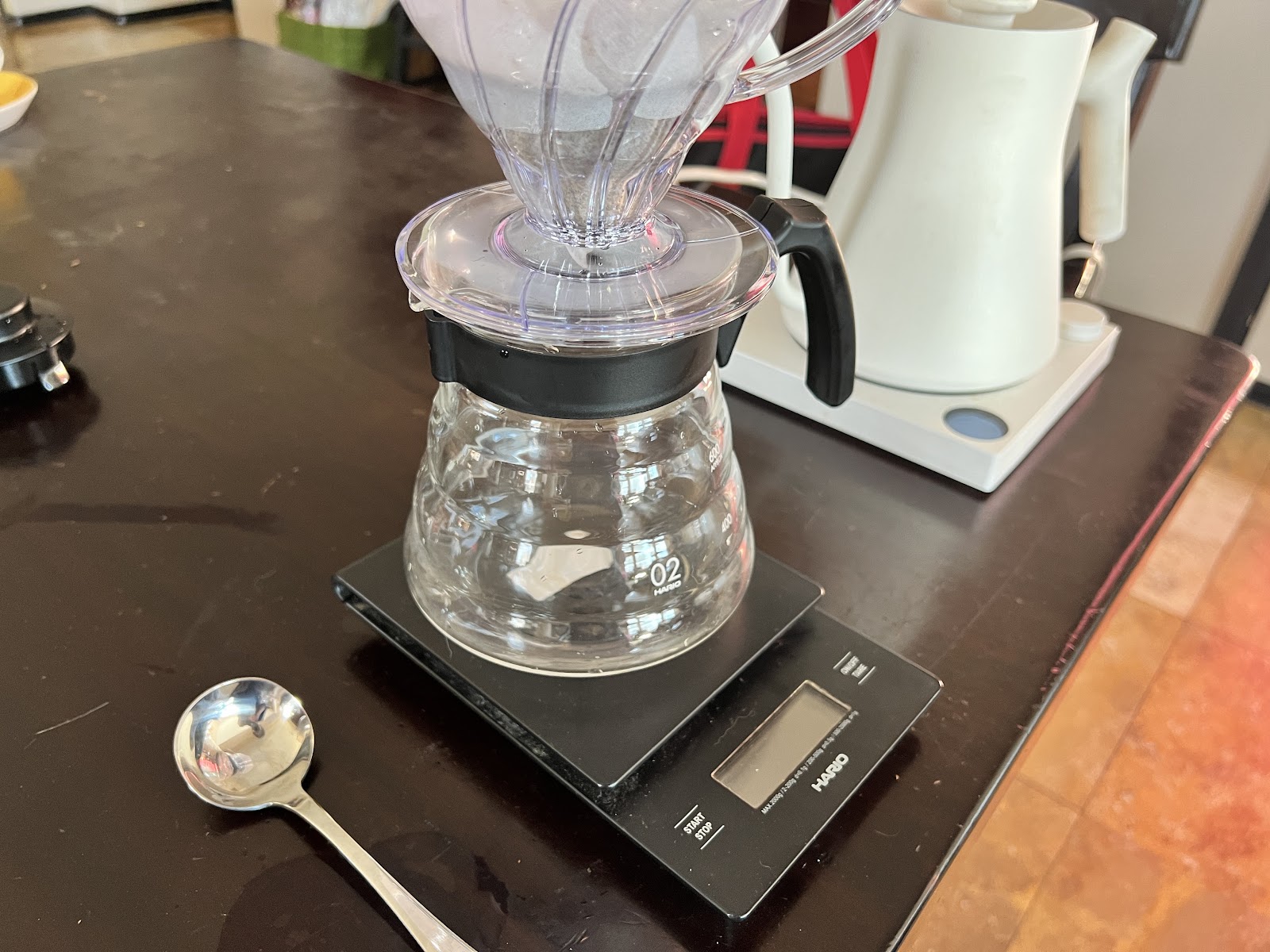
A Hario V60 in clear plastic is one of my favorite gadgets, and it costs only $9. This device is so simple yet so functional. It is my most commonly used brewer, and it has made some of my favorite coffee. It is one of the most iconic of what are known as pour-over brewers, likely because of its low price and simple cone shape. In short, this method involves the user manually pouring hot water on coffee grounds with a special type of kettle which then filters into a cup below. 

I have tried many recipes for this method which can be found online. I have tried barista trainer Scott Rao’s method, James Hoffman’s method, and several others, yet my favorite remains YouTuber Sprometheus’s V60 recipe. Coffee brewing is often done in ratios, generally grams of coffee per liter of water. For ideal pour over brewing, a scale is needed, but these can be purchased for very little on Amazon or even at Target. Filters designed for this brewer are available on Amazon, and I have found that many small coffee filters in stores work almost as well. Sprometheus uses 18g of grounds and 288ml of water. When he puts the grounds in the filter he makes a spiral, a Japanese coffee method called kubomi, or depression/hole. This results in a more even extraction. First he adds 50ml of water for 30 seconds, to bloom the coffee, which releases any excess carbon dioxide from the beans. You will see the coffee bubble as you do this. Then, you pour 123ml of water over the next 45 seconds in a circular motion, and then pour 115ml of water directly into the center for just over a minute longer.

There you go, a perfect cup of coffee.

Filed Under: Food Tagged With: Indy Behr, Why Making Coffee is My Favorite Part of the Day

How to Grow Culinary Mushrooms

August 25, 2022 by szachik@pvs.org 1 Comment

I tasked The Bird on Fire staff with describing, discovering, and detailing PVS hobbies. Alyna reminded us we fell into some “interesting” hobbies during quarantine. Luke gave us sage advice on collecting vinyl (Avoid scratches). This summer, Levi took up growing mushrooms . . . in his grandparents’ bathroom. Here is his tale.

Ms. Zachik, Blog Advisor

By Junior Levi Kassinove

I realize that, in writing this, few people will have the time and energy to grow mushrooms. If you do, however, choose to grow culinary mushrooms, know that you will end up growing many more than you know what to do with. It’s a rewarding yet comprehensive process. And, obviously, if you ask me, I’d tell you that it is totally worth it. All the information in this guide comes from my own experience growing pink oyster and lion’s mane mushrooms. 

Part 1: Life Cycle of a Fungus

Before learning how to grow mushrooms, it is necessary to understand the life cycle of the fungus itself due to its drastic differences from the life cycle of a plant. Additionally, note that fungi are neither plants nor animals, but rather their own kingdom. 

The life cycle starts with spores, which are microscopic balls of DNA that are released by the billion from the mushroom’s gills. The spores travel the universe by wind and sometimes an animal’s foot if it had stepped on a mushroom. Eventually, some spores settle on dirt, corpses, feces, basically anything with nutritional value. I’ve seen people grow mushrooms on cardboard. When two spores meet, they form a microscopic white strand between them called a hypha. Over time, the hyphae will branch out and grow in new directions, making connections between new strands. Collectively, these hyphae are called the mycelium. The mycelium is basically the entirety of the fungus. Its most basic functions are to absorb and send nutrients throughout the mycelial network. A good way to think of a fungus is to compare it to an apple tree, where the tree is the mycelium, and the mushrooms are the apples. But some more interesting functions of the mycelium include deciding when it’s time to produce mushrooms, and even communicating (to a degree) with surrounding trees (Science Direct-Fungal Consciousness). According to the University of Illinois, the mycelium’s “network-like design mirrors that of dark matter, neural connections in the brain, and even the human-created Internet.” But this is not a discussion about philosophical questions; this is about growing mushrooms. So, when the conditions are right, the mycelium will produce the fruiting bodies known colloquially as mushrooms. As the mushrooms mature, their caps will open up and release spores. The cycle starts once again. The whole process takes a few months. 

Part 2: Growing at Home

As I said earlier, mushrooms can pretty much grow on anything with nutrients. They don’t need sunlight (although its benefits are debated by the mushroom growing community, more on why later), and they don’t need much water. What they do absolutely need is a sterile environment (nothing will ever be truly sterile, but I will use the word to describe sterility to the degree that matters to us), which is the main difficulty in mushroom cultivation. You might be wondering why that matters if mushrooms can grow just fine in the wild. Well, the mushrooms we see in the wild have stood the test of time and beaten out all other microscopic competition (mold, bacteria, and other mushrooms). There’s a reason why mushrooms produce billions of spores; it’s incredibly rare that a given set of spores survive in the wild. If you attempted to grow mushrooms without using a sterile technique, the mycelium would quickly become overtaken by mold or bacteria. It is by luck that a given set of spores end up beating competition and creating mushrooms in the wild. This means that, in your own home, you have to kill all other competition. So how is that accomplished? 

Mushrooms require a sterile medium to grow in. The easiest option for us homegrowers is precooked, microwavable-ready rice. The exact kind you can buy at any supermarket. Be careful, however, to not buy any rice with a high sodium content (>500mg) or any flavorings. Plain old brown rice is the best way to go. Now, since the area within the ready-rice bag is sterile, you need to somehow transfer the spores into the rice without introducing contaminants. This process is called inoculation. There are multiple ways to accomplish this, but the easiest way is to use an MSS (multi-spore syringe) to pierce the unopened bag and inject the spores. It is a syringe with a solution consisting of water and spores, which can be bought online. The idea is to inject the spores into the bag of rice and squirt the solution, then quickly cover the hole. The needle will come sterilized, but you still need to sterilize the environment surrounding the bag just before you inoculate. It is not overkill to spray the entire room with Lysol spray. You need to be absolutely sure that nothing gets in the bag but spores. If contaminants get in, there is no chance your young and ungerminated spores will be able to fight them off. So spray the room with Lysol; get gloves on; mask up (so you don’t breathe on the bag); and wipe the bag down with alcohol wipes. One of the required materials I did not mention before was medical grade paper tape (name brand is Micropore, found at CVS), which is needed as a means to get oxygen into the bag while simultaneously filtering out contaminants. So once the spores are injected (injecting any more than 1cc of solution will induce bacterial wet rot), quickly cover the hole with the paper tape. This tiny hole, of course, will not provide sufficient oxygen. To provide sufficient oxygen, cut the corner of the bag (1 in. wide, with scissors wiped with alcohol) and cover it completely with paper tape. All of this should be completed within a minute or so, starting from once everything is sterilized. Now, you can leave it alone for a few weeks without touching the bag. The bag needs to stay sealed. The hardest part is truly over now, although this was not my main challenge when growing. I also should stress that you are only minimizing the chances of contamination, and not completely eliminating it. Doing all these steps in a relatively dirty house with pets would likely get you a bag full of mold. 

Part 3: The Waiting Game 

The amount of time it takes for the mycelium to fully colonize the bag is dependent on temperature, genetics (luck if you’re using a Multi-Spore Syringe), and the method of inoculation. The ideal temperature for mycelial growth is 75-77 degrees Fahrenheit. So room temperature will work for most people. Anything colder will slow down the growth, anything higher will increase the probability of contamination and start to cook the mycelium. The colonization process will take about a month. You can tell when it’s 100% colonized when the bag is hard all the way through. Not rock solid, but it should be quite firm. If it is firm in some areas but mushy in others, it still has a ways to go. The genetics are completely random and vary from spore to spore in an MSS (the species is guaranteed of course), but you can also inoculate the rice with a liquid culture syringe or a colonized agar wedge for faster colonization. A liquid culture syringe is a syringe with a solution of already established mycelium as opposed to spores, which saves about a week of waiting. An agar wedge is a wedge cut from an agar plate, which is basically a petri dish filled with nutrients (with mycelium growing in this case). The advantage of an agar wedge over a liquid culture syringe is that it is possible to genetically isolate the fastest and strongest mycelium in an agar plate. Unfortunately that is too advanced for this post; after all, I did recommend growing these things in a bag of ready-rice. 

At one point I grew pink oyster mushrooms in fancy mason jars I bought online specifically designed for growing mushrooms. They contain sterilized rye berries, a self-healing injection port, and a filter. I know I could have gone with the ready-rice method, but this method further reduces the chance of contamination since you don’t need to make your own filter. Anyway, the white stuff you see in the picture to the right is mycelium, and when the jars are fully white, they are ready for the next phase. 

Part 4: Spawning to Bulk

A mere bag of rice will only yield about five mushrooms, so the next step is to expand the mycelium further. Though if you want, the process could end with the rice. Given enough time, the mycelium will just start pumping mushrooms like no tomorrow, and you’ll end up with a bag of deformed little mushroom children. I don’t think they’ll taste good. Moving on, the idea of spawning to bulk is that you can dump the colonized rice in some actual soil to grow out the mycelium in a shoebox. Sterility is not as important now because at this point the mycelium is big enough to deal with its own problems (antibiotic properties). The real issue now is what soil to use. You can either choose to make your own substrate (a real pain), or buy it online. For mushrooms that grow on the ground, your best bet is to go with a coco coir-based substrate. Coco coir is the fibrous husk of the coconut. A condensed brick of coco coir could be found at PetSmart, which is actually ideal for this process because of a reason I’ll explain later. Grounded mushrooms can grow on just coco coir, but a blend of coco coir, vermiculite, gypsum powder, and coffee grounds is optimal. Mushrooms that grow on trees prefer either a sawdust or straw-based blend with the optional addition of the other ingredients from the grounded blend. As long as its base is correct, you can use any combination of the other ingredients. For example, sawdust and coffee grounds work fine. You can either buy all of these ingredients separately at PetSmart and Home Depot, or buy a pre-made substrate online like I did somewhat idiotically (I bought a coir-based substrate even though pink oysters grow on trees, but it ended up working). It’s cheaper, as you can imagine, to just buy the raw ingredients. But there’s a caveat: you need to pasteurize and hydrate the substrate.

 Pasteurizing is basically partially sterilizing something. You pasteurize the substrate because although the mycelium is big and strong, you still don’t want contaminants lurking in that coco coir. Normally it takes two months for the mushroom mycelium to end up producing spores, but mold can start blasting spores within days of its existence. Within the week you will be growing a green box of death instead of delicious mushrooms. But, you don’t want to kill all the microorganisms, as some are beneficial to the process (Science Direct). Hydration on the other hand is a whole different ball game. You need to hydrate the substrate so that it’s not too dry and not too wet. It’s called field-capacity, which in dummy terms means the maximum amount of water that soil can contain without dripping if you hold it up. There is a proper way to calculate field capacity, but I think saturating the substrate and then squeezing the water out is pretty surefire. You can pasteurize and hydrate the substrate in one go if you use boiling water and a bucket, which also expands the brick of coco coir. You can also pasteurize substrate with an oven, but I don’t know why you would do that. Once you have your pasteurized substrate, you can open the bag of rice and dump everything in a shoebox, mixing well. Close the lid on the shoebox and wait for the mycelium to fully colonize the substrate. After it’s fully colonized, it’s mushroom time, baby. Now, herein lies the final challenge. 

Part 5: Fruiting 

The most difficult part of this process for me was the fruiting conditions. I’ll explain why soon, but first it is critical to understand what fruiting conditions are in order to understand how I messed up. Also, at this point the colonized substrate-grain mix is called a cake. Fruiting conditions are the conditions necessary for the mycelium to produce mushrooms. The factors here include temperature, sunlight (you thought I forgot about that), humidity, and fresh air. The only thing you need to do to initiate fruiting conditions is crack the lid open. Now, obviously you need to take other measures to ensure things don’t go awry, but that is pretty much it. Mycelium likes a marked decrease in carbon dioxide levels and an increase in oxygen levels. Why? Because when mycelium is growing underground and has finally reached the surface, exposing it to fresh air, it knows that mushrooms will protrude above the surface. The same concept applies to sunlight. Sunlight is used as an indicator of when it’s time to fruit, because the mycelium will only sense the light of day when it has colonized the surface. Mushrooms can easily grow in the dark, however, much like how mushrooms can grow in the bags of rice. But the presence of sunlight is argued to decrease the time it takes for pinning to occur (mushroom babies forming). This along with many other things is a subject of great debate within the hobbyist mushroom growing community. The optimal temperature is about five degrees Fahrenheit below the colonization temperature in order to “shock” the mycelium into fruiting (cornell.edu). The relative humidity of the air around the cake should be at least 90% (the mycelium will produce humidity). Now back to my grave error. I grew these pink oysters during the wintertime, so it was extremely dry in my home. I took no precautions to ensure the humidity was right, and so the cake ended up completely drying out. It was cracking. And so, in a last ditch effort to save my mushrooms, I completely filled the shoebox with water. I had scoured the internet for what to do when your cake dries out, and submerging it in water was pretty much the only solution. I let it soak for a few hours as advised by the wizards of the internet, and drained the water afterwards. Then I bought a humidifier and put it next to the box. Every day, it is important to mist your cake in order to ensure the same thing doesn’t happen to you. Also, it is important to fan your cake every day with the lid in order to introduce fresh air and move away the stale air. Don’t fan so much that the cake dries out, though. And similarly, don’t mist too much or something will grow on the mycelium. If you’ve got all this down, pins will appear in no time. After I soaked my cake I got mushrooms within two weeks. Once you see pins, fully grown mushrooms will be present within one week. They grow rapidly. Also, when the mycelium stops producing mushrooms, the mushrooms on the cake are called a flush. The crazy thing is that you can have multiple flushes! In order to do this, cut the mushrooms from the cake (pulling can damage the mycelium) and soak the cake in water overnight. The mycelium puts most of its water into the mushrooms, so in order for it to grow more, it needs to be rehydrated. Eventually the mycelium will run out of nutrients, but you can solve that problem by soaking the cake in coffee instead of water. You can pretty much get an infinite amount of mushrooms with one cake, that is, until senescence catches up to it. You can also just take a spore print of the mushroom and scrape the spores into a new bag of rice with the same sterile techniques. 

The possibilities are endless. Now, onto the ways mushrooms will save the world, and after that, recipes! Just kidding, goodbye.

Levi’s pink oyster mushroom cluster

Filed Under: Advice, Food, Learned Something New Tagged With: How to Grow Culinary Mushrooms, Levi Kassinove

Are You Up to the Challenge?

August 24, 2022 by szachik@pvs.org 7 Comments

Each Wednesday, I assign the Blog Staff a creative prompt. This Wednesday, we borrowed a challenge from Instagram’s “bored_teachers.” The challenge?

       Write a scary back-to-school story using only four words.

Here’s how the Blog Staff responded:

  • “Teachers talking about me…” – Penny Andreas
  • “I forgot my Chromebook” – Indy Behr
  • “Return to high school.” – Remy Haring
  • “School starts at 8:45 a.m.” – Alyna Llapitan
  • “Dreading arguments with Indy” – Luke Sonderman

We vote on our favorite. This week, the winning submission comes from Levi Kassinove:

“He didn’t read Frankenstein.”

Want to play along? Submit your own scary four-word, back-to-school story in the comments. Ready, go!

Filed Under: Wednesday Writing Prompt Tagged With: Are You Up for the Challenge?

The Art of Collecting Vinyl

August 24, 2022 by szachik@pvs.org 2 Comments

By Luke Sonderman

Why Vinyl Records Are Still Relevant

Vinyl records were released to consumers almost 90 years ago, giving everyday people the ability to listen to the exact music they want without having to turn on a radio (thevinylrevivers.com). This revolutionary invention changed the way people could enjoy music forever! 

To this day, vinyl records have been one of the most prominent ways to listen to music amongst the pickiest listeners. Now, you may think that vinyl is dead because of streaming and downloading music, but YOU ARE MOST UTTERLY WRONG! Mark Michalek of Fluance, a home theater company, said, “[A] proper vinyl pressing will reproduce an uncompressed signal with no additional artificial sound processing such as dynamic compression resulting in a greater effective dynamic range for a more life-like sound” (techradar.com). Through the uncompressed vinyl sound we can allow our ears to hear all of the frequencies of the music as if it was being performed in front of us. With streaming and downloading, we do not get the same live effect. 

Collecting Vinyl

Listening to the sound on vinyl records isn’t the only part of the massive appeal. Vinyl records have become collectables, and some even sell upwards of two million dollars! (hmv.com) Many vinyl stores sell their records pre-owned which creates a large vinyl scavenging frenzy. When a collector walks into a vinyl store, they have no idea what treasure they may walk out with. You may buy a first edition Led Zeppelin print worth thousands, or you may find an old worthless Zappa album that isn’t worth skat. 

Personally, I don’t search for valuable gems. I just look for pre-owned cheap records from groups I like because the new prints are wicked expensive.

What To Look For When Buying Pre-Owned Vinyl

  1. Inspect the vinyl record’s cover. If the cover is in good condition, it is a good sign that the record will also probably be in good condition. If the cover is in bad condition, the record will most definitely be in bad condition. When you find a record in perfect condition with a very beat-up cover, there is a large chance that the cover is not original to the record and the same can be said vice versa. 
  2. Check if the record has a sleeve inside the cover. Never buy a record without a sleeve. The vinyl cover will scratch the record if there is no sleeve protecting it. Of course, if a sleeve is very torn and worn, the record was probably taken in and out of the cover many times. Usually, record stores will replace the sleeve if it is torn, which is good because when you buy a record you want to be able to maintain its condition. 
  3. Of course, you need to check the condition of the record itself. Often, used records in record stores have accumulated lots of dust and grime which you will want to brush off before purchasing the record. After dusting off the record, look for any scratches on the record. As a general rule of thumb, if you can feel a scratch with your finger, then the stylus (needle) will be able to feel it too. Also check to make sure that the record isn’t warped and is completely flat. 

If all of that checks out,  then you should be good to buy the record. When spending large amounts of money on vintage records, I would recommend you ask the store owner if you can play the record before purchasing it, but I buy my records for less than 10 dollars, so it’s not a big deal to me. 

Here is a list of recommendations for used vinyl albums you should buy:

  • Houses of the Holy – Led Zeppelin
  • Appetite for Destruction – Guns and Roses
  • Wasting Light – Foo Fighters
  • Shout At The Devil – Motley Crue
  • Physical Graffiti – Led Zeppelin
  • 2112 – Rush
  • Too Fast For Love – Motley Crue

Filed Under: Advice, Culture, Entertainment, Music Tagged With: Luke Sonderman, The Art of Collecting Vinyl

Mother Russia’s Carcass: A Serial Fiction

August 23, 2022 by szachik@pvs.org 1 Comment

Ночь*

A serial fiction by Junior Remy Haring inspired by The New Order–a mod for Hearts of Iron IV. Remy visits an alternate dark history where, in WWII,  the Axis powers won.

Amur, the Russian Far East, January 22, 1962

In the night, I faintly heard a man screaming. He swore he was innocent and begged for mercy. Until he didn’t. My left hand desperately grasped a corner of the curtain while in the other was a revolver. The cold, steel grip felt like death itself. Inside my house, it was pitch black. Only the outlines of furniture were illuminated by the dim glow of the moonlight. 

I peek from my curtain. Down the road, I see a pickup truck, and a man dragging a bag–big enough to fit a human. The man was tall with a muscular build and a clean, all-black uniform and a hat. A medal of a golden, double-headed eagle grasping a bundle of sticks glinted on his chest from my porch light. On his back was a bayoneted rifle. One of Rodzaevsky’s blackshirts, I thought. He dumped the bag into the bed of the truck and without a second look, returned to the driver’s seat and drove off into the night.

After an hour of glancing from the corner of my curtain, I finally felt safe. I jostled my handheld radio, the one found in a bombed out office. Debris clogged the speakers, and the antenna was dinged but by some miracle it picked up a signal from America. The volume was at barely a whisper, and static plagued the broadcast, but I knew what the reporter was talking about:

“President Nixon has confirmed the leaked satellite photos of Japanese nuclear warheads on Hawai’i are real. Experts say that these short and mid range missiles can strike as far as Houston, Texas. The Pentagon has raised the DEFCON level to-”

The broadcast promptly cut out, and the sound of static rang throughout the house, like the brutal, Siberian winter that surrounded me.

. . . to be continued.

*Night

Filed Under: Alternate Realities, Fiction Tagged With: Remy Haring

Stuck Quarantining at Home? Take Up a Hobby.

August 23, 2022 by szachik@pvs.org 1 Comment

By Alyna Rei–Upper School Junior and Blog Correspondent

I’m not usually the person to try many hobbies or go outside the box. But, with quarantine and a couple of boring days stuck at home, I was able to conjure up a few new hobbies—some I jettisoned when we came out of quarantine; some I continue to this day.

Quarantine hobbies that were just too weird to continue . . .

Collecting Crystals and Stones – I was pretty enthusiastic about this hobby in 2021. I would collect cool-looking stones. It might have been a crystal that had some essential meaning, or just a cool-looking stone. I still have my crystals, but I just don’t collect them as much now. I’m not sure why I stopped collecting them, but I feel like this hobby is off and on for me. This is something I may come back to, depending on my karmic need.

Socializing – I’m not sure if this can be considered as a hobby. When I was around 12 or 13, I would really like to talk to people and meet new people. Now that I’m older,  I feel that having two-three friends is comfortable. I also hate the idea of having to talk to strangers. Through the years, I started to like the idea of being alone on a couple of occasions and having me time. The thought of socializing with people that I don’t know or being in a huge crowd of people gives me a little anxiety. Plus, now that we’re out of quarantine, I’m in the world more. It’s nurturing to embrace me time.

Quarantine hobbies that stayed with me . . .

Reading – Going back to liking the fact of being by myself, I have gotten into reading. I got this hobby from my mom who loves fictional books (same with me). I love to listen to calm music and read a book in my alone time. I am mostly into romance books. I thrive on rom coms and fictional romances.

Collecting Plants – I started this hobby at the age thirteen. I would always see little succulent plants and houseplants on the internet and  ask, ”Why would anyone want to have a plant in their room?” But, through the years, I started to love having plants in my room and loving the habit of watering them. I say this is a good hobby since it taught me how to care for a living object and have responsibility. My mom first gave me plants that you can’t kill. Once my mom saw that I can keep a plant alive, I started to collect plants that are trickier, but plants that I am really interested in. I usually prefer plants that require not a lot of sun.

* * *

I’m pretty content with the hobbies I do now. I’m not sure if I will come up with more since I don’t like to switch into different hobbies and things. But, I feel like hobbies will always keep me productive and intact.

Filed Under: Daily Life, Home, Making Daily Life More Interesting Tagged With: Alyna Rei, What to Do When You're Stuck Quarantining at Home? Take Up a Hobby.

  • « Previous Page
  • 1
  • …
  • 28
  • 29
  • 30
  • 31
  • 32
  • …
  • 128
  • Next Page »

About

We are the Palm Valley Firebirds of Rancho Mirage, California. Join us in our endeavors. Venture through the school year with us, perusing the artwork of our students, community, and staff. Our goal is to share the poems, stories, drawings and photographs, essays and parodies that come out of our school. Welcome aboard!