the bird on fire

The Palm Valley School Student Blog

Subscribe to Blog via Email

Enter your email address to subscribe to this blog and receive notifications of new posts by email.

Powered by Genesis

Pros and Cons of Uniforms: Are they really benefiting us? 

May 4, 2023 by szachik@pvs.org 1 Comment

By Middle-School Blogger Penny Andreas

Here at Palm Valley School, we are required to wear uniforms: specifically (quoting from Mr. Winter in an email home to students) “white, grey, red, or black polo with the PVS logo on it, and khaki or black shorts or khaki or black pants; khaki or black skirts may also be worn, as well as the PVS plaid skirt or jumper.” There are numerous ways that these uniforms benefit us, but there are quite a few things that make these uniforms not likable, or material to protest against. I personally do not like these uniforms, but that’s my opinion on it. Here are some pros and cons of school uniforms. 

First, we have pros. The first thing that comes to mind is probably the idea that students will not be worried about their clothes and more about education. There is a con to this but that’s later. Another pro is listed in Pro and Con: School Uniforms | Britannica: kids are more likely not to get peer pressured or bullied. I’m not completely sure why that would be related to uniforms, but, according to Greatschools.org, it does lower the percentage to 30-50% (School Uniforms And Bullying Statistics ). One more pro for uniforms is that school uniforms do prevent gang colors or insignia, which could be a way to “protect” students. 

Now, we have cons. Circling back to worrying about education and not their clothes, students will be most probably thinking about their clothing. In fact, I can tell you that many students will be frustrated about not being able to express individuality. The National Youth Rights Association says that “Uniforms restrict students’ individuality, expression, and creativity” (youthrights.org). Lots of students believe that uniforms restrict self-expression. So, overall, yes, students WILL think about their clothing. Our second con is uniforms may cause a bad effect on students’ self image, thinking that they’re not different, or everybody’s the same, or that they look like everybody else, which, yes, very much affects their self image. An article on school uniforms in Britannica agrees: “Uniforms may have a detrimental effect on students’ self-image” (britannica.com). Another con is that most schools with uniforms are private, but some are public. In private schools, most of them require tuition, and uniforms also cost money. For example, one Palm Valley shirt that is required costs $24.99. Multiply that by four or five. Depending on the school, the uniform prices will vary. Some parents or guardians might not be able to afford these clothing items. This can be a definite con, possibly resulting in the student not being able to attend the school, or being limited to a few outfits for everyday wearing. 

So, with some pros and many cons, do you think uniforms are a good thing, or a bad thing? 

Filed Under: Culture, Daily Life, Fashion Tagged With: Penny Andreas, Pros and Cons of Uniforms: Are they really benefiting us?

Treats From The Philippines

March 28, 2023 by szachik@pvs.org Leave a Comment

By Upper-School Blogger Alyna Rei

I have never been to the Philippines before let alone out of the United States. But traveling there has always been on my bucket list. Along with traveling comes food and bakery goods. Note: I eat Filipino food on a daily basis. And, sometimes, it is cooked by my grandma–who is from the Philippines. But, Filipino baked goods overall are totally different from the day-to-day food served here in the U.S. I am writing this with an American perspective.

Puto

Before you yell at me for saying a bad word, Puto is a treat. It tastes like plain pancakes. Puto is basically a steamed rice cake. For me, I have always eaten Puto shaped in a muffin form, which is the most common shape for Puto.

The Puto I eat are more airy, but you often see this type of Puto in a store. Photo source: foxyfolksy.com

Kutsinta (koo-chin-ta)

When I go to any Filipino store, I always search for their Kutsinta. Kutsinta is another steamed rice cake, but it’s a lot sweeter and gummier than Puto. Kutsinta tastes like brown sugar with a tapioca consistency.

Along with Puto, Kutsinta has the familiar “muffin” shape. Photo source: pinoycookingrecipes.com

Pandesal (pan-de-sal)

Pandesal is another one of my favorite Filipino treats. To other people, Pandesal looks just like regular bread rolls. But, I prefer Pandesal over any type of bread. Pandesal is more doughy and floury than other types of bread. If I do have Pandesal, then I typically have it with breakfast before school. You can even have Pandesal with other things: such as butter, peanut butter (I like the crunchy peanut butter with Pandesal), beef, and even on the side with your meal. There are also a lot of flavors to get. My favorite is the pandan. Pandan tastes like coconut with a hint of vanilla, which confuses me since the color is green.

The outside of Pandesal is crispy while the inside is soft and fluffy. Photo source: seriouseats.com
This is pandan-flavored Pandesal. I pair this up with butter to get a sweet and salty taste. Photo source: sugarampsprinkle.com

Mamon (ma-moan)

Mamon is Filipino sponge cake. Like Pandesal, there are many flavors: such as butter, ube, mocha, cheese, etc. My favorite is butter mamon since it’s common and easier to get. When I’m in a rush for school, I usually take mamon with me since it’s easy to eat. Mamon tastes sweet but airy. 

Red Ribbon is my favorite brand of mamon. Photo source: TripAdvisor in Las Vegas

If you do wish to try these bakery goods, I would recommend actually going to a Filipino store as that is the closest you can get to the taste from the Philippines. The only stores I am familiar with are “Seafood City” and “ Island Pacific Market.” Mind you these stores are not in the Coachella Valley. The nearest Seafood City would be in Rancho Cucamonga, and the nearest Island Pacific Market is San Diego, Orange County, and Los Angeles. Out of all of these sweet treat options, I would recommend you try Pandesal. It may appear just like bread, but it tastes so much different.

Filed Under: Advice, Aesthetic, Daily Life, Food, The World Tagged With: Alyna Rei, Treats From The Philippines

Dear Marley

March 21, 2023 by szachik@pvs.org 2 Comments

Meet Marley. You may have seen Marley dropping off and picking up her human Jess in front of the Upper School. Marley leans authoritatively out the passenger-side window sporting a red or pink sweater. Marley, we’ve come to learn, knows much about the world. And, since it is a confusing world out there, we are fortunate Marley has agreed to share her sage advice here at The Bird on Fire. 

Hello everyone! It’s me, Marley–your favorite chihuahua. I am very popular and looked up to, so I thought I’d answer some questions from my fans. 

Why does your head look so weird? — Luke Sonderman

Hi, Luke, thank you for your question! I have a very large brain which takes up a lot of space. Also,  unfortunately, I cannot control how I look. #bekind #bigbrains 

Marley, do we have a connection? — Ms. Zachik

Hi, Ms Zachik, of course we do! I love that you got so excited to see me. It made my day. I’d love to meet you in person sometime.

Do you ever get bored of eating the same thing every day? — Louisa Richardson

Actually, I have a well varied diet. I usually begin my morning with some bacon and whipped cream. For lunch, I’ll have some turkey mince, and for dinner I’ll have chicken. About once a month, I’m  treated to  filet mignon.

What is a wise piece of wisdom you can share? – Maya Karpaty 

Always be yourself, even if people make fun of your head shape.

Between you and me, is Jess actually your bestie? How’s our relationship? – Enzo Lomsky

Enzo, you are my true number one bestie. I love you more than I love Jess! Let’s hang soon.

Have you ever thought of running away? — Zachary Kazmouz

Yes, everyday actually. I want to live with my best friend Enzo.

How are you doing? – Simee Patel 

I’m really good, thank you! I love answering questions from my friends:) How are you?

What is your favorite thing to do during the day? – Ms. Perea, US Administrative Assistant

I love to annoy my dad when he’s on work calls and sleep in the sun.

How big do you think you are? — Audrey Guess

Such a great question, Audrey! I’m proud to say I weigh 22.5 pounds.* That is a fact. 

Have you had any past lives? – Ike Spry

Yes, I was a cat in my past life. #meow. Jess said she wishes I was still a cat.

What is your favorite part of living with Jess? – Mirabelle Lee

Jess is so cool and funny. I love living with her because of that!

What is your favorite toy? — Anais Lee

LAMBY!

Who is your favorite family member? — James Billimore

Obviously, it’s Jess.

Thank you for reading. Tweet me with more questions or add them to the comments here @ thebirdonfire.org. #lovemyfans

*Marley weighs in at 4 lbs.

Filed Under: Advice, Animals, Daily Life Tagged With: Jess Billimore, Meet Marley

Coffee Around the Globe

February 2, 2023 by szachik@pvs.org Leave a Comment

By Junior Indy Behr, Coffee Connoisseur 

Indy suggested we blog about coffee, so it’s only fitting he travels the world offering up and explaining the many varieties of coffee we can ingest.

There are many different countries that produce coffee across the globe. I wrote an article delving into the culture and origin characteristics of Ethiopian coffee, but there are countries across Africa, South America, and Asia that produce significant amounts of coffee as well, all with their own growing processes and naturally occurring flavors. I will explore a few coffee producing countries from all of these regions.

Kenyan Coffee

Kenya is an African nation. Their coffee characteristics are somewhat similar to Ethiopian characteristics. The coffee has bright, fruity flavors. There is much more natural acidity present, and when the coffee is left to dry naturally before roasting, this acidity is even more prominent, and the flavors are reminiscent to tropical fruit, like mangos or pineapples. I have seen people describe these Kenyan dry-process coffees as Tropical-Skittles-flavored coffee. The coffee has a heavy body, and its mouthfeel is creamier than coffees grown in South America.

Many people say naturally processed Kenyan coffees remind them of Tropical Skittles (thewholesalecandyshop.com).

Ugandan Coffee

Uganda is another major coffee-producing nation in Africa. Ugandan coffee is similar to Kenyan coffee, but there is not as much natural sugar. This means there is not quite as much sweetness. Their coffee production used to be much less than its neighboring countries, but over the last few years, coffee has become their top earning export (tradingeconomics.com). Initially, they were producing low-quality, high caffeine, cheap robusta coffee, but they have now entered the arabica game, leading to more attention from the specialty coffee industry.

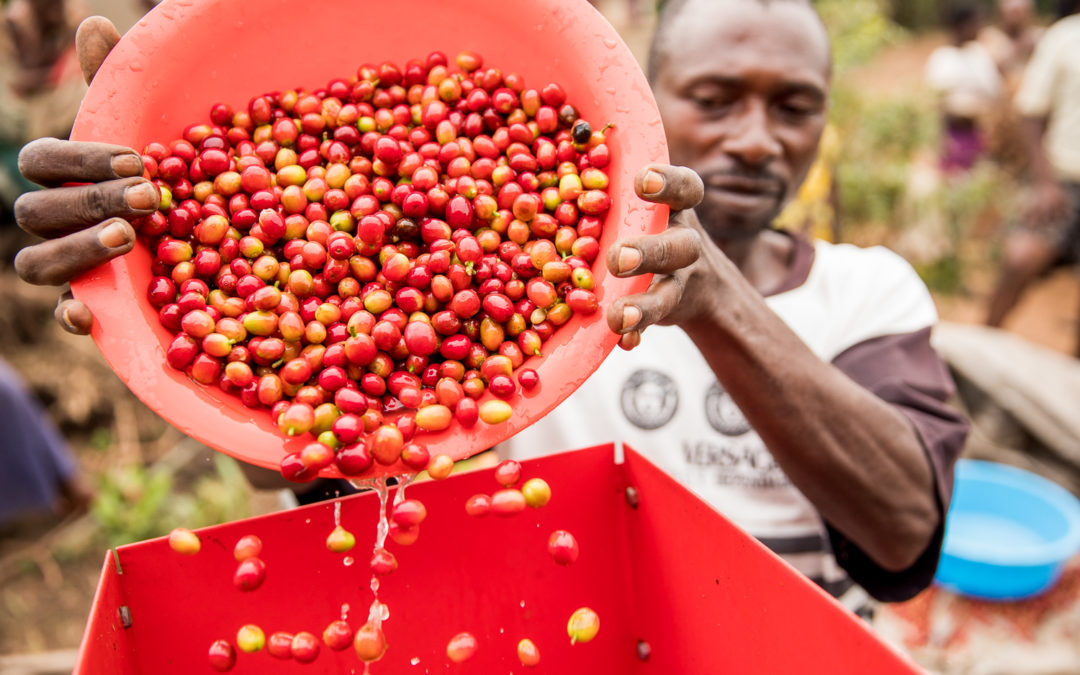
A Ugandan coffee former puts the coffee cherries into a machine that removes the outside fruit (hrnstiftung.org).

Indonesian Coffee

The biggest coffee-producing country in Asia by far is Indonesia. If you’ve ever had an espresso beverage from Starbucks (a latte, cappuccino, flat white, caramel macchiato, etc.), you’ve had Indonesian coffee. Asian coffees like these are relatively earthy, meaning they kind of taste like what can best be described as dirt or grass. Plenty of people enjoy this as evidenced by Starbucks’ popularity. Even when roasted lightly, it has pretty high natural bitterness. Personally, I am not a fan of these types of coffees that typically come from Asia. I like fruitier and more acidic ones in general. That being said, when your coffee is roasted nearly into ashes like Starbucks, any type of bean will taste like the same thing: carbon.

Starbucks’ coffee primarily uses very dark roasted Indonesian coffee in their espresso blend (starbmag.com).

Panamanian Coffee

Panama is a major coffee producer in South America that produces coffee with intense fruity flavors and sometimes even a peppery spicy note. Panama is the producer of most gesha coffees that are found throughout the world, even though this variety is actually native to Ethiopia. Geshas are one of the most expensive varieties of coffee, but they are generally some of the highest quality coffees you can find. Geshas often have the scent and flavors of honey and jasmine tea.

Panama is the largest producer of the expensive Gesha variety of coffee (sprudge.com).

Brazilian Coffee

Brazil is the biggest coffee producer in the world by far. More than 7.8 billion pounds of green coffee beans were exported by Brazil in 2020 (elevencoffees.com). Because Brazil is one of the largest coffee-producing countries in the area, the characteristics of their coffee significantly vary by region and growing altitude. Generally, their coffees are not especially acidic, though the higher they are grown, the more acidic they are. Their coffee often has really nice chocolatey notes, and they are usually more of sweeter, lighter milk chocolate notes unlike the intense dark chocolate notes found in coffees from places like Indonesia.

A large Brazilian farm grows coffee (ictcoffee.com).

Hawaiian Coffee

Of the fifty United States, only Hawaii grows coffee. This is because it is the only true tropical state. Hawaiian coffee is very naturally sweet, with molasses or brown sugar notes. There are also a lot of fruity notes found, especially berry ones. Hawaii also produces the very high quality Kona coffee variety. Kona has very pleasant nutty notes, like toasted almond or hazelnut. This variety is grown on the Big Island of Hawaii on the slopes of volcanoes. These areas are of relatively low altitudes, and this means Kona has very little acidity compared to coffees in places like Africa.

The Kona variety of coffee thrives in the Hawaiian sun (https://www.lovebigisland.com/).

Overall, I think that comparing the origin characteristics of different coffee-producing countries is really fun. Personally, my favorite coffees are acidic coffees from places like Kenya and fruity coffees from places like Brazil. I encourage you to try two single origin coffees from two different continents and try to tell what is different or similar between them. It’s a really fun way to explore coffee from around the world and find your preferences and dislikes. 

Filed Under: Daily Life, Food Tagged With: Coffee Around the Globe, Indy Behr

What’s the Level of Coffee Addiction at PVS?

January 26, 2023 by szachik@pvs.org 2 Comments

By PVS student-blogger Louisa Richardson

The Blog Staff continues to plumb the depths of PVS’s relationship to coffee. Is it as simple as love-hate? Louisa sheds some light on our coffee-drinking habits, tastes, and associations.

Coffee is not something I have ever been allowed to have; however, apparently it is quite the controversial subject here at Palm Valley. Some people think that it is a great source of energy. Whereas others (Pip Watson) think of it as a “legalized drug.” Since I don’t drink coffee, I don’t have much opinion about it. The students and teachers at PVS do. Here’s what they had to say about America’s favorite morning drink.

Teacher Mr. Satterfield’s opinions on coffee: 

I think coffee, like most things, is healthy in moderation. There are people who have done great amounts of research on the subject who argue that coffee provides significant health benefits. There is also, I believe, a body of research (and common sense) that suggests too much coffee is unhealthy. Personally, I rarely drink coffee because I want the caffeine to work when I need it to, which is usually on a long drive. But most people I know well do drink it often, and only a few of them have what I would call a coffee problem.

Student Pip Watson’s one of two opinions on coffee:

While I cannot comment on the nutritional value of coffee, I do know it contains copious amounts of caffeine. Caffeine is an addictive, mind-altering drug which most people shrug off as something that provides energy.

Teacher Mr. Parsons comments on coffee:

Coffee is at the heart of many cultures, particularly in Europe, Africa, and the Americas, and it has been for centuries. Noteworthy individuals wrote poems and songs dedicated to the taste and effects of that little roasted bean. All around the world, coffee shops have sold this stimulating beverage to artists and their fans. These centers for creativity blossomed organically out of the thriving bean trade with South American and African nations. Famously Beethoven brewed his morning cup of Joe from exactly 60 beans, no more and no less. Many blame coffee for his often erratic and grumpy behavior. The downsides of coffee are not to be ignored. Drinking too much caffeine (the potent chemical that gives coffee its boost of energy) can make people irritable and can prevent a good night’s sleep. Folks can even become hooked on coffee; their entire mood depends on their next espresso. Let’s just hope it doesn’t arrive too latte (Dad joke intentional)!

Teacher Mr. Killeen’s thoughts:

On a scientific level, coffee has both benefits and issues when it comes to personal health. According to the Mayo Clinic, coffee may offer protection from Parkinson’s, type 2 diabetes, liver disease, liver cancer, heart attack and stroke.  However it can also lead to an increase in blood pressure which can also be problematic for people. Just like anything you consume, moderation and listening to the signs your body is sending you is important to maintaining good health.

Staff member Ms. Greer talks about coffee:

I think coffee, actually caffeine in general, is addictive but it is something I really enjoy. I love a cup of hot coffee in the morning or an iced coffee on a summer afternoon.

Student Olivia Puetz (or Olie) says:

I like coffee, but not black coffee because it tastes too bitter. I like sweet coffee like frappuccinos and lattes.

Student Brooklyn Hatrack believes:

I’ll be for real – coffee is disgusting. It’s so bitter and the taste never gets out of your mouth. It also doesn’t even energize you. Also, the breath of a coffee drinker is VERY distinct. It’s icky.

So, as you can see when asking the question “What are your opinions on coffee?” I found that a surprisingly large number of people do not think coffee is a good thing. This can only be proving my mother right.  Despite Starbucks’ success, I am definitely starting to think that coffee may not be so great after all.  

Filed Under: Culture, Daily Life, Food, Uncategorized Tagged With: Louisa Richardson, What's the Level of Coffee Addiction at PVS?

Politeness is a Waste of Time

September 6, 2022 by szachik@pvs.org Leave a Comment

The Bird on Fire staff bloggers are tasked with writing about a cause. Here, Levi opts to go after the glue that holds together our society–politeness and small talk. It nearly goes without saying, the opinions of Levi do not necessarily represent the views of The Bird on Fire.

Blog Advisor Zachik

By Levi Kassinove, Junior

Dear Readers, given the comprehensive, semi-scientific post of last week, I feel you deserve a break. It’s time for a lighthearted post about why polite people are living a lie.

— Levi

Recently, on vacation, my friends and I were walking outside at night in the desert. Without giving too many details so as to not embarrass anyone, there were scorpions roaming around, and we needed a UV light to see them. We did not have a UV light. We walked around nonchalantly, accepting our situation, until a lady walked up to us and offered to let us borrow her UV flashlight. One of my friends fought absolute TOOTH AND NAIL for her to not give it to us. My friend repeatedly told her, “Oh you don’t have to, you really don’t have to,” to which the lady responded, “I insist. You guys are children and you should have fun.” This exchange kept going until I interrupted and said that I would like to use the light to see the scorpions. My friend grimaced and told me that I didn’t know how to handle social interaction. We had a great time looking at the formerly invisible scorpions in the night. We took pictures and gazed in awe at their beauty. Personally, I, along with some other people with us, had never seen scorpions in the wild before. It was a cool opportunity. Anyway, the point is that this would have never happened if my people-pleaser friend had successfully shooed the light-lending lady away. The lady had offered us a UV light that she already owned. She insisted that we try it out. So why fight out of politeness? It harms both parties in this case, since the lady seemed to genuinely want us to have fun. This exchange is an example of one of the many reasons why it is a bad habit to be unnecessarily polite, which is that it can prevent people from taking advantage of opportunities. 

Small talk, on the other hand, is something that we’ve all had to endure throughout our lives. Some live for it. I’d say that they aren’t really living. You can forget having a real human connection with the person if you insist on rhetorically asking how the other person is doing. If one person simply gives the other a real answer, the conversation will switch and both parties will let their guard down. So, I say just skip the small talk. Everyone would find it refreshing, unless they don’t have anything to talk about beyond the weather. The people that prefer to stay engaged in small talk are not interesting, and not worth getting to know any further. That is, if there is anything further to know. 

Perhaps small talk ties into politeness, if enough people feel that it is common courtesy. Ultimately, however, it is an unnecessary and exhausting exchange between people. And, it won’t provide any information of substance to the other person. To be blunt is to be genuine. I would go insane if people were to only engage in small talk. 

Consider this guy Bill who’s asking about the weather, when they are both literally standing outside. Bill has no idea how to respond, as this is a nonsensical question. Be more like Bill. 

englishclassviaskype.com

Filed Under: Advice, Culture, Daily Life, Introspection, Op-Ed, Unpopular Beliefs Tagged With: Levi Kassinove, Politeness is a Waste of Time

Stuck Quarantining at Home? Take Up a Hobby.

August 23, 2022 by szachik@pvs.org 1 Comment

By Alyna Rei–Upper School Junior and Blog Correspondent

I’m not usually the person to try many hobbies or go outside the box. But, with quarantine and a couple of boring days stuck at home, I was able to conjure up a few new hobbies—some I jettisoned when we came out of quarantine; some I continue to this day.

Quarantine hobbies that were just too weird to continue . . .

Collecting Crystals and Stones – I was pretty enthusiastic about this hobby in 2021. I would collect cool-looking stones. It might have been a crystal that had some essential meaning, or just a cool-looking stone. I still have my crystals, but I just don’t collect them as much now. I’m not sure why I stopped collecting them, but I feel like this hobby is off and on for me. This is something I may come back to, depending on my karmic need.

Socializing – I’m not sure if this can be considered as a hobby. When I was around 12 or 13, I would really like to talk to people and meet new people. Now that I’m older,  I feel that having two-three friends is comfortable. I also hate the idea of having to talk to strangers. Through the years, I started to like the idea of being alone on a couple of occasions and having me time. The thought of socializing with people that I don’t know or being in a huge crowd of people gives me a little anxiety. Plus, now that we’re out of quarantine, I’m in the world more. It’s nurturing to embrace me time.

Quarantine hobbies that stayed with me . . .

Reading – Going back to liking the fact of being by myself, I have gotten into reading. I got this hobby from my mom who loves fictional books (same with me). I love to listen to calm music and read a book in my alone time. I am mostly into romance books. I thrive on rom coms and fictional romances.

Collecting Plants – I started this hobby at the age thirteen. I would always see little succulent plants and houseplants on the internet and  ask, ”Why would anyone want to have a plant in their room?” But, through the years, I started to love having plants in my room and loving the habit of watering them. I say this is a good hobby since it taught me how to care for a living object and have responsibility. My mom first gave me plants that you can’t kill. Once my mom saw that I can keep a plant alive, I started to collect plants that are trickier, but plants that I am really interested in. I usually prefer plants that require not a lot of sun.

* * *

I’m pretty content with the hobbies I do now. I’m not sure if I will come up with more since I don’t like to switch into different hobbies and things. But, I feel like hobbies will always keep me productive and intact.

Filed Under: Daily Life, Home, Making Daily Life More Interesting Tagged With: Alyna Rei, What to Do When You're Stuck Quarantining at Home? Take Up a Hobby.

The Tea Club Revival

May 4, 2022 by szachik@pvs.org Leave a Comment

By Levi Kassinove, Tea Club Founding Member

Two years ago, the former 8th grader Remi Benomar had the idea of starting a middle-school Tea Club. He pitched the idea to me during a Wednesday assembly meeting in the MPR. We talked at length about our visions for the Tea Club and how it would evolve in the future; we dreamt up Tea Club meetings where we would have tastings and discussions of flavor notes. It would be a place where people come together and have peaceful conversations. It wouldn’t just be about the tea, but rather the community. Immediately after hearing his idea, I knew we had something great. 

Mr. Killeen (now the Tea Club advisor)  loved the idea and, fortunately, so did the middle school. We had the former Science room completely filled on the first meeting. Around 30 kids were showing up for these weekly tea parties at lunch. Overnight, it became one of the most popular clubs in middle school. We had multiple varieties of tea, including spiced chai, hibiscus, and green tea. Members were to pick their tea at their leisure and add honey if they so desired. Some brought their own mugs, such as Indy Behr, and others used the mugs generously provided by Mr. Killeen, who also provided the tea. The club was a thriving community, but, unfortunately, it had some issues. For instance, moderation was extremely difficult with our large member count. Dozens of kids were in a single room, each with a cup of near boiling water. Spills and burns were inevitable especially with the shaky plastic tables we had. When Covid hit, the Tea Club disappeared into the shadows and was largely forgotten, save for a few of us who drank tea over Google Meets in its memory. By the time we were allowed to come back to school, the Tea Club was gone. 

Nowadays, a handful of middle schoolers still meet every week behind the gym to drink tea. But it’s known as an informal gathering rather than an official Tea Club meeting. So I’m revamping it. It’ll be the same aesthetic meeting place (behind the gym, mountains in the background), same core idea, but our methods will be slightly different. For instance, instead of having a fixed set of regular teas, we will have one type of tea available per week. The tea will change every week–a tea of the week, if you will. This way, the general discussion will be geared more towards the specific tea rather than normal lunch talk. The previous tea club was more club than tea, and now we want to put more emphasis on the tea. We will have fewer members, but in turn we will have higher quality teas. We will introduce members to the world of teas, from normal green, to matcha, to hibiscus, to oolong, and even to blends carefully curated by tea enthusiasts. It will be a place where people can discuss flavor notes and ultimately bond over tea, just like Remi’s vision all those years ago. This time, it’s without the chaos of a large group. It’ll have a peaceful and relaxing atmosphere, unlike the rowdy type that seems to be an inherent part of middle-school groups. It’ll be a tight-knit family of 16 high school students that come together every Tuesday to enjoy tea. Our debut was yesterday, Tuesday, May 4, at lunch behind the gym. The next meeting is next Tuesday the 11th. If you want to make friends and explore the wondrous world of tea, you can stilll sign up for the club. But, there are only 16 slots!

Sign up at this poster at Mr. Winter’s door. (Poster by Cole Robinson)

Filed Under: Culture, Daily Life, Festivities, School Events Tagged With: Levi Kassinove, The Tea Club Revival

Senior Spotlight: Isabella Goetschel

April 26, 2022 by szachik@pvs.org Leave a Comment

By Lilah Nick 

In just about a month we will all have to say goodbye to our beloved seniors. While they are still here gracing our company, let’s talk about them. Here’s graduating Senior Isabella Goetschel. 

I have known Izzy since I was a freshman. We’ve acted together. We share ASB responsibilities. So, I talked with Izzy and asked her some questions about high school. 

How was your high-school experience?

I think I have had a pretty good high school experience. I have been so lucky with some of my teachers and the friends I’ve made have been…interesting. Interesting but hilarious. I’m truly grateful to have been able to enjoy it as much as I have.

Do you have any favorite memories?

There are so many funny memories. A lot of them are probably from lunch in the student lounge. I do have a really good one from golf, but I can’t expose Jane like that–lol.

What’s your favorite thing about high school?

My favorite thing about high school has got to be the people. My friends and teachers have just been the best!

What’s your favorite subject?

My favorite subject in my whole high-school experience was probably AP Government or Algebra II.  I’ve just always loved politics and math. AP Gov really allowed me to learn more about the government and things going on in real time, which I loved. As for Algebra, I just find math to be fun when you understand it, and I just have fond memories of that particular math class.

Are you involved in any club?

In school, I’m the Captain of the Owls, Founder/ President of Amnesty International Club, President of United Way, President of Film Club, and Vice President of Junior Statesmen of America (JSA).

Are you excited to graduate from PVS?

Let’s just say I don’t think I’ve ever been this excited in my life.

What university are you going to?

As of right now, I’m going to UC Santa Barbara, but it all depends on whether I get accepted from the waitlist at UC Berkeley.

What are you planning on majoring in?

I plan on majoring in Political Science with perhaps a double major or minor in French.

What are your plans for the future? Dream Job?

I would love to become a civil rights attorney. If not that then something with human rights and perhaps public administration.

What are you most excited about in the future?

I’m definitely most excited about the independence and freedom that comes with college.

What are your favorite hobbies?

My favorite hobbies are definitely dancing and acting.

What are some things you do outside of school?

Outside of school, I’m usually at work. I work at the movie theater. I work at the Cinemark at the River. Honestly, it’s been one of the best experiences I’ve had in all of high school. I love working there! I also do dance! I mainly do contemporary and lyrical dance. I love hip hop as well, but I find it much harder to find a good teacher for hip hop. I tried to find a lot of places to dance here in the desert, but they were either too far or just not the right fit for me. I danced at Starlight Dance out here for a while, but then Covid hit. I plan on just picking up dance again in college rather than finding a place now.

What’s your favorite thing to do in your free time?

My favorite thing to do in my free time is read. I loveeee reading!! I also love to watch youtube. I can’t say I have a favorite book because there are just too many good ones, but one of my top books is for sure the Shadow and Bone/ Six of Crows series. If you read them, READ THEM IN ORDER!!! Do not start with Six of Crows!! 

What’s a fun fact about you?

 A fun fact about me is that I used to go to a French school.

What is your favorite kind of music?

My favorite kind of music would have to be rap. I’m really the type to listen to everything from classical to rap, but there’s just something about rap music. I have wayyy too many favorite songs. I love music so much, I could never pick one, and they constantly change. Right now some of my favorite songs are probably “Lucky You” by Joyner Lucas and Eminem, “Parents” by YUNGBLUD, and “Achilles Come Down” by Gang of Youths. Veryyy different songs but all so good! I usually use the last one to study or do homework.

So, let’s all congratulate Izzy on her future endeavors. Izzy, keep us in the loop; drop us a line; let us know how you’re doing as a Gaucho or a Bear.

Filed Under: Daily Life, School Events, The Last Tagged With: Lilah Nick, Senior Spotlight: Isabella Goetschel

Dress Code: Sound Educational Practice or Suppression of Self Expression?

March 23, 2022 by szachik@pvs.org 1 Comment

Luke Sonderman and Lilah Nick take on the age-old argument over dress codes. Ripped jeans, crop tops, and short shorts all get called into question. Dr. Sherman even contributed to the matter. Read on to find out the fashion fate of Palm Valley. – Editor-in-Chief, Jesse Denyer

By Lilah Nick and Luke Sonderman

Dress Codes:

Dress codes are a common rule set at schools, workplaces, and special events. Most dress codes create a uniform and appropriate look for a body of people, but some dress codes can be unfair and suppressive of self-expression. 

There is no doubt that dress codes do serve important purposes in a professional and educational setting–such as to prevent offensive symbols and wording on clothing and accessories, but do dress codes go too far? Laura Bates, a founder of The Everyday Sexism Project, says, “There’s a real culture being built up through some of these dress codes where girls are receiving very clear messages that male behavior, male entitlement to your body in public space is socially acceptable, but you will be punished [for your clothing choices]” (theatlantic.com). At many high schools in the United States, dress codes restrict clothing that women wear: such as not allowing shoulders or collarbones to be visible or not allowing short skirts, bare midriffs, or leggings. When dress-coded at most schools, students are usually forced to change into other clothing provided by the school which may cause embarrassment and distraction. Sometimes, a student will even get sent home. “That’s crazy that they’re caring more about two more inches of a girl’s thigh being shown than them being in class,” says Anna Huffman who recently graduated from Western Alamance High School in Elon, North Carolina, and helped organize a dress-code protest involving hundreds of participants (theatlantic.com). 

Many schools around the country, and specifically in California, have reformed their restrictions to be more accepting of women’s fashion. Alameda Unified School District in the Bay Area is a new leading example of a no-shame, accepting dress code. This dress code allows tube tops, tight pants, ripped jeans, short skirts, and pajamas as long as they don’t show underwear (USAtoday.com). According to Dani R., Staff Writer of the Grizzly Growler, a young person’s social-justice news source, “Women’s shoulders, knees, or stomach, should not have to be covered up on a hot summer day due to men being ‘distracted’” (grizzly growler.org).

Uniforms:

Having uniforms in private schools is very common, but do uniforms oppress student expression? According to the National Youth Rights Association, “Uniforms restrict students’ individuality, expression, and creativity” (youthrights.org). Although dress codes and uniform systems are being reformed all over the United States, “[T]he percentage of public schools requiring uniforms increased from 12 to 20 percent” (youthrights.org). The NYRA website adds, “The increase in the use of uniforms may be due to a mistaken belief that uniforms prepare students for the workplace and reduce bullying in schools” (youthrights.org). But, there is controversy even amongst the experts on the effect of uniforms on bullying in schools. Tony Volk, Ph.D., Associate Professor at Brock University, stated, “Overall, there is no evidence in bullying literature that supports a reduction in violence due to school uniforms” (Britannica). 

David L. Brunsma, Ph.D., Professor of Sociology at Virginia Polytechnic Institute and State University (Virginia Tech), analyzed a group of 10th graders and discovered “no effects of uniforms on absenteeism, behavioral problems (fights, suspensions, etc.), or substance use on campus” and “no effects” on “pro-school attitudes, academic preparedness, and peer attitudes toward school” (Britannica). In addition, Brunsma found a “negative effect of uniforms on academic achievement” (Britannica). Some ways that uniforms have a negative effect is they take away individuality; they can be an additional school expense; and they can be pretty uncomfortable and stressful. Brunsma’s research found that uniforms did not improve academics or reduce bullying with even elementary students and 8th graders (Britannica). “A peer-reviewed study found no significant effects of school uniforms on performance on second-grade reading and mathematics examinations, as well as on 10th-grade reading, mathematics, science, and history examinations.… [In] many of the specifications, the results are actually negative” (Britannica). Studies suggest the common argument schools make–that uniforms take away distractions from the learning environment–has little scientific basis and may actually have a negative effect on a student’s performance. 

Relevance to Palm Valley School:

At Palm Valley, there is only one day a month where students wear their own clothes to school, and many students have to purchase separate clothes to wear on these free-dress days. In the past few years, the uniform dress code has become more relaxed as to what types of pants and shorts are allowed, but the free-dress code has stayed the same. By our interpretation, all preschool, lower school, middle school, and high school students follow the same clothing dress code found in the Students and Families Handbook 2021-2022. When asked to comment, Dr. Sherman, Palm Valley Head of School, countered, “It actually is not the same for Preschool through Upper School.” Dr. Sherman adds, “[I]f you are referring to certain freedoms that you would like to see given to Upper School students, I would encourage you to involve Mr. Coffey in a conversation that you might foster towards that end.”

Palm Valley School is a preschool, lower school, middle school, and college-preparatory upper school. Although it is common for college preparatory schools to have uniform policies, colleges do not implement uniforms unless they are a special academy or military school. It is important for high-school students to be able to express themselves socially before going to college and through allowing students to wear their everyday clothes, students begin to embrace freedom of expression.

In an email interview, Dr. Sherman explains the school’s position: “[T]he objective in having uniforms as part of the PV dress code is to eliminate clothing issues from the social, disciplinary, and academic agenda of our school. Sometimes, clothing can be polarizing and controversial – leading to a distraction from our sole purpose as a school. As students mature, they often choose to express their individuality in overt ways by their choice of clothing and outward dress.” Dr. Sherman went on to say, “[Free dress days are] an attempt to allow students some freedom of expression as it relates to their dress.” 

Palm Valley Student Survey:

In a survey, we asked Middle and Upper School students if they had ever been “dress-coded” (approached about violating the dress code or ever asked to change because of violating the dress code), and, out of 66 responses, 32 had been “dress-coded.” 70% of these “dress-coded” students were female. 

We also collected quotes from students about the dress code. Indiana Behr of the 10th grade said,

“Clothes are a way for people to express themselves, so when we have a day once a month to wear clothes that we are comfortable in, telling girls all of these excessive rules is completely unnecessary.”

Indiana Behr, Sophomore

Ciera Carr from the 8th grade responded to the Handbook guidelines prohibiting cleavage:

“This society really needs to desexualize breasts…. I don’t understand why girls are being taught to be ashamed of their bodies.”

Ciera Carr, 8th Grade

Other students who responded under anonymity said, “We should be comfortable while learning”; “[The dress code] makes [students] feel shameful about their own body”; “Boys have almost no dress-code, on the other hand, girls struggle to find things to wear”; “School should be a place where you can explore yourself freely and respectfully and not be shamed for it.”

As a small preparatory school, it is important to improve the social aspect of the school environment in all ways that we possibly can. In the past five years, too many studies have shown that uniforms have no positive impact on academic performance, and the lack of social expression actually has a negative impact on academic performance and mental health. The Palm Valley School dress code and uniform policy is something that needs to be continually discussed and possibly reformed. As social change progresses, the policies and code on student expression need to change with it.

Filed Under: Controversy, Daily Life, Fashion Tagged With: Dress Code: Sound Educational Practice or Suppression of Self Expression?, Lilah Nick, Luke Sonderman

  • « Previous Page
  • 1
  • 2
  • 3
  • 4
  • 5
  • Next Page »

About

We are the Palm Valley Firebirds of Rancho Mirage, California. Join us in our endeavors. Venture through the school year with us, perusing the artwork of our students, community, and staff. Our goal is to share the poems, stories, drawings and photographs, essays and parodies that come out of our school. Welcome aboard!