the bird on fire

The Palm Valley School Student Blog

Subscribe to Blog via Email

Enter your email address to subscribe to this blog and receive notifications of new posts by email.

Powered by Genesis

Can you eat Foie Gras guilt free?

March 14, 2023 by szachik@pvs.org Leave a Comment

We said, “Write about the implications of grass.” Levi, as always, went in a surprising direction: foie gras. (Note: “gras” does NOT mean grass, but “fat.”) Foie gras is a highly contentious cuisine. Levi thinks he’s found a guilt-free way of tasting the delicacy.

By Junior Levi Kassinove

Have you heard of foie gras? “Foie gras” is French for fatty liver. If you’ve heard of it but don’t like it because it’s unethically produced, then I have good news for you. There exists ethical foie gras, where the geese frolic about a pasture eating acorns, olives, and grass. If you don’t know what foie gras is, then why are you even here?

Foie gras is fattened goose (or rarely, duck) liver. Typically, it is produced year-round in factories by shoving metal tubes down the throats of geese and force feeding them (sentientmedia.org). And, they are forbidden from exercising. This force feeding of stationary geese can fatten the liver to 10 times its normal volume (npr.org). If you read my wagyu article, you’d know that the more fat involved, the better flavor and texture. Unsurprisingly, because of the name, this is a product of France. However, in Spain there exists two men by the names of Eduardo Sousa and Diego Labourdette who have a farm that produces foie gras…ethically (npr.org). 

Geese wandering around the farm outside of Pallares, Spain (npr.org). 

How do they do it?

As I said earlier, these geese are not force fed. They roam free, eating–of their own free will–olives, acorns and whatever else they desire. Naturally, the geese fatten themselves up during the beginning of the winter to prepare for their annual Southward migration (a-z-animals.com). We all know, though, that the geese will not be making their Southward migration. They will instead be “sacrificed” on a “night of the new moon” when their livers are the fattest (Eduardo Sousa, npr.org). In an interview with NPR, Sousa revealed that before they kill the geese, they “paralyze them with flashlights.” After the geese are hypnotized, they are swiftly and painlessly killed with a knife. The rest of the goose is used for various other products such as meals of duck leg and duck breast (npr.org). 

What does this ethically-raised foie gras taste like?

Usually, foie gras barely tastes like liver because it is so fatty, but this liver tastes like liver. While I cannot personally vouch for its flavor, James Beard award-winning chef Dan Barber said it was “the best foie gras of my life” (npr.org). Taking on the flavors of what they eat, the foie gras would probably have a deep, earthly flavor with notes of acorns, olives, and whatever else the geese choose to eat. 

How to buy it?

Because only a handful of geese are slaughtered every year, Sousa’s foie gras is extremely difficult to obtain. You can find the foie gras on their website (lapateria.eu/) for €200 per 180g. It is currently sold out, but I will try to get my hands on it and report back this winter!

Filed Under: Food, The Outdoors Tagged With: Can you eat Foie Gras guilt free?, Levi Kassinove

Rain + coffee shops = happiness

February 9, 2023 by szachik@pvs.org Leave a Comment

While most bloggers explored the literal coffee-drinking experience during our Coffee Theme Week, Alyna delved into a new corner of the coffee shop. She shares here a virtual cafe. For those of you missing your morning coffee-shop vibes, Alyna tells you have to access coffee-shop sounds any time of the day.

By Upper-School Blogger Alyna Rei

I hate studying or doing homework when it’s really quiet. If there is some noise in the room, then that is what keeps me from going into distracted deep thinking. Most days I listen to music on a playlist. But there are some days where I don’t even want to listen to music–even if there are no lyrics. Because of this, I decided to search around to see if there are other options. 

I came across a website called www.imissmycafe.com.  I found this website during lockdown when I had to study at home instead of going out. This website plays different sounds as if you were in an actual coffee shop. For example,  there are sounds such as people talking, coffee machines, coffee cups, baristas, rain, etc. The best part about this is that you can control the volume on each sound. The reason why I like this website is because you don’t pay for anything, you can control what you hear, and it is easy to access. 

My favorite combinations would be the sounds of preparing drinks, coffee cups, machinery, and rain, so I push those sounds a little louder. This website also comes with a playlist of songs that you can play while listening to sounds at a coffee shop. These songs are on the calmer side and have the aesthetic of a coffee shop. These aren’t my favorite songs, so I just open up Spotify and play my own songs. The way you can enter this soothing virtual coffee-shop website is by going on a browser and typing in www.imissmycafe.com. It will take you straight to the website.

So, please come in, and sit down to a cup of coffee in this virtual cafe, tailored just for you. 🙂

Filed Under: Food, Technology Tagged With: Alyna Rei, Rain + coffee shops = happiness

Coffee Around the Globe

February 2, 2023 by szachik@pvs.org Leave a Comment

By Junior Indy Behr, Coffee Connoisseur 

Indy suggested we blog about coffee, so it’s only fitting he travels the world offering up and explaining the many varieties of coffee we can ingest.

There are many different countries that produce coffee across the globe. I wrote an article delving into the culture and origin characteristics of Ethiopian coffee, but there are countries across Africa, South America, and Asia that produce significant amounts of coffee as well, all with their own growing processes and naturally occurring flavors. I will explore a few coffee producing countries from all of these regions.

Kenyan Coffee

Kenya is an African nation. Their coffee characteristics are somewhat similar to Ethiopian characteristics. The coffee has bright, fruity flavors. There is much more natural acidity present, and when the coffee is left to dry naturally before roasting, this acidity is even more prominent, and the flavors are reminiscent to tropical fruit, like mangos or pineapples. I have seen people describe these Kenyan dry-process coffees as Tropical-Skittles-flavored coffee. The coffee has a heavy body, and its mouthfeel is creamier than coffees grown in South America.

Many people say naturally processed Kenyan coffees remind them of Tropical Skittles (thewholesalecandyshop.com).

Ugandan Coffee

Uganda is another major coffee-producing nation in Africa. Ugandan coffee is similar to Kenyan coffee, but there is not as much natural sugar. This means there is not quite as much sweetness. Their coffee production used to be much less than its neighboring countries, but over the last few years, coffee has become their top earning export (tradingeconomics.com). Initially, they were producing low-quality, high caffeine, cheap robusta coffee, but they have now entered the arabica game, leading to more attention from the specialty coffee industry.

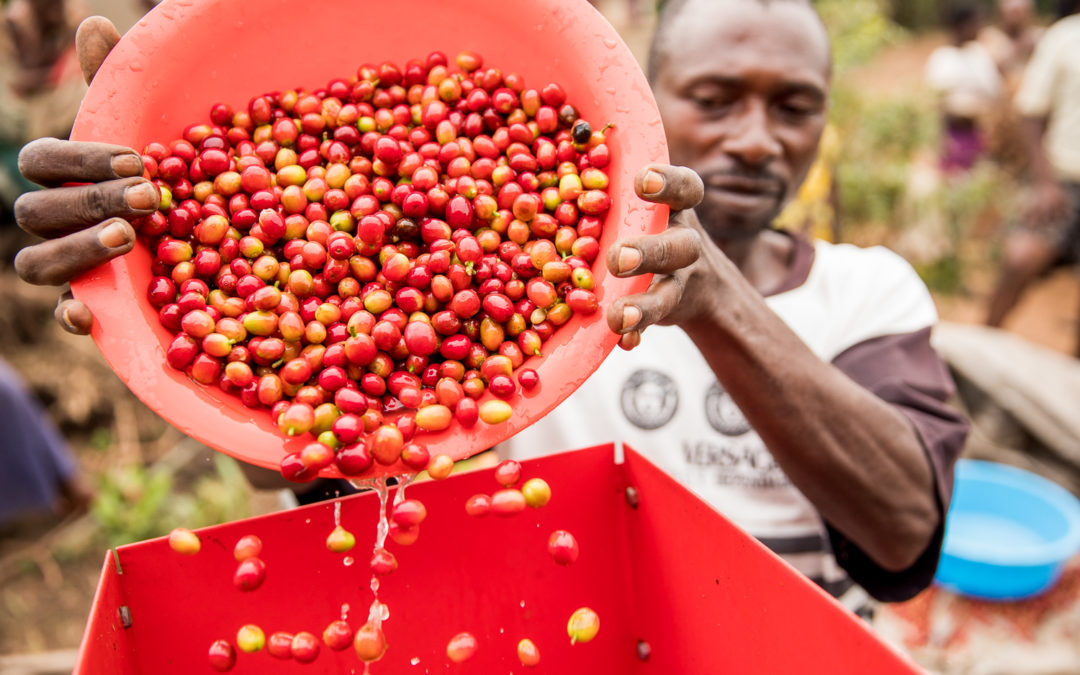
A Ugandan coffee former puts the coffee cherries into a machine that removes the outside fruit (hrnstiftung.org).

Indonesian Coffee

The biggest coffee-producing country in Asia by far is Indonesia. If you’ve ever had an espresso beverage from Starbucks (a latte, cappuccino, flat white, caramel macchiato, etc.), you’ve had Indonesian coffee. Asian coffees like these are relatively earthy, meaning they kind of taste like what can best be described as dirt or grass. Plenty of people enjoy this as evidenced by Starbucks’ popularity. Even when roasted lightly, it has pretty high natural bitterness. Personally, I am not a fan of these types of coffees that typically come from Asia. I like fruitier and more acidic ones in general. That being said, when your coffee is roasted nearly into ashes like Starbucks, any type of bean will taste like the same thing: carbon.

Starbucks’ coffee primarily uses very dark roasted Indonesian coffee in their espresso blend (starbmag.com).

Panamanian Coffee

Panama is a major coffee producer in South America that produces coffee with intense fruity flavors and sometimes even a peppery spicy note. Panama is the producer of most gesha coffees that are found throughout the world, even though this variety is actually native to Ethiopia. Geshas are one of the most expensive varieties of coffee, but they are generally some of the highest quality coffees you can find. Geshas often have the scent and flavors of honey and jasmine tea.

Panama is the largest producer of the expensive Gesha variety of coffee (sprudge.com).

Brazilian Coffee

Brazil is the biggest coffee producer in the world by far. More than 7.8 billion pounds of green coffee beans were exported by Brazil in 2020 (elevencoffees.com). Because Brazil is one of the largest coffee-producing countries in the area, the characteristics of their coffee significantly vary by region and growing altitude. Generally, their coffees are not especially acidic, though the higher they are grown, the more acidic they are. Their coffee often has really nice chocolatey notes, and they are usually more of sweeter, lighter milk chocolate notes unlike the intense dark chocolate notes found in coffees from places like Indonesia.

A large Brazilian farm grows coffee (ictcoffee.com).

Hawaiian Coffee

Of the fifty United States, only Hawaii grows coffee. This is because it is the only true tropical state. Hawaiian coffee is very naturally sweet, with molasses or brown sugar notes. There are also a lot of fruity notes found, especially berry ones. Hawaii also produces the very high quality Kona coffee variety. Kona has very pleasant nutty notes, like toasted almond or hazelnut. This variety is grown on the Big Island of Hawaii on the slopes of volcanoes. These areas are of relatively low altitudes, and this means Kona has very little acidity compared to coffees in places like Africa.

The Kona variety of coffee thrives in the Hawaiian sun (https://www.lovebigisland.com/).

Overall, I think that comparing the origin characteristics of different coffee-producing countries is really fun. Personally, my favorite coffees are acidic coffees from places like Kenya and fruity coffees from places like Brazil. I encourage you to try two single origin coffees from two different continents and try to tell what is different or similar between them. It’s a really fun way to explore coffee from around the world and find your preferences and dislikes. 

Filed Under: Daily Life, Food Tagged With: Coffee Around the Globe, Indy Behr

The Best Coffee I’ve Ever Had

January 26, 2023 by szachik@pvs.org 1 Comment

A Sonnet Ode by poet Levi Kassinove

Ere the morning fog vanished,

By the hand of the golden sun,

Which rises betwixt London clouds,

Amber divinity, I was fated to meet.

Awoken by wanderlust, at 10 a.m.,

I trekked through blighted streets,

Gazing with ardent curiosity,

At the aquaponic garden surrounded by glass. 

When my shackled palette, 

Consanguineous with fog,

Entered its welkin doors ensconced in light,

Mine eyes fell upon machinery old and new. 

T’was a Japanese iced o’ th’ Panama geisha stripe,

The amber sun unshackl’d my tongue. 

Photo Source: handground.com

For context: When I was in London, I had a Japanese-style iced coffee, made with Panama Geisha beans. Japanese-style iced coffee is when the barista pours the coffee directly over the ice as part of its mass, as opposed to the ice being added afterwards with no regard for the proportion between water and coffee. Geisha is a highly prized strain of coffee bean, and this particular variety was grown in Panama.

Filed Under: Food, Poetry, The World Tagged With: Levi Kassinove, The Best Coffee I've Ever Had

What’s the Level of Coffee Addiction at PVS?

January 26, 2023 by szachik@pvs.org 2 Comments

By PVS student-blogger Louisa Richardson

The Blog Staff continues to plumb the depths of PVS’s relationship to coffee. Is it as simple as love-hate? Louisa sheds some light on our coffee-drinking habits, tastes, and associations.

Coffee is not something I have ever been allowed to have; however, apparently it is quite the controversial subject here at Palm Valley. Some people think that it is a great source of energy. Whereas others (Pip Watson) think of it as a “legalized drug.” Since I don’t drink coffee, I don’t have much opinion about it. The students and teachers at PVS do. Here’s what they had to say about America’s favorite morning drink.

Teacher Mr. Satterfield’s opinions on coffee: 

I think coffee, like most things, is healthy in moderation. There are people who have done great amounts of research on the subject who argue that coffee provides significant health benefits. There is also, I believe, a body of research (and common sense) that suggests too much coffee is unhealthy. Personally, I rarely drink coffee because I want the caffeine to work when I need it to, which is usually on a long drive. But most people I know well do drink it often, and only a few of them have what I would call a coffee problem.

Student Pip Watson’s one of two opinions on coffee:

While I cannot comment on the nutritional value of coffee, I do know it contains copious amounts of caffeine. Caffeine is an addictive, mind-altering drug which most people shrug off as something that provides energy.

Teacher Mr. Parsons comments on coffee:

Coffee is at the heart of many cultures, particularly in Europe, Africa, and the Americas, and it has been for centuries. Noteworthy individuals wrote poems and songs dedicated to the taste and effects of that little roasted bean. All around the world, coffee shops have sold this stimulating beverage to artists and their fans. These centers for creativity blossomed organically out of the thriving bean trade with South American and African nations. Famously Beethoven brewed his morning cup of Joe from exactly 60 beans, no more and no less. Many blame coffee for his often erratic and grumpy behavior. The downsides of coffee are not to be ignored. Drinking too much caffeine (the potent chemical that gives coffee its boost of energy) can make people irritable and can prevent a good night’s sleep. Folks can even become hooked on coffee; their entire mood depends on their next espresso. Let’s just hope it doesn’t arrive too latte (Dad joke intentional)!

Teacher Mr. Killeen’s thoughts:

On a scientific level, coffee has both benefits and issues when it comes to personal health. According to the Mayo Clinic, coffee may offer protection from Parkinson’s, type 2 diabetes, liver disease, liver cancer, heart attack and stroke.  However it can also lead to an increase in blood pressure which can also be problematic for people. Just like anything you consume, moderation and listening to the signs your body is sending you is important to maintaining good health.

Staff member Ms. Greer talks about coffee:

I think coffee, actually caffeine in general, is addictive but it is something I really enjoy. I love a cup of hot coffee in the morning or an iced coffee on a summer afternoon.

Student Olivia Puetz (or Olie) says:

I like coffee, but not black coffee because it tastes too bitter. I like sweet coffee like frappuccinos and lattes.

Student Brooklyn Hatrack believes:

I’ll be for real – coffee is disgusting. It’s so bitter and the taste never gets out of your mouth. It also doesn’t even energize you. Also, the breath of a coffee drinker is VERY distinct. It’s icky.

So, as you can see when asking the question “What are your opinions on coffee?” I found that a surprisingly large number of people do not think coffee is a good thing. This can only be proving my mother right.  Despite Starbucks’ success, I am definitely starting to think that coffee may not be so great after all.  

Filed Under: Culture, Daily Life, Food, Uncategorized Tagged With: Louisa Richardson, What's the Level of Coffee Addiction at PVS?

Sorry, “affogato” your name

January 24, 2023 by szachik@pvs.org 1 Comment

The Blog Staff, united in its passion for that morning drink so many of us (especially Indy) can’t do without, celebrates coffee this week. Penny, however, voices a different opinion.

By Middle-Schooler Penny Andreas

(If you love coffee, prepare to be offended.)

From cold brew, to de-caf, to your extra tall carmel macchiato with 2 teaspoons of creamer with just a hint of sugar along with the smiley face on top, I dislike coffee. For the most part, I think coffee is gross and disgusting. 

First, what actually is coffee? If you think about it…It’s ground up beans that are served hot. Some people even add flavors like “pumpkin spice,” along with cream. I don’t know about you, but beans with creamy chemical flavoring are disgusting.  Also, What is the smell? To me it absolutely smells like burning rubber, or dry desert dirt. Both are gross. 

Photo Source: saki.us

Second, the taste is the most revolting, sickening, repulsive, icky, gut-churning, and monstrous thing I have ever tasted in my entire life. It tastes extremely bitter, even with (I promise) two cups of creamer. I swear every type tastes like the specific definition of dust and dirt. No matter how many types of coffee I have tried, I find almost no difference except the fact that some are spicy…which has been somewhat concerning to me. 

Third, there are actually hazardous things when it comes to drinking the beans! Consuming and drinking too much coffee can lead to nervousness, addiction, frequent urination, or not being able to control urinating. Is coffee worth the risk of peeing your pants in public? I didn’t think so. However, there are some health benefits that coffee can give you, but that’s only if you don’t put a quart of creamer and a cup of sugar in your coffee. It can help you prevent cancers, heart diseases, and depression (hsph.harvard.edu). But note, once addicted to coffee, your body has an extremely hard time working and functioning without caffeine’s help. This can make you constipated–or the complete opposite. This is often caused because the caffeine in coffee affects the muscles in the digestive system. 

So, as you can see, there are many things that happen to you internally when you drink the beans, from constipation, the loss of ability to control urination, and the gagging from the horrid taste. So…drink coffee or pee your pants in public? I wonder what you will choose….

Photo Source: gq.com

*Affogato is an Italian coffee-based dessert.

Filed Under: Food, Op-Ed Tagged With: "affogato" your name, Penny Andreas, Sorry

How to Make Tamales

December 29, 2022 by szachik@pvs.org 1 Comment

We wanted to squeeze in one more Levi post before the year ends and December–Tamale-making season–passes. Happy New Year!

By Junior Levi Kassinove

My family’s annual tamale-making party, where we are making pork tamales.

If you haven’t had a tamale before, I’m sorry. They are more than delicious; they are divine. It is a one of a kind texture, with a flavorful inside. They can be dinner and dessert. The ingredients that go into tamales are no less than the elements of life itself, such as meat, vegetables, and cheese. If you want to try a tamale, wait until December to ask your Mexican friend if you can tag along with them to their family’s annual tamale-making party. I guarantee you they will happily accept. Or, wait until next year’s Tamale Festival in November, which is also where fellow blogger and food-lover Luke Sonderman saved a turtle. Full disclosure, tamales and turtles are COMPLETELY unrelated.

What is it and how are they made?

Tamales are basically pockets of masa–that can be filled with absolutely anything–wrapped in a corn husk. But, before we can get into the different types of tamales and how they are made, we need to understand what masa actually is. Masa is corn that has gone through a process called nixtamalization, which is a chemical process that involves soaking and cooking corn in an alkaline solution. In 1000 BCE, when we didn’t know what chemistry was, it is estimated that people in Mesoamerica put chunks of limestone in boiling water to make the alkaline solution. It is not known what originally drove people to put limestone in water to boil corn, but it works…Okay, I’ll say what we are all thinking. It was divine intervention. 

Masa being spread across a corn husk (muydelish.com)

After the masa is made, it is spread on a corn husk as seen in the picture. From there, one can put anything they want on the masa. If it’s a savory tamale, the most common things to put on it are shredded pork with a red chile sauce (my personal favorite), chicken, or cheese and peppers. If it’s sweet, some common tamales I’ve seen are mango, strawberry, and blueberry. I have never seen a chocolate tamale before. Usually, a dessert tamale is just a tamale with fruit. 

Strawberry tamale (dorastable.com) 

After the toppings are put on, the corn husk is wrapped to create a sort of rectangular burrito. It is then steamed until the masa is solid yet soft so that it holds shape, as seen with the strawberry tamale. The texture of masa is hard to describe; you’ll have to experience it for yourself. It is light and airy, but with much more flavor than a typical tortilla. Also, masa can be added to a sort of hot chocolate along with brown sugar to make champurrado, a drink fit for the winter. In conclusion, you gotta try it. 

Filed Under: Culture, Food, Seasonal Holidays Tagged With: How to Make Tamales, Levi Kassinove

Steak of the Gods–Wagyu

November 15, 2022 by szachik@pvs.org Leave a Comment

By Junior Culinary Aficionado Levi Kassinove

Who wants turkey when you could have wagyu?

What is Wagyu?

A grade A5 Wagyu steak is Levi’s picture of beauty. (Photo source: robbreport.com)

You know steak. You might have heard of wagyu. Wagyu literally means Japanese cow, which has evolved to connote the highly marbled and expensive ($200 per pound) steak that we know today. Generally, people agree that the more marbling (intramuscular fat) a steak has the better. The marbling is the white stuff you see in the steak. The steak pictured is grade A5, which is the highest grade of wagyu. Wagyu is graded by the Japanese Meat Grading Association (mychicagosteak.com). I wonder if there is a Japanese Meat Tasting Association. If so, sign me up. Anyway, for comparison, here is a picture of normal angus steaks that you’d buy at the grocery store:

Typical angus steaks found in the typical grocery store. You don’t see as much marbling, although an angus is still good if cooked right. (Photo source: dartagnan.com) 

As you can see, the wagyu steak has much greater marbling. But what does this mean for the flavor? How do you cook it? And, most importantly, is the price worth it? I’ll give you a hint: The answer to all three questions is “Yes.”

The Flavor

Assuming that the steak is cooked correctly (which I will get to later), wagyu will genuinely be one of the best, if not the best, food you will ever eat. Your favorite food is pasta? Pizza? Tacos? Not anymore. It’s wagyu now. You know what umami is? It’s the flavor that makes things taste good. You best believe that wagyu is full of it. When you take a bite, it’s like a hedonist party in your mouth. The amount of rendered fat in there will make you redefine the word “juicy.” 

Honestly, I don’t know how else to describe it. The flavor of wagyu isn’t actually so complex. It has a sort of…fiery simplicity. There is an explosion of comfort. It is heavenly. I will say, though, that the more marbling a piece of wagyu has, the less it tastes like steak and more like a kind of refined grease. It certainly won’t make you feel good after eating it. That is why I recommend staying away from notoriously marbled cuts like ribeye. In my opinion, it will just be too fatty. 

How to Cook Wagyu

I would say that 70% of what makes a steak good depends on how you cook it. For most steaks, the optimal way to cook a steak is by reverse searing, which is basically just cooking the steak in an oven before searing it on a piping hot cast iron skillet. Medium rare to rare is objectively the best level of doneness for steaks, as evidenced by the late chef Anthony Bourdain in his book Kitchen Confidential. Bourdain stated that people ordering well done steaks at a restaurant “pay for the privilege of eating our garbage,” and that anyone who does it is a “philistine” who “cannot tell the difference between food and flotsam” (mashed.com). Now, I’m about to say something that might make you hate me. I prefer wagyu that’s cooked medium. I know that some idiots inexperienced steak lovers will say that medium rare is still optimal for wagyu. And, if you want to try that, then have fun. Tell me how it goes. I’m sure it will still be good, but I encourage you to do a side by side comparison of my method vs. the regular medium rare reverse sear. The fact of the matter is that wagyu is just too fatty to be cooked like a regular steak. Cooking a wagyu steak medium rare or rarer will just not render (melt) all of the intramuscular fat (in my experience), leaving you with a steak that hasn’t reached its full potential. Now, I’m going to teach you how I cook wagyu. It’s based on the way Japanese chefs do it.  

Materials:

  • A wagyu steak
  • A cast iron skillet or stainless steel pan
  • High quality salt (why use the cheap stuff on a $150 steak?)
  • Meat thermometer for losers (optional; you can touch the steak to gauge internal temp)

That’s seriously all I would use. Now, let’s get into the preparation. I’m assuming you know how to defrost a steak. If you’re thinking about defrosting it in the microwave or something, you might as well stop reading this article. Moving on, the next step is to trim the fat. Save whatever you’ve trimmed off because it will be important later. After that, salt the steak. Be generous. Cover all sides including the edges. If you think you’ve salted it enough, put a little more. Then, you’re going to want to put it in the fridge for at least an hour. What’s going to happen is the salt will draw moisture from the steak, then let it distribute back in. This is why you need so much salt. You are salting the whole steak. This tenderizes the steak and gives it more of an evenly distributed flavor. The longer you leave it in, the better. People do it for 24-48 hours even. But I don’t know if I could leave wagyu in the fridge for two days without eating it. 

Cooked wagyu (Photo source: kitchencookbook.net)

Now that the preparation is over, the next step is to get the skillet ready. You’re going to want to get it as hot as possible. I would say like 700 degrees Fahrenheit is a good place to start. If you don’t have an infrared thermometer, you can just splash some water on the skillet and see if it evaporates instantly. At this point you should also take your trimmed fat out of the refrigerator for it to melt at room temperature. Once melted, brush the steak with the fat and coat the skillet. Now, cut the steak into strips or cubes, whatever you want. This will efficiently cook the steak. Now toss them onto the skillet and sear the strips for about a minute on each side. The time will vary depending on the thickness of the steak. Just take it out when you feel like it’s right. Also, be sure to have a fan running and a window open because it’s gonna get smoky. 

That’s it, and that’s all. Have it with a glass of wine–or water for the kids. But, I know you’re not sharing your wagyu with your kids. If you’re having it with wine, just make sure it’s red, unless you want to expose yourself as someone who doesn’t understand how the universe works.

Is the price worth it?

Honestly, yes. Absolutely. If I were a billionaire I’d have it for breakfast, lunch, and dinner. I’d live fast and die young for wagyu. In all seriousness, if you can afford it, I’d highly recommend you try it at least once before you die. It is truly an unforgettable experience. Even if you can’t afford it, I suggest you still save for it. Who needs water and electricity? Who needs to respond to the IRS? Spend that otherwise wasted money on wagyu instead. You won’t regret it.  

Filed Under: Advice, Aesthetic, Food, Op-Ed Tagged With: Levi Kassinove, Steak of the Gods–Wagyu

Eating Healthy

October 6, 2022 by szachik@pvs.org Leave a Comment

In answering “How to Live a Healthy Life,” thebirdonfire.org staffers offer a few health hacks. Penny suggests we (sadly) put down the sour-cream-and-onion chips and pick up an apple or two.

By Penny Andreas, 7th grader

Fries, burgers, pizza, ice cream–these foods are so delicious, but there is one bad side to them….They are terrible for your health. Though they are tasty and hard to resist, it’s important to know what happens when you eat unhealthy foods. 

Healthy Diets

To be healthy, you don’t need to be skin-and-bone thin or be on a Keto diet. It just means getting the right nutrients for your body. Since bodies are constantly working, it really is important that you pay attention to what you eat. Harmful foods that have high sodium can give you intense headaches, migraines, acne, and more. Instead of eating junk all day, think of eating two or three servings of “growing food.” Growing food is literally things that have nutrients you need to survive–such as vitamins and minerals. 

Why is it Important to Eat Well?

Eating healthy is important because certain foods make natural “shields” to other diseases like cancer, heart disease, and diabetes. Eating well also provides a good boost to life. Technically, you can live longer when healthy, and you also can be more active. Not only does eating healthy make you feel good physically, it also makes you feel good mentally. Your brain naturally releases happy hormones, but it can be quickly altered by junkie foods. 

Things to Eat

When I get home from school, most of the time I’m very hungry, and I reach for the chips and candy. Thanks to my mom, I know now that there are much better options to eat. For example, nuts and granola are way more nutritious than the good ol’ sour-cream-and-onion chips. For breakfast, yogurt, granola, and fruit are delicious AND nutritious. When you’re eating a sandwich for lunch, a good side is some fruit and popcorn. Popcorn is actually good for you, just minus the extra butter, salt, and additional candy. 

healthline.com

As you can see, eating healthy is a natural requirement of life, and it is important to watch what goes in your body. This doesn’t mean you have to be vegan or what not; it just means don’t eat junk food your whole life. An apple a day, really does keep the doctor away. 

Filed Under: Advice, Food, Health and Disease, Uncategorized Tagged With: Eating Healthy, Penny Andreas

Why Ethiopian Coffee Culture is So Fascinating

October 5, 2022 by szachik@pvs.org Leave a Comment

We know Indy digs coffee. He has his own Coffee Room, for goodness sake. So, when I asked the Blog group to explore the theme of CULTURE, Indy combined his love for coffee with his unquenchable curiosity and dove into the culture of Ethiopian Coffee.

Blog Advisor Zachik

By Junior Indy Behr

culturallyours.com

The idea of roasting and brewing the seeds of coffee plants was likely first thought of in the East African nation of Ethiopia. As a result, a fascinating coffee culture has developed over many centuries that is still present in Ethiopia today. Over 400 million pounds of coffee beans are harvested in Ethiopia annually, and the beverage created is enjoyed across the world.

The History of Ethiopian Coffee

Legend states that in 700 BCE, a man in Ethiopia one day approached his goats and found them to be doing something best described as dancing. He determined that this was a result of them consuming red fruits of the coffee arabica plants that are native to Africa. There is a divergence of opinion of what comes next in this legend, but most versions agree the man excitedly told a monk he had found a plant that would keep people awake. 

One version states the monk was thrilled and that he ate the beans to pray longer and sleep less. The other story is that the monk dismissed the goatherder’s findings and threw the beans into a fire, accidentally creating the first instance of roasted coffee beans, which the man then ground and then boiled, creating the first ever cup of coffee. Coffee then made its way around the world, first with travelers going to Yemen through the Red Sea with coffee on board (coffee also grew well in Yemen), and it spread throughout the Middle East. It then made its way into Europe and Asia and eventually traveled throughout the entire world.

The Growing of Ethiopian Coffee

natgeofe.com

Coffee in Ethiopia is relatively easy to grow as it is native to Ethiopia. It is actually the fifth largest coffee-producing country in the world, and there are over 15 million farmers who spend all of winter plucking the fruits from trees by hand. With over 390 million pounds of coffee being exported from this country annually, this nation has had a massive impact on the coffee industry. Coffee is a significant supporter of Ethiopia’s economy as a result of this. Coffee production in Ethiopia has been severely damaged by climate change and government crises in recent years. However, many coffee companies from around the world have established cooperatives to help fund small coffee farms in Ethiopia.

Yirgacheffe is a subregion in Sidamo, Ethiopia. The region grows a large amount of the coffee made in Ethiopia, and many people call its product one of the world’s best varieties of coffee. Its flavor is chocolatey with notes of fruit. Harrar is another large coffee-producing region. Its product is unique in that the coffee is dry processed as opposed to wet, and its flavor is earthy. This region also grows peaberry coffee, which is a rare species where each cherry of coffee has one bean instead of two. Though I have only had the opportunity to taste this variety once, I enjoyed it a lot. It was very light and almost tasted like tea.

Ethiopian Coffee Ceremonies

Ethiopia’s culture is still very much influenced by coffee in the present day. The Ethiopian coffee ceremonies have been seen throughout the world as a way of bringing people together to have conversations over a cup of delicious coffee. The beans are roasted on an iron pan, and people often inhale and appreciate the smells that coffee gives off while it roasts. The coffee is then ground in a mortar before being put into a clay pot with very hot water to brew. 

Ethiopian coffee is served with things like sugar or salt, and frankincense is lit to create smoke that some believe rids the room of bad spirits. People are expected to drink at least three cups of coffee, as they believe one’s spirit transforms after three cups are enjoyed. However, there is no limit to how much coffee one can have until all of it has been consumed. 

Filed Under: Culture, Food, History Tagged With: Indy Behr, Why Ethiopian Coffee Culture is So Fascinating

  • « Previous Page
  • 1
  • 2
  • 3
  • 4
  • 5
  • …
  • 9
  • Next Page »

About

We are the Palm Valley Firebirds of Rancho Mirage, California. Join us in our endeavors. Venture through the school year with us, perusing the artwork of our students, community, and staff. Our goal is to share the poems, stories, drawings and photographs, essays and parodies that come out of our school. Welcome aboard!