the bird on fire

The Palm Valley School Student Blog

Subscribe to Blog via Email

Enter your email address to subscribe to this blog and receive notifications of new posts by email.

Powered by Genesis

the world is dying…part 2

December 8, 2020 by szachik@pvs.org Leave a Comment

by Hannah Hall

As Erik prompted the Blog Staff to write the theme “Apocalypse,” Hannah inferred that ours is soon to come. Read on as Hannah continues her climate change saga and discusses the devastating effects of climate change. 

As mentioned in my previous post the world is dying, climate change is something that should be taken seriously and dealt with accordingly. Our world can only handle so much more. 

To help publicize and emphasize the issue, an organization called “Climate Clock” has set up clocks in three cities around the world. The clocks tick away, indicating the end of our carbon budget. That means it projects the amount of years we have left until we peak the CO2 threshold our atmosphere can take before our temperature raises roughly 35F above pre-industrial levels. This is our “deadline.” The website climateclock.world also shows our “lifeline.” This lifeline is the percent of the world’s energy that is sourced renewably; we need this lifeline to reach 100% before the other line hits 0. As of this moment, our deadline is just under eight years, and our lifeline is almost reaching 28%. This organization uses science to back their clock, which is sourced directly from multiple organizations: The Intergovernmental Panel on Climate Change Special Report on Global Warming, Mercator Research Institute on Global Commons and Climate Change, and “Tipping elements in the Earth’s climate system” from the national Academy of Sciences (climateclock.world). 

The Climate Clock located in Berlin, Germany

But, in the case we meet our carbon threshold, and global warming is irreversible, this is what will happen to our world:

  1. More irregular weather patterns will be prevalent. The evaporation of water caused by global warming increases rainfall. Excess rain in the polar and subpolar regions, and other unlikely regions, can wipe out organisms that can’t adapt to those conditions or migrate out of them. On the contrary, global warming also causes droughts, which can lead to major water crises and heat waves. This is especially damaging to plants and will cause a shortage of food. This shortage could lead to anything from war to starvation to inflation.
  1. There will be differences in the lengths of seasons. The change in seasons could be anything from seasons starting later or lasting longer. Nevertheless, this change could disrupt the natural food chain because of certain animals migrating either too soon or too late. This could lead to extinction of certain species.
  1. Ice caps will melt. When they melt, sea levels will rise. If sea levels rise to just 1.8 ft higher, that will impact 1 billion people, including Americans in our eastern coastal cities—and by 2100, the levels are predicted to rise roughly 10 ft higher! 
  1. Ocean water and air temperatures will rise. This will lead to more frequent and stronger hurricanes. Along with hurricanes, rising water temperature will lead to coral bleaching. When reefs become affected, ecosystems once flourishing will be diminished. 
  1. Natural disasters will become more regular. Rising global temperatures, caused by rising greenhouse gas levels, will have dire consequences. The added carbon dioxide in the air will lead to stronger and longer wildfires that risk the lives of humans and wildlife. The death toll from natural disasters is predicted to wipe out 75% of our population. Not to mention the people who survive will have to endure the spread of water-borne illnesses and the destruction of our world-wide electrical infrastructure.***

***all info sourced from conserve-energy-future.com and natgeo.com***

As I close out my climate change special, I want to remind everybody once again: The fight isn’t anywhere near being over. But, hopefully this article shocks you, and makes you understand that climate change is real and nearly irreversible. And, with that, I will end with a quote from the Dalai Lama, “It is our collective and individual responsibility to preserve and tend to the environment in which we all live.”

Apocalypse Editor: Erik Bearman

Sources:

https://climateclock.world/

https://climateclock.world/science

https://www.worldwildlife.org/stories/our-planet-is-warming-here-s-what-s-at-stake-if-we-don-t-act-now

https://www.conserve-energy-future.com/globalwarmingeffects.php

https://www.nationalgeographic.com/environment/global-warming/global-warming-effects/

https://www.goodreads.com/quotes/132851-it-is-our-collective-and-individual-responsibility-to-preserve-and

Filed Under: Apocalypse Tagged With: Hannah Hall, the world is dying…part 2

the world is dying…

December 4, 2020 by szachik@pvs.org 2 Comments

by Hannah Hall

As the new administration begins its transition, we see a new era in climate-change policy. Hannah lays it out for us.

We are headed towards an environmental meltdown. And I’m not even talking about the pandemic going on. I may be exaggerating, but our world is dying, and I know you know why….climate change. Our world can only handle so much more. 

Unluckily for America, during President Trump’s four years in charge, he has majorly reversed our progress towards climate-change solutions. Just to name a few setbacks, he has pulled out of the Paris Climate Agreement, ditched the requirements of The Clean Power Plan that would have cut our national carbon emissions by 32% by 2030, and removed climate change as a national security threat (nationalgeographic.com).

But, luckily for America, our President-Elect Joe Biden has plans for climate change. He publicly announced that “the number one issue facing humanity” is climate change, and if left “unchecked, it is going to actually bake this planet…[and] we have a moral obligation [to solve it]” (cnbc.com). Biden has three plans: the Tackle Climate Emergency plan, the Clean Energy Future plan, and the Secure Environmental Justice plan. So, to get the gist of these plans across, I have created a bullet list full of quick facts.

Joe Biden will…

  • work to turn the solutions for climate into opportunities for economic growth, thus creating jobs for middle-class Americans.
  • ensure America has a 100% clean economy with zero emissions by 2050. 
  • attempt to ensure that our future is protected from the harmful effects of climate change.
  • re-enter the Paris Climate Agreement.
  • fund carbon capture, use, and storage (CCUS) technology.
  • partner with family farmers, ranchers, and landowners to provide more water and encourage the practice of better, decarbonized agriculture.
  • put climate change back on the list of national security priorities.
  • increase demand for and integration of more American non-carbon emitting vehicles.
  • cut energy bills and energy pollution by establishing the Energy Efficiency and Clean Electricity Standard (EECES).
  • create the Environmental and Climate Justice Division within the US Department of Justice, establish an Office of Climate Change and Health Equity within the US Department of Health and Human Services, and create the position of Climate Czar in the Cabinet.
  • improve public health in disadvantaged communities by prioritizing, identifying, and systemizing climate strategies to improve their air pollution. ***

***all bullets are sourced from joebiden.com***

So, as you can tell, when Joe Biden becomes our leader, our country has a lot of climate change advances to look forward to. Personally, I am looking forward to the days of our country being protected when these policies are enacted. I hope that now, you are too. But just because Joe Biden’s policies are quite progressive regarding climate change, it doesn’t mean the fight is over.

Future of Politics Editor: Jake Sonderman

Sources:

https://www.nationalgeographic.com/environment/2019/02/15-ways-trump-administration-impacted-environment/

https://www.cnbc.com/2020/10/24/joe-biden-climate-change-is-number-one-issue-facing-humanity.html

https://joebiden.com/climate-plan/

https://joebiden.com/clean-energy/

https://joebiden.com/environmental-justice-plan/

Filed Under: Politics Tagged With: Hannah Hall, the world is dying...

The Times They Are A-Changin’

December 2, 2020 by szachik@pvs.org 2 Comments

When asked about the future of American Politics, blogger Evan Spry chose to spill his personal thoughts on the matter.

By Evan Spry

The world as we know it is in a constant state of change. From population to climate and geography, we humans are hardwired to adapt to this ever-changing environment. Politics, too, adapt over time. How have humans changed and what does that mean for their politics? 

In America, as we all know, our political spectrum is dominated by two parties: the Republicans and the Democrats. There are more registered Democrats than Republicans (pewresearch.org). American politics differ from most other countries because of our electoral college system. This system  gives more representation to the smaller states, which there are more of. So, our politics don’t always represent the majority of our views. It is pretty much impossible to get rid of the electoral college system because, like every other country with it, it’s written in our constitution. 

In the past half decade, we have seen a surge in popularity for and from the left. With young liberals in and out of office making headlines across the nation. However, this movement did not start because of Trump; he just proved their point that we need change. Now that Trump’s rule is over, both parties have a lot of work cut out for them. The Republicans need to maintain relevance without their party head in the White House, and the Democrats need to prove that they are the peoples’ voice by producing policy and legislation that the American people want to see. 

Many Republicans are contemplating how they’re going to move forward, with multiple Republicans jumping the Trump ship in acceptance  of the Biden administration. However, these Republicans like John Kasich and Mitt Romney are still the same Republicans they always have been. Just because they are reasonable enough to side with the democratic process, in terms of the election, it doesn’t mean that they are Biden-lovers. Don’t let Kasich and Romney,  protectors of the status quo, trick you. The same anti-Trump Republicans confirmed Amy Coney Barret as a Supreme Court Justice during an election year, which they were against in the past, heavily reinforcing a conservative dominance in the Supreme Court. 

Now, I don’t think the Republicans are doing anything wrong policywise because they are supporting exactly what they “should” be as Republicans. They are acting as standard conservatives. In my opinion, the Republicans’ greatest flaw is their lack of new and original ideas and policies. Some new policy ideas would be nice! Recently, all that seems to be coming out of the conservative think tanks is the notion that the Democrats are overrun with socialists, we should decrease spending on public funding, and that abortion is bad–none of which are new ideas. 

Maybe Republicans should compromise on Coronavirus relief. Forbes states, “According to a recent poll from OnePoll, 82% of Americans believe that a one-time stimulus check of $1,200 from the CARES Act is not enough to pay for living expenses in the wake of the COVID-19 pandemic.” 82 percent! This is way past partisan lines. If you don’t listen to 82 percent of the population, then who are you listening to?! Now, obviously, this poll isn’t 100 percent accurate because OnePoll didn’t poll every single American. This poll is of a small group of people compared to our total population, so you can’t get a perfect analysis of what every American wants. However, it is a good gauge. The least that Republicans could do would be to support a new COVID stimulus plan to keep the population more satisfied and stable. 

Now for the Democrats (cracking of knuckles). There may actually be more to unpack here than there was for the Republicans. Unlike the Republicans, the Democrats are much more divided within their own party. With the new, young, and progressive left clashing with the older, more neoliberal establishment, the Democrats really need to support each other more if they want to have a blue government. Similar to the Republicans, I believe that the Democrats also need to cater more to the younger generations that will eventually be leading the country. The thing about the Democrats is they already have the majority of young votes, but they still have many young people that are angry with them. Why is this? Well, I think that young liberals are upset with the Democratic party because they don’t see them taking any risks to promote progress: Where’s medicare for all, a sustainable lifestyle, and gun control?

Also, when establishment Democrats side with Republicans over liberals, you’re sure to see some disappointment from the left. According to The New York Times, “Young Voters Know What They Want. But They Don’t See Anyone Offering It.” If these politicians truly believe in democracy and the democratic process, then they should at least attempt to put policy or legislation in play that the majority of Americans want. There is no attempt from the Democratic establishment to create a public option for medicare, and there’s not enough action about climate change. According to pewresearch.org, “About two-thirds (65%) of Americans say the federal government is doing too little to reduce the effects of climate change….” Both parties agree that this is something that needs to be addressed. But, this would cost money, and legislators question the cost, even if it means saving our lives and securing our future. 

We see establishment Democrats and their allied organizations covering up and silencing progressive candidates or policy. For example, Hillary Clinton, with the help of MSNBC, accused young House Representative Tulsi Gabbard of being a “Russian asset” during the 2016 presidential race because she is starkly against our endless wars and wants our troops to come home. Clinton dismissed the fact that Gabbard served twelve months as a combat medic in an infantry battalion in Iraq. Gabbard was not the only victim of the Democratic establishment. Andrew Yang suffered constant rejection, disclusion, and neglect from the media station MSNBC. The Daily Beast reported, “Andrew Yang doubled down on his criticism of MSNBC on Saturday, appearing on CNN to accuse the network of “suppressing” him and “ignoring” his campaign.” With the majority of the Democrat and Republican establishment not addressing the issues of the majority, it’s hard to be excited about anything. But, we do have something…Time. 

More and more people that we thought of as young a little while ago will soon be old enough to be in charge of the rest of us. We need to listen to our people and make progress. It’s not a bad thing to have the government spend more money for some time to ensure our future generations some stability. And, as a final note, I want to personally apologize for ranting in your ear for this long. Hopefully Jake will have cut down this article a little; these topics have just been bombarding my thoughts, and I needed to let them out in some way. So, If you actually made it this far, I really appreciate your devotion. One Love.  

https://www.pewresearch.org/fact-tank/2020/10/26/what-the-2020-electorate-looks-like-by-party-race-and-ethnicity-age-education-and-religion/ 

https://www.pewresearch.org/science/2020/06/23/two-thirds-of-americans-think-government-should-do-more-on-climate/

https://www.cntraveler.com/gallery/the-10-happiest-countries-in-the-world

https://worldpopulationreview.com/country-rankings/developed-countries

https://www.forbes.com/sites/zackfriedman/2020/05/19/stimulus-check-monthly-poll/?sh=7c793d0a6308

https://www.politico.com/news/2020/01/22/tulsi-gabbard-sues-hillary-clinton-over-russian-asset-smear-102074

https://www.ncbi.nlm.nih.gov/pmc/articles/PMC7054854/#:~:text=This%20observational%20study%2C%20which%20analyzed,%24414%20million%20on%20contributions%20to

Future of Politics Editor: Jake Sonderman

Filed Under: Politics Tagged With: The Times They Are A-Changin’

Who is Sarah McBride?

November 20, 2020 by szachik@pvs.org 2 Comments

When asked to write about the future of American politics, Blogger Erik decided to write about Delaware state Senator-elect Sarah McBride. With so many other historical events defining 2020, Senator-elect McBride adds one more–making history as the first transgender senator. And, what better day to publish than today, Transgender Day of Remembrance 2020.

By Erik Bearman

On November 3rd, 2020, Sarah McBride, a renowned advocate for the LGBTQ+ community, defeated Steve Washington and is now set to become the U.S.A.’s first openly transgender senator. 

McBride’s victory is a defining moment in our country’s political history, especially for the LGBTQ+ community. McBride is only a few months away from becoming the nation’s highest ranking, openly transgender politician. As a senator, she will focus on legislation regarding trans-rights. This gives hope to the trans community because McBride will be looking out for their interests in the Senate and help pass LGBTQ+ protection bills. She will also try to block bills that may harm trans people or anyone else of the LGBTQ+ community.

But McBride is not only advocating for trans rights. The many things she is advocating for include accessible health care, criminal justice reform, renewable energy, and gun safety laws.

Andrew Cray, Sarah McBride’s late husband, tragically lost his life to cancer in 2014. This ordeal made expanding health care accessibility a priority for McBride. McBride has also stated that she wants “[to lower] insurance and prescription costs, and [fight] for comprehensive coverage for all of us” (sarahmcbride.com). 

McBride believes that correcting our criminal justice system will be beneficial for our communities. And, although much progress has been made in recent years, she does not want to stop just yet. McBride claims she’s “committed to . . . investing in training and employment for ex-offenders, and breaking down the school-to-prison pipeline” (sarahmcbride.com).

One of the biggest issues facing the country is the threat posed by climate change. Moving forward, McBride wants to create green jobs in green industries in order to boost the U.S. economy and communities as well as investing in renewable energy for the future.

McBride, like many of her voters, is a supporter of common sense gun safety laws. These types of laws will ban the sales of assault weapons and also require those wishing to purchase a gun to have a license before doing so. 

Overall, McBride’s election is a victory for the Democratic party moving forward and provides hope for members of the LGBTQ+ community everywhere.

Sources:

https://sarahmcbride.com/sarahs-values/

https://www.nbcnews.com/feature/nbc-out/sarah-mcbride-become-first-transgender-state-senator-u-s-history-n1246211

Future of Politics Editor: Jake Sonderman

Filed Under: Politics Tagged With: Erik Bearman, Who is Sarah McBride?

The Future of the Republican Party

November 18, 2020 by szachik@pvs.org 3 Comments

When asked about the future of politics, blogger Elizabeth Shay chose to write about the future of the Grand Old Party.

By Elizabeth Shay

There’s no doubt about it, the question on every Republican’s mind is: What does the future hold for the GOP? In the wake of the Trump presidency, one thing’s for sure; we definitely have not heard the last of him. The general consensus is that “Trumpism is here to stay,” says Washington lobbyist and longtime GOP campaigner Ed Stewart (Cityam.com). Trump’s highly passionate group of supporters won’t just disappear into thin air. Commentators are convinced that Trump will continue to be extremely influential within the party in the coming years, whether it’s through a new position as a kingmaker, or a re-run in 2024, “reinvigorated after four years of tweet-sniping from the sidelines” (Commondreams.org). This would not be the first time a president ran non-consecutively; Grover Cleveland was successfully reelected in 1893, four years after his initial term. It is not in Trump’s nature to roll over and die, and he will likely emerge in four years to launch another campaign, which poses the question of whether he will be the Republican nominee. But is there any Republican who could pose a viable challenge to Donald Trump, who has “so dominated the thinking of the Republican Party for the past four years that there hasn’t been any more room for new leaders to emerge, for new ideas to emerge to counter Trumpism or offer an alternative view point [sic] or way forward” (Stewart).

Anyone who attempted to emulate Trump would probably not be successful and may not garner the needed support from his base. His unique rhetorical style and image as a businessman and not a traditional politician are part of his appeal. In a panel sponsored by USC regarding the future of the Republican party, conservative journalist Bret Stephens mentioned Senator Tom Cotton of Arkansas as a possible contender for the 2024 election, referring to him as: “Trump with a higher IQ.” Stephens calls Cotton the “most intelligent expositor of Trumpist ideals,” and “other than Trump’s family, the most perfect heir” to the presidency. If this is the case, Tom Cotton may be the necessary person to retain the ardent Trump supporters while regaining some of the more moderate Republican votes that went to Joe Biden in the 2020 election. Author and historian Douglas Brinkley, also on the panel, made an interesting statement, referencing a possible ticket with Nikki Haley at the top. In order to placate Trump not to run, the ticket could also include Donald Trump Jr. or Ivanka Trump as VP.  This retains Trump’s base while moving in a more moderate direction. Several other panelists expressed support for former UN ambassador and Governor of South Carolina, Nikki Haley, including Karl Rove and Bret Stephens. Another popular name was Dan Crenshaw, a representative from Texas and former Navy SEAL. 

In order for the mainstream Republican party to become more moderate, they’d likely have to experience multiple electoral losses over the course of several years. However, as the country’s demographics rapidly shift, the party may not be able to afford losses in multiple election cycles. States that have been traditionally red, including Texas, Arizona, and Georgia became critical swing states and are projected to remain that way in the future. In order for the GOP to remain alive, they need to move closer to the center quickly, as time is not on their side. Karl Rove stresses the need for the party to build on diversity, regain the suburban vote, and take a strong stand against QAnon. Trump surprisingly expanded the Republican voter base, and saw increased turnout amongst Latinos (especially Cuban Americans), African Americans, and the white working class. In order to win future elections, the party needs to retain and expand upon these votes. 

When you think of the GOP, the word “young” does not exactly come to mind. Bret Stephens says that Trump may have turned away young voters from the party for the rest of their lives. Members of Gen Z tend to lean left much like millennials (NPR). Nevertheless, conservative youth groups such as the Young America’s Foundation and Turning Point USA have significant membership, demonstrating a presence of young Republicans in the country. The Republican party needs to expand their young voter base in order to even be remotely successful in the coming years. According to The Atlantic, “. . . in 2024, the two younger generations are expected to equal the older ones as a share of actual voters on Election Day.” The Democrats have attracted the attention of younger generations in part because of their election of diverse leaders, in terms of gender and race. Interestingly, the average age of the Democratic leadership in the House is 72 years old, compared to 48 years for Republicans (Quorum).  And just this year, 25-year-old Madison Cawthorn won North Carolina’s 11th Congressional District, becoming the youngest Republican elected to the House (New York Times).

How the Republicans will proceed remains to be seen. The ideological future is uncertain for both parties, and only time will reveal the answers to the questions that remain unanswered. One thing is certain, these years will definitely be studied closely by future historians. 

Sources:

‘Trumpism is here to stay’: The future of the Republican Party

https://www.commondreams.org/views/2020/11/13/biden-will-fail-bring-back-normal-politics-whats-needed-now-populism-left

https://www.npr.org/2020/09/02/908350700/generation-z-in-the-gop-young-republicans-reflect-on-the-future-of-their-party

https://www.quorum.us/data-driven-insights/the-115th-congress-is-among-the-oldest-in-history/

https://www.theatlantic.com/politics/archive/2020/10/millennials-and-gen-z-will-soon-dominate-us-elections/616818/

Future of Politics Editor: Jake Sonderman

Filed Under: Politics Tagged With: Elizabeth Shay, The Future of the Republican Party

The Squad: Who Are They and What Future Do They Represent in American Politics?

November 18, 2020 by szachik@pvs.org 2 Comments

The election has just (almost) concluded. Although we appear focused currently on the here and now, Editor Jake Sonderman chooses to look to the future of American politics. He’s assigned the Blog Staff to investigate and ruminate. Sara looks at an important up-and-coming group and ideology in American politics.

By Sara Habibipour

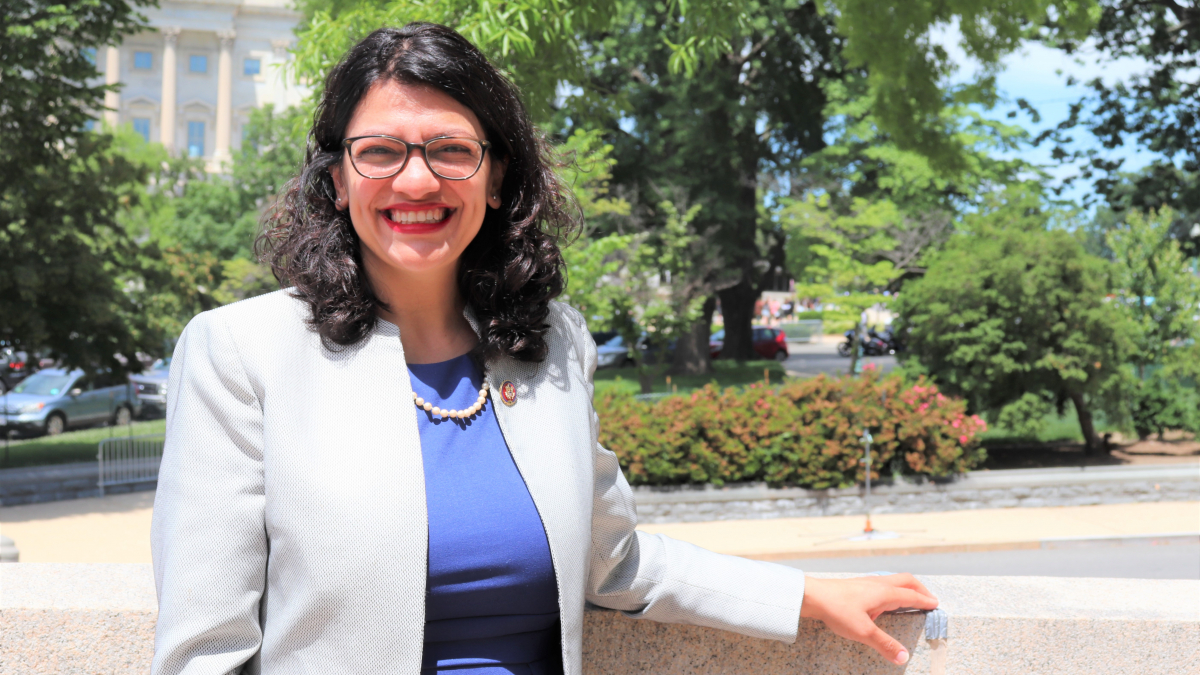
The Squad is a group of four women of color in the House of Representatives known for their efforts to push Washington Democrats towards more progressive policies. The four Congresswomen–Reps. Ilhan Omar of Minnesota, Alexandria Ocasio-Cortez of New York, Rashida Tlaib of Michigan, and Ayanna Pressley of Massachusetts–seemed to gain more popularity on social media after their comebacks to Trump’s derogatory remarks regarding their heritage. He falsely implied that they weren’t American and suggested they “go back and help fix the totally broken and crime infested places from which they came” (CNN). 

But, these women have made it clear they aren’t going anywhere. In fact, all four were recently re-elected.

Who Are They?

Alexandria Ocasio-Cortez (AOC) (Rep. of New York’s 14th Congressional District–the Bronx, Queens, and Rikers Island)

AOC became the youngest woman (and youngest Latina) ever elected to Congress after defeating ten-term incumbent Democratic Rep. Joe Crowley (CNN). 

In addition to being a member of the Democratic Socialists of America, she introduced the Green New Deal, which “outlines the framework for combating climate change by creating millions of jobs in new green industries as well as transitioning to new energy sources and building new infrastructure” (Ocasio-Cortez.House.Gov). 

She has also worked with others, such as Bernie Sanders, on more progressive ideas like Medicare for All, a $15 minimum wage, and student loan forgiveness. She has called for abolishing Immigration and Customs Enforcement (ICE) due to the harsh conditions in our southern borders’s detention centers (CNN). 

Rashida Tlaib (Rep. of Michigan’s 13th Congressional District–Detroit and its surrounding areas)

Tlaib is the first Palestinian-American woman to serve in Congress. Like AOC, Tlaib has embraced Progressive ideas like Medicare for All, a $15 minimum wage, debt-free college, and the abolishment of ICE. 

She has also gained a significant amount of social media attention after her controversial comments regarding sanctions and boycotts on Israel. 

Ilhan Omar (Rep. of Minnesota’s 5th Congressional District–Minneapolis and its surrounding areas)

Ilhan Omar is the first Somali-American ever elected to Congress. She and Tlaib are also the first two Muslim women ever elected to Congress. She came to the United States two decades ago after fleeing her homeland as a refugee. She then became a US Citizen at the age of 17 (CNN). 

Similar to AOC’s journey to politics, she ran with the support of the Justice Democrats (a Progressive political-action committee). She is also a proponent of Medicare for All, abolishing ICE, tuition-free college, and $15 minimum wage. 

Ayanna Presley (Rep. Massachusetts’s 7th Congressional District–Boston, Cambridge, and surrounding areas)

Pressley is the first black congresswoman to represent Massachusetts after defeating twenty-year incumbent Rep. Mike Capuano (CNN). 

Pressley’s passion for politics greatly stems from personal experiences. For example, she often speaks about her father being incarcerated for much of her childhood and how she is a rape survivor. 

Pressley is also known for speaking out about the poor conditions of detained migrants at the Texas border, and she has called upon Democratic lawmakers to take action. 

How Do These Women Represent the Future of Politics?

According to the New York Times, the Squad represents a more inclusive and representative future of politics. “The Squad understands that ‘diversity’ is meaningless if the measure of success is ‘sameness.’ The Congresswomen are choosing to do politics a different way because they recognize that Congress has never worked for their communities.” By bringing in voices from communities Congress has never heard from before, it is possible that the future of politics will finally serve communities of color rather than silence them; “…inclusivity means that people from different communities, backgrounds and ideological traditions will do their jobs differently and will bring new sensibilities, commitments and understanding with them when they sit at the tables of power. If they are doing their jobs, they will be accountable to people who sent them there, not maintaining the status quo” (The New York Times). 

The Squad also greatly represents the visions of the young people of our nation who tend to prioritize equality and climate change. Many say that the Squad’s ideas for Progressive policies represent the future of the Democratic party, even though the party seems to look more moderate at the moment. This is obviously frustrating for these Progressives, but according to Conor Lamb (Democrat Representative of Pennsylvania), more moderate policies are needed to unify the country in its current state (New York Times). The future could possess these ideals, especially as the younger generation starts to fill seats in Congress.

Sources:

https://www.cnn.com/2019/07/15/politics/who-are-the-squad/index.html

Image Sources: 

https://apnews.com/article/f80a96ce79934860936ebdc2127c28fc

https://i.insider.com/5fa2a2a469331a0011bc731c?width=1000&format=jpeg&auto=webp

https://tlaib.house.gov/about

https://www.theatlantic.com/ideas/archive/2019/08/where-ilhan-omar-failed/596743/

https://www.wbur.org/news/2019/03/30/ayanna-pressley-democrat-committee

Future of Politics Editor: Jake Sonderman

Filed Under: Politics Tagged With: Sara Habibipour, The Squad: Who Are They and What Future Do They Represent in American Politics?

A Review of Braiding Sweetgrass

November 17, 2020 by szachik@pvs.org 3 Comments

For this week’s theme of “Wilderness,” Sara shares a favorite read that encompasses the beauty of nature, the learning of science, and the wisdom of indigenous people.

By Sara Habibipour

Braiding Sweetgrass: Indigenous Wisdom, Scientific Knowledge, and the Teachings of Plants is one of my new favorite books. It is written by Robin Wall Kimmerer, a Native American woman and biologist. As a botanist, the author has been trained to view the world and its inhabitants through a scientific lens. But, as a member of the Potawatomi nation, she teaches her students that there’s more to plants than just bodies; they have spirits. 

Plants have been on this earth longer than we have, so we must listen to them, especially if we want to save our earth from the destruction we humans have inflicted through our selfish activities. It’s not too late yet to reverse the damage we’ve done to nature. But, if we want to make positive progress, we must learn from those who don’t take nature for granted: the Natives. 

In the book, Kimmerer draws on her experiences as an indigenous woman and scientist to show how other living creatures all share their gifts with us. In order to gain a wider scientific and ecological understanding of what must be done to save our earth, we must learn to appreciate each being’s gifts. Not only that, but we must show appreciation for these gifts by giving back and establishing a reciprocal relationship with the earth. It is only then that we can restore our lost relationship with nature. 

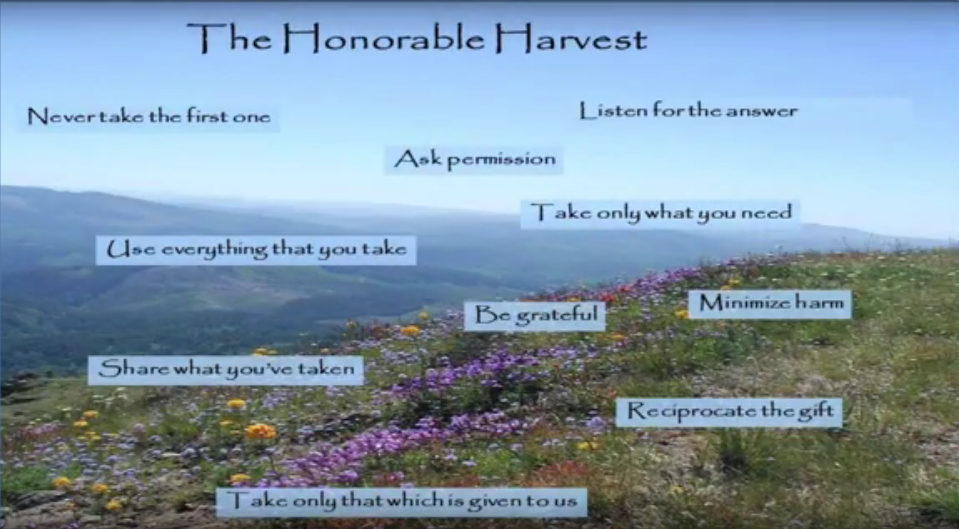
In Potawatomi culture, there is a practice called The Honorable Harvest. It is a set of unwritten rules that guide how much to take from the earth so as to not deplenish all of its resources for future generations. 

In the culture, before taking anything from nature (a plant, a deer, etc.), one must not take the first creature they see; this ensures that an endangered species is not being killed. One must also ask the being if it’s okay to take its life. If there’s no sign or gut feeling that it should not be taken, then it’s okay to use. Finally, you must use all of what you take and share it with others so as to not waste any part of it. 

In a capitalist society, we are raised to believe that taking from the earth is normal. But, this book is trying to tell us that if we can just recognize the destructiveness of our greedy nature, then we can all “become indigenous” and save our earth. We can all give back.

If you love nature, and if you appreciate science, I highly recommend that you read this book. I’d love to discuss it with you!

Wilderness Editor: Hannah Hall

Image Source: 

The Honorable Harvest: thinking more mindfully about what it means to be a consumer, forager, hunter, human

Filed Under: The Outdoors Tagged With: A Review of Braiding Sweetgrass, Sara Habibipour

Why Don’t You Go Take a Hike?!

November 17, 2020 by szachik@pvs.org 1 Comment

Editor Hannah likes “being outside a lot.” She recognizes the benefits of the outdoors, so she assigned “Wilderness” as a topic for her Blog Staff. Evan, too, finds the outdoors beneficial. Let him explain.

By Evan Spry

As time has evolved, being out in the wilderness has become a lower and lower priority on the list of things to do. Nowadays, it is so low on the list of priorities it contributes to our growing unhealthiness. According to the CDC, in 2017-2018, 42.4% of American adults were obese (CDC.gov). I truly believe that, among other things, a lack of outdoorsiness hurts. It is so interesting that something that would seem so primal and instinctive would be this absent in most of our lives. The reason is that many of us would chuckle at the proposition of going to the wilderness with your friends or family just to be in nature. Many people would rather sleep on a comfortable mattress with a TV hanging on their wall with access to the almighty microwave than sleep in a sleeping bag on the ground with a campfire as your only heat and light source at night. I don’t blame these people at all. I mean, there is a reason all of us live in buildings with electricity and running water. Progress is a thing that is important. I don’t think the solution to our unhealthiness is to completely revert back in time and live in caves. The solution is that we should spend a chunk of time in the wilderness. The reason spending time in the wilderness is important is because when you’re really there, and all that is on your mind is adapting and surviving, you forget about all your “real world” problems and return to a primal state of acceptance and awareness. You learn to love and appreciate the natural world and its gifts. You live in the day and sleep in the night. You are surrounded by a completely different energy than that of a big city. It is an organic energy that feels refreshing and pure. Soon, you get used to living and surviving like your ancestors did so long ago. Every action you take to increase your chance of survival in the wilderness feels like a huge victory. Also, when you’re not distracted by the noise and light pollution of the city, everything seems right, everything is peaceful. It is dark out when it’s supposed to be and light out when it’s supposed to be. Something that most people don’t realize is that putting yourself through the nice experience of camping in the wilderness is an effective meditation. Like I said, you’re not worried about the problems of the “outside world” if you have to survive in the wilderness. When you are able to think about those problems, you have a much different perspective….You have the perspective of a survivor. So, I urge you to go out and experience the wilderness. Survive in it. If you don’t find an amazing and meditative experience, then I am sorry. However, I think it is important to connect to our natural world and rhythms.

Wilderness Editor: Hannah Hall

Source Referenced:

CDC

https://www.cdc.gov/nchs/products/databriefs/db360.htm#:~:text=Among%20men%2C%20the%20prevalence%20of,those%20aged%2060%20and%20over.

Filed Under: The Outdoors Tagged With: Evan Spry

Wilderness Words

November 16, 2020 by szachik@pvs.org 2 Comments

Editor Hannah told blog writers to think about, write about, and embrace the “Wilderness.” Elizabeth searched the globe and found some of the most beautiful and unique nature/wilderness words from various languages.

By Elizabeth Shay

  • Feuillemort– (n.) the color of a dying leaf

Deriving from the French term, feuille morte (dead leaf), this word refers to the brownish-oranges and reddish-yellows seen as trees shed their leaves in the fall.

  • Petrichor- (n.) the smell of earth after rain

The word is Greek in origin. We don’t get much rain here in the desert, but, still, you can save this word for a rainy day. When it does rain here, the air is pungent with creosote and damp desert.

  • Frondescence- (n.) the condition or period of unfolding of leaves; foliage

From the Latin frondescere (to become leafy), this word describes a phenomenon that is reminiscent of springtime plant growth.

  • Weald- (n.) a wooded, uncultivated area; forest

This word was first used before the 12th century, in the days of Old English, as a general term for “forest.”

  • Nemophilist- (n.) a person who loves the woods or forests; a haunter of the woods

This word is obscure and hasn’t really been used for over 100 years. Not to be confused with: Dendrophilous- (adj.) loving trees; living in or on trees.

  • Psithurism- (n.) the sound of the wind through the trees and rustling leaves

This word is imitative, and ultimately comes from the Greek word psithuros which means “whispering.” Unfortunately this word is obsolete, but maybe we can help it make a comeback.

  • Gökotta- (n.) the act of rising early in the morning to hear the birds sing at sunrise and appreciate nature (rendezvousmag.com)

This is a Swedish word that is unlike any word we have in English and describes a specific concept so perfectly.

  • Komorebi- (n.) sunshine filtering through the leaves of trees (theculturetrip.com)

Social values, aesthetics, and culture are largely intertwined with the Japanese language. There is no English equivalent for this word which holds so much meaning in eight letters.

  • Shinrin-yoku- (n.) a visit to the forest for relaxation and to improve one’s health

This is another word from the Japanese language and translates to “forest bath.” The Japanese people often practice forest bathing, opening their senses and connecting with the natural world.

  • Waldeinsamkeit- (n.) the feeling of solitude in the woods

From Wald (woods/forest) and Einsamkeit (loneliness), this German word, much like the Japanese word above,  is about creating a one-on-one relationship with nature and refers to a very specific feeling. 

Hopefully you learned something new, and these words made you think about nature. Comment on this post, and then go outside!

Sources:

https://www.merriam-webster.com/

https://en.wiktionary.org/wiki/nemophilist

https://theweek.com/articles/442920/10-unusual-nature-words-should-use-more-often#:~:text=Psithurism%2C%20the%20sound%20of%20rustling,whispering%20or%20rustling%20in%20general.

Gokotta- Foreign words with Beautiful Meanings
https://theculturetrip.com/asia/japan/articles/20-japanese-words-that-will-make-you-think/

https://time.com/5259602/japanese-forest-bathing/

Words Beyond Translation: Waldeinsamkeit

Wilderness Editor: Hannah Hall

Filed Under: The Outdoors Tagged With: Elizabeth Shay, Wilderness Words

The 10 Essentials

November 13, 2020 by szachik@pvs.org 2 Comments

Thinking of escaping into the wild this weekend? Jake has the essentials you should bring along with you.

By Jake Sonderman

For any backpacking or camping trip in the wilderness, there are 10 things you must bring. These 10 things could be the difference between life and death in a survival situation, but they could also be the difference between having a pleasant hike and being miserably uncomfortable. While I am no wilderness survival expert like some other people in the senior class, I have been a Scout since middle school and have recently finished my Eagle Scout. Early on in Scouting, you learn the importance of always having these 10 things on you when venturing out into nature. The Scout motto is “Be Prepared”; and with these 10 things, you will be prepared for anything the wilderness throws at you.

  1. Navigation

In the days of electronic navigation and GPS, maps have become obsolete. But, in the wilderness, batteries only last so long. While it is definitely smart to bring an electronic navigation device, you should make sure to not only bring a physical map and compass, but the skill to use them. Bringing proper navigation tools and knowing how to use them helps you to not get lost, which, in the wilderness, is very dangerous.

  1. Knife

Food, Fire, Shelter–the knife is the most versatile tool and absolutely necessary for feeding, sheltering, producing warmth. A multi-tool–like a Swiss Army Knife–is also very useful, though you should probably bring one or the other and not pack the weight of both. 

  1. Fire

Waterproof fire starters are a commonly forgotten item but 100% necessary for any trip. Fire is needed to cook food, melt snow, purify water, and provide heat, among other things. I always carry matches in a waterproof case, but a better option is probably a disposable butane lighter. The lighter is most waterproof. If water gets into your match case you’re pretty screwed. The lighter also gives you more lights than matches will. It is also a good idea for cold/wet weather to gather some dry tinder and put it in a plastic bag. This will make starting a fire significantly faster and easier. Another common solution is to put some cotton balls soaked in petroleum jelly in a small container. They are good fire starters. Please do not forget this; it is so extremely hard to start a fire without a fire starter, and it is highly likely you won’t be able to do it your first try (I’ve never lit a fire without a fire starter). If you do find yourself without a fire starter, your best bet is probably to make a small bow to spin your wooden spindle. Check out this video on how to do that: https://www.youtube.com/watch?v=dptkV1mYZU0 

  1. Water 

How much water you should be drinking will differ on where you are camping/hiking. Always, though, bring at least a one-liter water container and a way to purify more water–the best probably being water purification tablets. 

  1. Sun Protection

This is definitely the most forgotten item, especially in cold environments. It is always important to have protection from the sun not just to shield yourself from sunburn, but to prevent skin cancer and potential dehydration. Sun protection includes a lot of things, such as sunscreen, hats, clothes, sunglasses, etc. If you’re somewhere cold, you probably won’t need as much sunscreen because of your clothes, but the sun can still get you where you’re not covered and can even reflect off the snow to burn you. 

  1. Headlamp

This category used to be “light,” but headlamps are the best option for light by far, so you can do other things with your hands while you have light. It also is smart to bring some extra batteries for a longer trip. 

  1. First Aid

It is not only important to bring a first-aid kit but to know first aid, especially for wilderness situations. Also make sure that your kit is fully equipped. There are many short courses you can take to learn first aid, and getting CPR certified is a good idea, too. It would be good to know what to do for small and large cuts, shock, hypothermia, and dehydration.

  1. Shelter

The Boy Scout handbook actually says “rain gear” for this one, but many people put “shelter” instead, and I am inclined to agree. It is very important to carry a rain shell at all times because you never know when it will start raining. Obviously, your tent is also pretty important if you are camping, but make sure you also have the proper stakes and a rain fly for your tent to shelter you from the elements. It is also important to always have some small emergency blanket or, even better, a small bivy sack, which is basically a very small tent/sleeping bag. You should always have shelter ON you, and not just back where you set up camp. 

  1. Food

This varies on where you are going and how long you will be there. It is necessary to always have these certain ready-to-go foods on you: bars, nuts, dried fruit, beef jerky. Additionally, if you have a bunsen burner, or another way to cook food, then oatmeal, hot cocoa, and other small things are good options. Always bring more food than you need. 

  1. Extra Clothes

This obviously varies a lot depending on where you are going. For every trip I always bring an extra pair of socks (trust me there are not many things worse than hiking in wet socks). For cold trips, some long underwear isn’t a bad idea either. It adds an extra layer. 

Bonus: Duct Tape

This one was listed in the Scouting magazine, and I instantly thought “of course.” Duct tape has come in handy so many times, mostly with fixing water containers and clothes/tarps. While this might not sound huge, having a leak in a tent or your water bottle can be absolutely devastating, leaving you or your stuff totally soaked.

Note: All of these things are totally necessary, but it is also important not to overpack. Overpacking only applies to backpacking, not car camping. The right weight for a loaded backpack is about 20% of your body weight. There are pretty lightweight options for all of the items listed above, and it is smart to split up different items like your tent and food if you are camping with multiple people. 

Wilderness Editor: Hannah Hall

Sources:

https://scoutingmagazine.org/2019/08/the-10-essentials-a-21st-century-update/
The Scout 10 essentials: Items every Scout needs in the outdoors

https://www.mountaineers.org/blog/what-are-the-ten-essentials

The Boy Scout Handbook(2012 edition). 

Filed Under: The Outdoors Tagged With: Jake Sonderman, The 10 Essentials

  • « Previous Page
  • 1
  • …
  • 55
  • 56
  • 57
  • 58
  • 59
  • …
  • 128
  • Next Page »

About

We are the Palm Valley Firebirds of Rancho Mirage, California. Join us in our endeavors. Venture through the school year with us, perusing the artwork of our students, community, and staff. Our goal is to share the poems, stories, drawings and photographs, essays and parodies that come out of our school. Welcome aboard!