the bird on fire

The Palm Valley School Student Blog

Subscribe to Blog via Email

Enter your email address to subscribe to this blog and receive notifications of new posts by email.

Powered by Genesis

Air Fluffs

May 7, 2020 by szachik@pvs.org Leave a Comment

By Luke Langlois

When I was tasked with writing about happiness, I had no idea what to write about. Obviously, happiness is different for everyone, and, sometimes, we’re not even sure what happiness feels like when we truly are happy. So, I consulted an outsider, ex-blogger Claire Jenkins, for an idea. Being the purveyor of happiness and the pilot she is, she said to write about “clouds or something.” Perfect.  While they are not going to buy you a new car, clouds are fascinating, and a beautiful strain of clouds is bound to make you stop and take a look.  Moreover, unless you are fresh out of a science class (or pilot training), it is likely that you have forgotten your cloud types! Let us take a scientific look at the types of clouds that can roam the air with some lovely examples that hopefully make you want to look to the skies yourself.

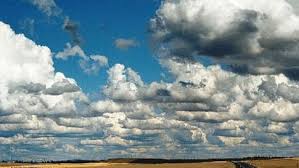
  • Cumulus clouds are the “figurehead” of clouds. They are sometimes known as the “fair weather” cloud because they appear on clear, sunny days when the sun is able to heat the ground directly below. If you can see these clouds, be grateful because you are experiencing some swell weather.
  • Sky Watching: Cumulus Clouds | The Weather Channel
  • Stratus clouds may not represent happiness to most of the world’s population because they cover up the sky and hang low. Luckily for us desert folk, stratus clouds represent light mist or a drizzle of rain, so they should represent happiness because everyone loves a bit of water. 
  • Science Source - Stratus Clouds
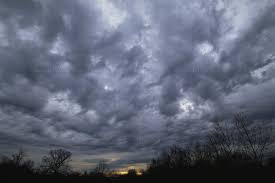
  • Stratocumulus clouds are a bit of a hybrid between the above two (given the name). They cover the sky, but not as wholly as the stratus clouds. Stratocumulus clouds leave gaps in the sky where blue peeks through. These clouds are seen on days of low atmospheric convection. 
  • Stratocumulus clouds - Met Office
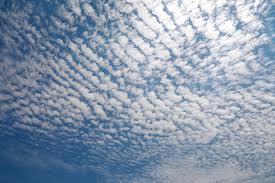
  • Altocumulus clouds are smaller fluff puffs in the sky. They are often confused with stratocumulus, but they do not cover as much of the sky and the individual clouds are smaller. These are not a frequent sighting in the desert, as they usually appear on hot and humid days when a thunderstorm or cold front is to follow.
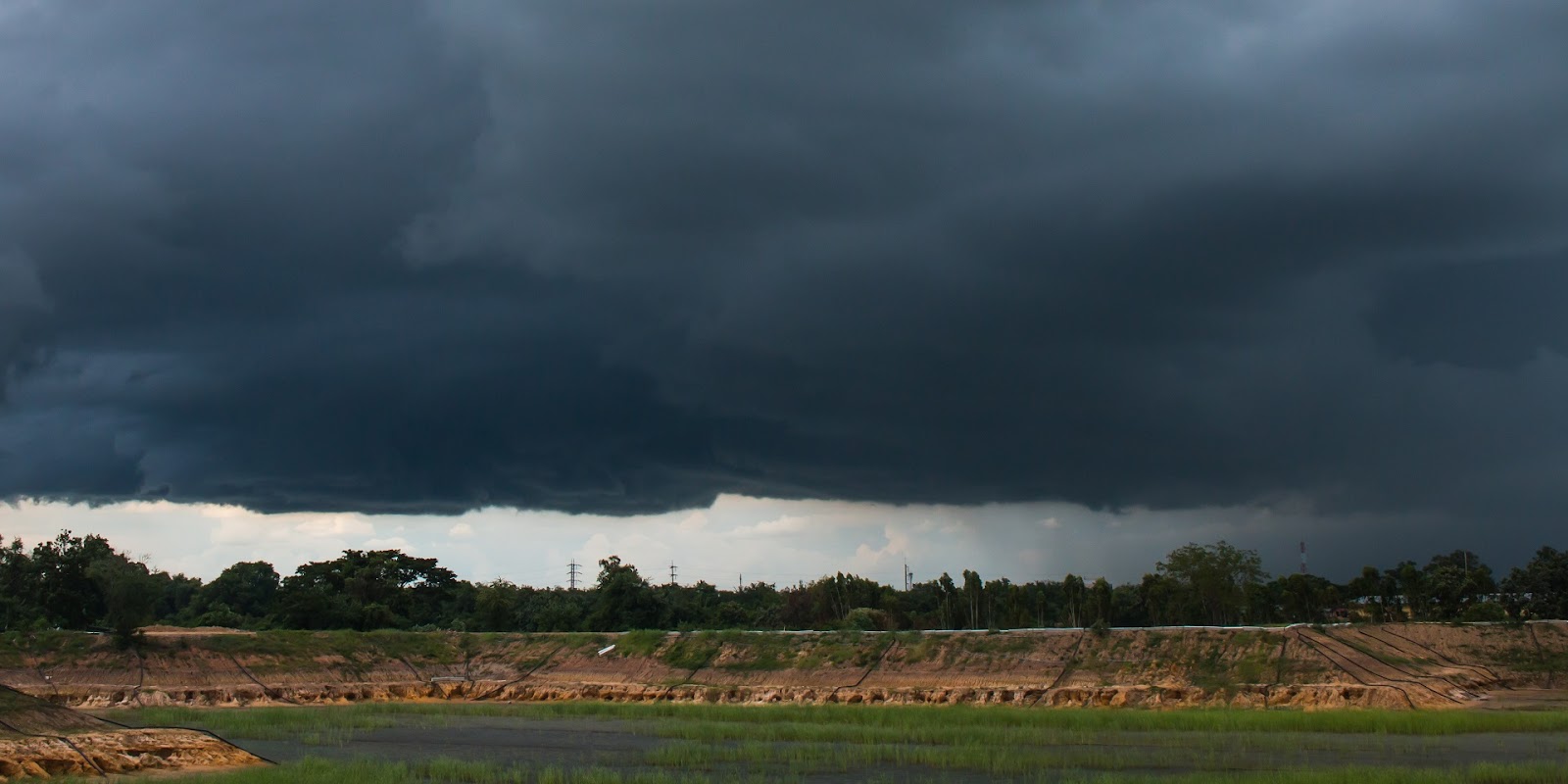
  • Nimbostratus clouds are THE rain or snow cloud. They’re dark, hazy, and ominous-looking, but they are absolutely majestic.
  • Nimbostratus clouds - Met Office
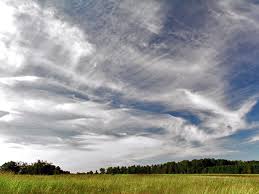
  • Cirrus clouds, Latin for “curl of hair” clouds, are thin wisps of ice crystals that streak above 20,000 feet (an altitude with low temperatures and low amounts of water vapor). They usually appear in fair weather, but they can indicate warm fronts or perhaps even a cyclone, not exactly a reliable measure of what is to come.
  • Cirrus cloud - Wikipedia
  • Cirrocumulus clouds cannot be well-described outside of a picture. They are small white patches of clouds that “live” in high altitudes like the cirrus clouds. Some say they look like small grains dotting the sky. These clouds tend to appear in cold, but fair, weather. 
  • Cirrocumulus definition and meaning | Collins English Dictionary
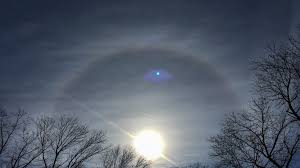
  • Cirrostratus clouds are white-ish and transparent clouds that cover the entire sky. It may be hard to identify the clouds by the clouds themselves, but cirrostratus clouds form a halo around the sun or moon due to the refraction of the light on the ice-crystals that make up the clouds. They indicate a large amount of moisture in the upper atmosphere or a potential warm front. 
  • Cirrostratus Clouds: Pale, Veil-like Layer | WhatsThisCloud
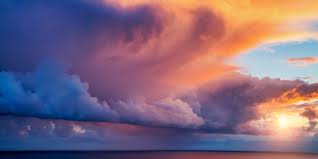
  • Cumulonimbus clouds are the proper behemoths of the cloud family. They are one of the few clouds that span the low, middle, and higher layers of the atmosphere. They generally resemble the cumulus clouds (from which they originate), but they rise and expand further upwards and downwards. These clouds are thunderstorm clouds and can indicate short periods of severe weather. 
  • Cumulonimbus clouds - Met Office
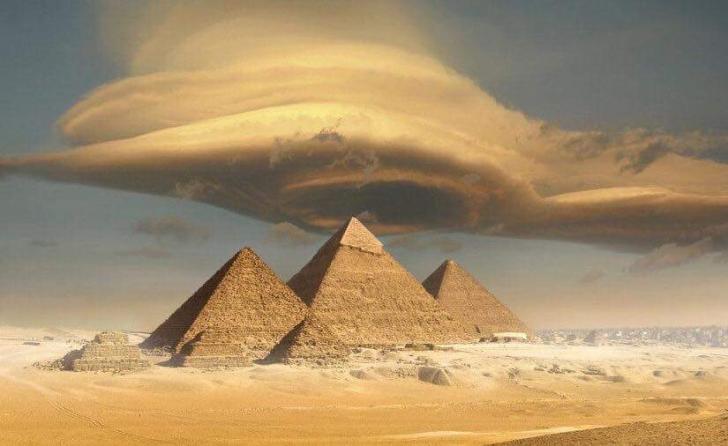
  • Bonus: Lenticular clouds are a rare formation, forming downwind of an “obstacle” in the path of a strong air current. They often form near mountainous regions because mountains can often be the “obstacle” required for formation.
  • Lenticular clouds over the Great Pyramids of Giza

If you have read this and are not a science teacher, pilot, or general cloud enthusiast, there is no doubt that you have learned something. Congratulations, you have officially had a productive day! I now encourage you to go outside and spot these clouds with your own eyes, predict the weather, or just relax. If it’s a cloudless sky, which it often seems to be as we descend into 100-degree weather, then you can go and be rightfully sad. 

Source

https://scied.ucar.edu/learning-zone/clouds/cloud-types

Happiness Editor: Chelsea Xu

Filed Under: Happiness Tagged With: Air Fluffs, Happiness, Luke Langlois

Doomsday Poem

May 5, 2020 by szachik@pvs.org Leave a Comment

Love Billy Collins? Well, this isn’t quite Billy Collins. It’s Quintus Ni’s take on the end of the world. Says Shirley Sun, “A little bit dark, but it’s very attractive. LOVE the last part of this poem!!”

By Quintus Ni

Tilting earth,

Churning sea,

Erupting volcano,

Doomsday is coming.

Life is approaching an end:

Carnival!

The city’s dignity is falling;

The proud civilization is crying:

Crazy!

The heaven and the earth change their position.

The sun is no more rising.

Everything is swallowed unscrupulously by water and fire.

The monsters are busy escaping

With no time left for  biting.

Proud and humble

Are fleeing on the road.

Truth, kindness and beauty, and the false, the ugly and the evil

All destroyed together,

With only a pile of ruins remaining,

Nothing is left.

And there’s no room for brash fire.

Everything is in peace.

No hunger or war–

No more suffering or tears will be left.

I am sitting at the luxurious crystal table

Enjoying the last supper

And appreciating the collapsing world

As if it is a wonderful drama–

That rebirth in despair

Accompanied by the violent symphony.

Doomsday Editor: Doreen Yuan

Filed Under: Doomsday Tagged With: Doomsday Poem, Quintus Ni

Does Doomsday Have a Silver Lining?

May 5, 2020 by szachik@pvs.org Leave a Comment

By Katelin Mei

In these times, it must feel like it is nearing the end of the world. We are all stuck in our homes (I hope) trying to stay safe from the coronavirus. Life has changed dramatically. It may seem just like the end of the world to some people.

With all this negativity surrounding us, it may be hard to look on the positive side. However, no matter how bad things become, there is always a positive.

The effect that humans have on the environment is truly showing. As more of us stay at our homes during the pandemic, the Earth has been healing. The pollution from factories in China is decreasing; the canals in Venice are clear again, and the ozone is healing itself.

Air Pollution in China Drops Dramatically During Coronavirus ...

Some people do not believe we have an effect  on this planet, but we have shown exactly what happens when we remove ourselves from the world. I only hope that once the pandemic is over and people emerge from their homes that we realize the effect we have on our planet and become more mindful of preserving it.

Doomsday Editor: Doreen Yuan

Filed Under: Doomsday Tagged With: Does Doomsday Have a Silver Lining?, Katelin Mei

Doreen’s Favorite Book: Doread

May 5, 2020 by szachik@pvs.org Leave a Comment

Doing much reading during quarantine? Doreen has a suggestion for you to add to your bedside table.

By Doreen Yuan

Today, I would like to recommend a book called The Kite Runner. This is the first work of Khaled Husseini, an Afghan-American writer. It caused a sensation immediately after it was published in the United States in 2003. In 2006, this moving story was introduced to China and became a bestseller that moved millions of readers. For ten years, this book has meant a good time reading for countless readers. The sad and happy separation of the protagonist Amir and Hassan has deeply affected the hearts of readers, and, according to the book cover I was reading in China, it is the life-long five-star novel “most wanted to share with friends.”

Spoiler Alert: The story is about a young man who is eager to be recognized by his father and his servant like-a-brother friend. Because of his cowardice and timidity, the young man committed a crime that required atonement. The novel not only recollects his experience, it includes political events between countries–America and Afghanistan. There is description of hierarchy and racial discrimination. After reading the novel, my biggest feeling is that I realize the cruelty of the war, which has broken Afghanistan, separated its people and destroyed their families.

In the main description of the novel, the saddest part is the fate of Hassan’s father and his son, not only because of the humiliation of the hierarchical class and racial discrimination, but also because of the cowardly behavior of the protagonist. Loyal, honest, optimistic Hassan and cowardly selfish Amir make me lament the injustice of fate. To expiate sin, can Amir really atone? Stealing, in the novel, is unforgivable. Perhaps for the suffering person, atonement is just the memory of the sin stolen by the sinner, but the kind Hassan chooses to forgive.

Each of us should have a kite of our own, which can represent family, friendship, love, integrity, kindness and honesty. For Amir, the kite metaphor is an essential part of his personality. Only when we catch up with our own kite, we become a sound person. The beginning and the end of the novel are overlapped and become two similar pictures: the vast sky, the snowflakes falling, the air cold and clear, the kite chasing, children running with laughter, chasing the flying light and shadow. This scene is played out repeatedly in different regions and between different generations, but between each repetition, life has undergone dramatic changes. With the change of the protagonist’s fate, this picture has been continuously dyed with new colors, falling from the naive vision of children into the sadness of the transformation of world affairs.

Maybe the ending of the story is not perfect, maybe a little bitter and sour. But life is like this. We make mistakes, miss again, and then use life to save life.

Favorite Book Editor: James Zheng

Filed Under: Favorite Books Tagged With: Doreen Yuan

Apocalypse Survival Kit!

April 30, 2020 by szachik@pvs.org Leave a Comment

By: Chelsea

No matter if it is a zombie apocalypse, nuclear outbreak, global pandemic or asteroid strikes, we all need some tips to survive these difficult times. Well, you found just the right post to help you do exactly that!

Water

Keeping bottled water (at least two 8-packs) in your garage is essential during the apocalypse. Water is the one thing that you cannot live without, along with food.

Canned food

Having canned foods in your storage would be essential as well, especially if the situation arises where you cannot go out to buy stuff. Gather cans as much as possible.

Gas mask (nuclear outbreak)
Gas masks are needed during a nuclear warfare since there’s radiation in the air. You should wear a gas mask no matter where you are, even at home if your house is close to the nuclear active zone.

Weapon

Having weapons on hand is extremely helpful during a zombie apocalypse. Usually having the deadier the weapons are better because you are going to knock some zombie head off.

Facemask

Facemasks are important during a pandemic, especially when some types of virus are carried in the air. Putting facemasks on helps to decrease the air particles that are coming into your lungs thus decreasing the likelihood you are going to get the virus. Still, stay away from huge crowds or big social gatherings. Stay safe everyone!

Some sort of communication

It’s always good to keep some sort of communication to the outside world in your grasp, especially when you are living alone. Having communication to the outside world is important because it can help you keep an update on the current situation.

Some sort of transportation

Having some sort of transportation is very important in apocalyptic situations. It can help you get far or help you escape dreaded situations. 

Toilet paper

Last but not least, toilet paper. What can I say? Toilet paper is quite important after all, no matter how serious the situation is.

Doomsday Editor: Doreen Yuan

Filed Under: Doomsday Tagged With: Apocalypse Survival Kit!, Chelsea

What happens after Doomsday?

April 28, 2020 by szachik@pvs.org Leave a Comment

By James Zheng

Doomsday always sounds like it will never happen. However, it is reasonable to speculate what aftermath doomsday could bring and be prepared to face it. But in this post, the main focus is not giving some “science-fiction” ways we could use. You might have heard things like time-travel, someone’s random superpower, or even like some confidential files that determine human fate. These are unrealistic! So, in this post, I am only going to point out some realistic methods that could possibly save human civilization (or not). 

Nuclear Fission. Nuclear fission, also known as nuclear division, is the change of one nucleus splitting into several nuclei. Only some very large nuclei such as uranium, thorium and plutonium can work with the fission. After absorbing a neutron, the nuclei of these atoms will split into two or more nuclei with smaller mass. At the same time, they will release two or three neutrons and an immense amount of energy, which can make other nuclei undergo nuclear fission. This process is called chain-reaction (like trigger-to-trigger). When nuclear fission occurs, the nucleus releases huge amounts of nuclear energy. To give you a concept of how much energy is released, the energy produced by one kilogram of uranium could keep a nuclear power plant running for one thousand hours. Why should nuclear fission be mentioned here? Well, if we think about what has forged the human civilization of technology today, once the doomsday comes, nuclear fission could support humans to rebuild everything. If humans master use of nuclear fission, it is infinite energy. Without energy, it will be infinite regression. 

Space Colonization? Kepler-452b is a wonderful astronomical discovery achieved by NASA in 2015. It is considered to be the only planet that contains 83% similarity to Earth’s structure. It is located in a constellation called Cygnus, fourteen thousand light years from the Earth. This seeming “habitable” planet, which revolves around the sun like a star and is about the size of Earth, may have a similar atmosphere and flowing water resource. Although many people misunderstand this planet as a second Earth, it has never been officially claimed that by NASA. However, it is a possible hope for planet migration.

The Man-Made Sun. Or International Thermonuclear Experimental Reactor, now that is us as humans playing God. This project was actually started in 2003. It involves a cooperation program that puts many countries in the same spot. It is estimated to cost five billion dollars and will take ten years approximately to complete. The Man-Made Sun is related to nuclear fission by way of the same aspect of learning to manipulate nuclear power. When doomsday comes, to maintain or rebuild ecological systems and to have the positive effects from the sun as usual, man-made sun may be indispensable.

So, there you have it. Now your question might be: does it mean that reading this post could possibly save my life? Well, unfortunately, probably not, because I do not think there is a doomsday, at least not yet. And plus, it depends on what form doomsday would take. But, I do keep an optimistic view towards the future. There better not be a real doomsday. Still, I hope you learned something . . . just in case there is. 

In times of calamity, we always have new solutions, just like the three examples I give you. Especially during this harsh time, I hope you stay safe, and trust each other. 

Doomsday Editor: Doreen Yuan

Filed Under: Doomsday Tagged With: James Zheng, What happens after Doomsday?

Happy National Poetry Month

April 23, 2020 by szachik@pvs.org Leave a Comment

In honor of this month ‘o poetry, I asked Bloggers to share their favorite poems. Chelsea found her favorite Longfellow delivered in delightfully lively fashion. The following clip comes from Poetry Out Loud finals.

Filed Under: Something to Think about Thursday Tagged With: Longfellow, National Poetry Month

In honor of Shakespeare’s birthday . . .

April 23, 2020 by szachik@pvs.org 1 Comment

For our “Something to Think About Thursday,” I asked Blog Staffers to share a favorite poem, as it is National Poetry Month. Luke went a step further. Not only does he share some pretty famous verse, he celebrates Shakespeare on Shakespeare’s Day. Here is James Earl Jones performing a monologue from Othello.

Filed Under: Something to Think about Thursday Tagged With: National Poetry Month, Shakespeare

Quintus’s Love for All Things Romantic: Wuthering Heights

April 23, 2020 by szachik@pvs.org Leave a Comment

When Editor James asked the Blog Staff, “What’s your favorite book?” Quintus responded with Wuthering Heights.

By Quintus Ni

When there is love in your heart, everything is beautiful in your eyes; when there is darkness in your heart, everything is ugly. In Wuthering Heights, by Emily Brontë, the hero Heathcliff, who became hostile because he couldn’t get love, performs a lot of unsympathetic revenge. However, he finally gets a release because of the power of love.

The wilderness, the west wind, the distant towns, the broken grass, the rough terrain, the bleak sunset, the sequestered life, the hard journeys, the lonely years, all that Emily Brontë had, had no glory — at least in the days of her life — she went though twists and turns, ups and downs, and with her dreams died.

This talented woman who died young would never have imagined that, after her death, Wuthering Heights, her only novel, would be remembered as the “most peculiar novel” and become one of the brilliant precious gems of British literature of the 19th century. Today, it has still won over millions of readers with its magnificent and moving splendour, who are deeply shocked by its special artistic charm.

All the time I was reading, I was wondering whether Cathy loved Edgar. If yes, how could she love another, when she loved Heathcliff so strongly and so deeply? Through repeated perusal of her words, I have come to understand that she liked Edgar, as I like Edgar, for he is handsome, rich, young, and active.

The love between Heathcliff and Catherine Earnshaw can be described as “infatuation.” The sunshine, sweetness, and laughter are not the main part of their love, while the dark hatred, misunderstanding and resentment are mixed into the main color of their love, creating their crazy love.

Heathcliff is me, said Catherine, and I am him….This kind of love was not understood, accepted, or allowed by others, so they constantly struggled, fighting with everything around them, but they were tortured and bullied in the real life, as Heathcliff was treated as an inferior, a wild child without status, background or cultivation, who was deprived of the right to enjoy a good life, rudely beaten and insulted for his street urchin’s humble birth. He had given up all hope of being a decent gentleman. And Catherine was an honorable young lady.

Emily Brontë deliberately created an eerie, nightmarish, exaggerated atmosphere. Some of the plots seem to have queer mystique from an unreal world. The soul, the ravings, the hallucination, and the nightmare give the story a layer of legend, incisively and vividly showing the deepest infatuation, the most crazy persistence, and the most painful struggle. The wind and rain, the snow, the night, the wild nature and the stirring emotions of the characters complement each other. The bleak wilderness is profound, changeable, gloomy and sorrowful, which highlights the personality traits of the characters and shows the deep love from human nature. The impermanence and boundless love of the hero, Healthcliff, like nature, takes a deeper root in the hearts of characters and readers. With her exquisite thoughts and feelings and the superb artistic techniques, Emily Brontë created a soul-stirring tear-jerker with strong artistic appeal. In this way, Wuthering Heights made Emily Brontë well-known all over the world.

Favorite Book Editor: James Zheng

Filed Under: Favorite Books Tagged With: Quintus Ni

Cold Weather Exercise

April 21, 2020 by szachik@pvs.org Leave a Comment

Should we have one last cold snap before summer hits, or if you’re exercising in high altitude coldness, Quintus has some advice about when and how you exercise.

By Quintus Ni

The weather is very cold in winter. Many people like to exercise in this season to strengthen their ability to resist the severe cold, and these people like to exercise in the morning. However, it is not good to exercise on winter mornings. This is not the best time to exercise, even if you insist on exercising at this time every day, you will hurt yourself. What is the right way to exercise? We should choose the best time to exercise according to the following popular science.

Many people blindly think that exercising in the early morning in winter not only allows for the breathing of fresh air, but also improves their body’s cold resistance.

First of all, getting up early on a winter morning is harmful. The cleanliness of the air changes with the seasons; in winter, the cleanliness of the air is the worst of the four seasons, especially before 8 am and after 5 pm. Because the ground temperature on winter mornings is lower than the temperature of the air, an “inversion layer” forms and causes the dirty air to stay close to the ground where it is hard to dilute and diffuse. Pollutants drift in the lower air, and there are fewer green plants in winter to dilute the pollutants. If you exercise at this time, pollutants will be inhaled through the respiratory tract. Therefore, the best time for winter exercise should be around 10 a.m.

In addition, winter exercise should be carried out when there is no fog. Fog is a mass of tiny water droplets floating in the low air on the surface of the earth, and many harmful substances are dissolved in these water droplets, and harmful solid particles such as dust and pathogens are also absorbed in it. If you do strenuous exercise in the fog, these harmful substances will be inhaled a lot, which may cause many diseases.

Due to the cold of winter, the body’s fat content increases compared to other seasons, and body weight and body circumference have increased accordingly. Therefore, winter exercise should increase the number of actions and frequencies. We should increase our aerobic exercise, and extend our exercise time accordingly to improve function and consume body fat.

It turns out that the best time to exercise in winter is not in the early morning or in the evening, but at ten o’clock in the morning. Other times are not suitable for people to exercise at all, because there will be a lot of pollutants at those times that won’t help your health and build your body.

Winter Sport Editor: Chelsea

Filed Under: Winter Sports Tagged With: Cold Weather Exercise, Quintus Ni

  • « Previous Page
  • 1
  • …
  • 61
  • 62
  • 63
  • 64
  • 65
  • …
  • 128
  • Next Page »

About

We are the Palm Valley Firebirds of Rancho Mirage, California. Join us in our endeavors. Venture through the school year with us, perusing the artwork of our students, community, and staff. Our goal is to share the poems, stories, drawings and photographs, essays and parodies that come out of our school. Welcome aboard!