
the bird on fire

The Palm Valley School Student Blog

Subscribe to Blog via Email

Enter your email address to subscribe to this blog and receive notifications of new posts by email.

Powered by Genesis

Holden Rants About a Topic That Isn’t Really Relevant But is Still Kind of Interesting Part 3

January 25, 2019 by ehesson@pvs.org 2 Comments

The National Milk Producers Federation: Got Milk?

By Holden Hartle

Now, I love milk just as much as the next person, but would I dedicate my career to lobbying for it? Well, no, but Randy Mooney would. He is the Chairman of Dairy Farmers of America, Inc., which works within the interest group the National Milk Producers Federation (NMPF). I’ve never thought about it, but the dairy industry is booming in America (we do love our butter).

The NMPF is big on issues like the selling of raw milk. As you may know, milk must be pasteurized so as to get rid of bacteria. And, apparently, it is within the bounds of the law to sell raw milk that can make the consumer sick. In 2018, The NMPF has brought down legislation that makes raw milk more available, such as Amendment 30 from the 2018 Farm Bill. This amendment would have removed the restrictions that are currently in place that prevent the interstate sale of raw milk. But, the NMPF, along with Paul Ryan and Nancy Pelosi, shot down the amendment, stating that it would be, “an unnecessary risk to consumer safety and public health.”

The NMPF is also big on helping the environment. They are in the process of developing the Spill Prevention, Control, and Countermeasure (SPCC). This is in place to clean up oil and fuel spillages on farms. Also, they started the National Air Emissions Study (NAEMS), which measures the pollution emitted by dairy farms and is finding ways to limit them.

Possibly the issue that the NMPF cares about the most is the price of milk. The Federal Government stopped regulating milk prices, meaning that the prices are very volatile based off of supply and demand. Instead of allowing milk prices to go up so that the milk industry can make more a profit, the NMPF is working on an “insurance-based federal safety net program to give farmers an effective tool to protect their farms in times of extremely low milk prices or high feed costs.” In short, instead of milk prices getting too low and farmers not making money, the NMPF is working on a way to prevent farmers from going bankrupt. Instead of being pro-industry, the NMPF is more concerned with the financial well-being of farmers.

On a separate note, if you are interested in doing graduate research on the dairy industry, the NMPF has a scholarship just for you, the NMPF National Dairy Leadership Scholarship Program. The past winner was Isaac Salfer, who is in the process of getting his doctorate in animal sciences and is studying the effect of nutrient intake on circadian rhythms in the mammary gland of dairy cows.

In my research of the NMPF, I have come to the conclusion that the NMPF is adorable. As far as I can tell, the National Milk Producers Federation is genuinely interested in selling milk that is “safe, wholesome, and nutritious.” Nothing Federation members do, at least the things they promote, project them as money-hungry and greedy. They are active in changing legislation that promotes animal cruelty, and they care about the environment. And, on top of all that, they are creating a safety net for farmers if the price of their product falls too low. And on top of all that, they have a scholarship for graduate students who are pursuing a career in the dairy industry. Their actions seem like a certain brand of milk–wholesome.

If you would like to learn more of the NMPF, the link to the website referenced is http://www.nmpf.org

Editor: Leo Milmet
Filed Under: Culture, Food, Politics, The World Tagged With: Holden Hartle, The National Milk Producers Federation: Got Milk?

What are We?

January 23, 2019 by ehesson@pvs.org 1 Comment

By Leo “Little Rabbit” Milmet

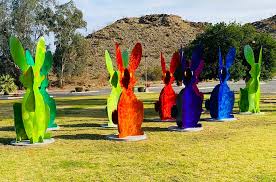
People appreciate us as pieces of fine art.

They praise the beauty of our metallic shine and the vividity of our bright and varying colors.

We are ginormous and multicolored;

though a man of no artistry whatsoever may say we should be small and gray,

most love us for what we are.

We are inspired by the benevolent Irish spirit Pooka.

We were brought forth by the brilliant, visionary artists Tony and Karen Barone.

One of us, a purple one, was named Little Rabbit, a nickname given to this poet by his dear, loving grandmother.

We live on Highway 111 by the Atrium, for all to see, interact with, and appreciate.

What are we?

Image result for karen and tony barone rabbits

Editor: Makena Behnke

Filed Under: Culture, Current News, Media, Poetry, The Outdoors, The World, Visual Arts Tagged With: Leo Milmet, Rabbit, What are We?

The Weak

January 14, 2019 by ehesson@pvs.org Leave a Comment

By Translator and Blogger James Zheng

So, I was browsing on a Chinese video sharing website called Bilibili (which is similar to Youtube), and then I found this amazing poem among the comments while I was watching a well-made AMV (anime music video). Shockingly, this poem was written by a normal anime reviewer. The translation is by me.


By Scattered Sakura (Screen name)


Rain brings the flavor of the sky;

the ocean carries the atmosphere of the abyss;

cicadas of late summer deliver their taunts to human beings;

the intolerable pain of the spine oppresses the fragile nerves.

Those cowards who had never been to the battlefield roared presumptuously.

They were wishing to tear apart the prey,

while they remained endlessly hateful about the cloudy sky,

and the deadly calm of the Jordanian river in the deep winter.

Twisted with hundreds of emotions and sentiments, the battlefield led to the Crows’ bloodthirst.

The stinky wind came from the sea;

the heavy rain brought extremely frozen water,

And the furiously raging flame was extinguished.

No redemption, no destruction, only obedience can lead to survival.

Sweat flowed down the girl’s smooth body,

withered leaves sprinkled with blood and tears.

The swan cut across the sky,

full of loneliness and desolation–caged birds pray for a storm full of life.

However, in front of the higher herdsmen,

we can only be captive lambs, fearing death, while hoping that the glory of victory spreads over the earth before dawn.


Before I shoot off to tell you how extraordinary this poem is, I must tell you that there is a slight difference between Chinese and American figurative and literal meanings, as well as writing styles. Because of the translation, there might be some places in the poem that may slightly confuse you.

What is really fascinating about this entire poem is the way it depicts a vivid image to interpret the significant term, “the weak.” The word choice actually conveys to me an oppressive atmosphere where one force overcomes another.

Editor: Luke Langlois

Filed Under: Culture, Poetry, The World, Uncategorized Tagged With: James Zheng, The Weak

The U.S Bureau of Consular Affairs

December 19, 2018 by ehesson@pvs.org 2 Comments

By Luke Langlois

Today, I am going to share a resource with you. If you were to collect one million bucket lists, you would likely read of people’s desires to “travel the world” many, many times. However, the U.S Bureau of Consular Affairs, a branch of the Department of State, would most likely tell “world travelers” to hold their horses. You see, the Bureau has a little something called the Travel Advisories, the links for which can be found below. These websites gives the world’s countries a 1-4 ranking, based on how suitable a nation is for American travelers.

Level 1: Exercise Normal Precautions

Level 2: Exercise Increased Caution

Level 3: Reconsider Travel

Level 4: Do Not Travel

Let me break down these ranks. A Level 1 country is normally safe to travel to; you would just need to take the usual precautions. Level 2 countries are also usually fine places to travel. They are marked as such due to a slightly higher rate of petty street crimes or an increased risk of terrorist activities. Level 3 countries are not the ideal travel destinations. They usually are marked as having high rates of crime or increased risk of terrorist activity, which is relatively similar to a Level 2 nation. However, Level 3 countries are set apart from Level 2 due to domestic strife. For example, Haiti is marked as Level 3 due to political and civil unrest; the high rates of crime are a result of this. Traveling to Level 4 countries is an extreme risk. If you are bent on traveling to a Level 4 nation, expect resistance at every step of the way. It is important to note, though, that people are only explicitly banned from traveling to the Democratic People’s Republic of North Korea; everywhere else is “fair game.”  The Bureau, quite literally, recommends that travelers write their wills, as well as check on their life insurance, before they travel to a Level 4 country. Level 4 countries are usually rampant in crime, especially towards outsiders from the west.  Level 4 countries are, most likely, experiencing deadly domestic conflict, or are under the rule of a violent dictator. Some of the Level 4 countries are even in the midst of a civil war. There are only eleven countries with this designation. The Bureau advises those that travel to Level 4 countries to stay in certain, safer, locations within the nation. These areas tend to be densely populated regions that are somewhat under control of the local government, which makes it easier for a response in case something were to happen to the traveler. There is much more to be seen on the website itself, but this hopefully has given you a good idea of the rankings system.

I am not a traveler, but I enjoy checking the Travel Advisories every once in a while to see what is going on in the world. You see, the media does not tend to focus on domestic foreign affairs unless they’re large and publicized issues that Americans are interested in. To get an idea of what is going on in the world, you would have to really pay attention to the media, or you would have to find international outlets. While nations with stability have credible news sources, many nations do not have seriously credible sources of news.  In short, seeing the state of countries around the world is not an easy thing to do. With this resource, you can see the world at a glance. If you at all are curious, check out the Bureau’s websites below. There’s always something to learn.

https://travelmaps.state.gov/TSGMap/

A map view of the world, with rankings.

https://travel.state.gov/content/travel/en/traveladvisories/traveladvisories.html/

A list view of the world, with rankings.

Editor: Holden Hartle

Filed Under: Advice, Culture, Current News, Politics, The World, Travel Tagged With: Luke Langlois, The U.S Bureau of Consular Affairs

Review of Monthly Girls’ Nozaki-kun

November 16, 2018 by ehesson@pvs.org Leave a Comment

By James Zheng

Hey guys, today I got completely new stuff for you! I am not recommending the overwhelmingly popular anime, but I am recommending some meaningful anime. Today, I am going to present a unique anime for you. When you take a look at this anime title, you might think something like, ”What is this about? Publishing a magazine every month?” Well, that would be quite boring, right? Although the title seems really confusing, the story is perfectly arranged. In addition, the rhythm of story always sticks with the plot. As you are watching it, it won’t be too hard to follow the storyline.

Monthly Girls’ was produced by Doga Kobo animation studio, which is a pretty famous company. Doga Kobo’s anime style can be described as “cute.” Among the realm of anime, Doga Kobo dominates in character design. The company is so specialized in designing the appearance of characters that Doga Koba’s works are very attractive to teenagers. Monthly Girls’ was published by Kadokawa Shoten Publishing Co., Ltd, and Media factory, and they both are the brand company of Kadokawa Corporation.

In short, Monthly Girls’ is a romantic comedy. But, the events that happen in the story do not follow the normal routine of romantic comedy. There will actually be many “What the heck?” moments. The funny and surprising storyline goes on for 12 episodes; right after you finish one episode, you might want to move on to next one immediately.


In Monthly Girls’, Sakura Chiyo is a heroine who wants to express her love to the hero, the famous romance author Nozaki Umetarou. When she comes to Nozaki, she is feeling extremely nervous which makes her say the wrong words to Nozaki. “I am your fan!” When those words come out, Nozaki freezes. And all the sudden he replies, “You could come to my house tonight.” Then, the story begins . . . but not as you expect. Basically, to give you a sense of the setting of the story rather than spoiling it, I would say that’s the most intriguing part of Episode 1. Watch it; see what happens.

Before I decided to recommend this anime, I already knew that many people prefer action anime. On the other hand, I am saying that we could switch our taste of anime by seeing different anime styles. Moreover, Monthly Girls’ definitely will not disappoint.


Editor: Holden Hartle

Filed Under: Advice, Culture, Fiction, Media, Review, The World, Visual Arts Tagged With: James Zheng, Review of Monthly Girl Nozaki-kun

我不喜欢这世界,我只喜欢你。–Jeremy Cheng on the memoir “I don’t have a crush on the world, only on you”

November 15, 2018 by ehesson@pvs.org Leave a Comment

Fashion & Food Critic and Blog Poet Jeremy Cheng reacts to the novel I don’t have a crush on the world, only on you, by QiaoYi, published by Hunan Children Publishing Company.

QiaoYi is not a proper writer but a recorder of normal life. She had a brother named Guanchao, a dog named Dollar, and a lover named Mr. F. She had the best girlfriend named Hao WuYi.


This book follows Yi and her lover from school uniforms to wedding dresses. Although the writing technique used is not a traditional Chinese writing technique, she uses many Chinese characters and makes them into elegant words to narrate her story.


I like this book because of its graceful writing, which not only shows a desirable life but also shows the style of writing and intoxicating vignettes.

Why QiaoYi wanted to publish her story

Microblog, a Chinese Twitter, had posted the question, “How do you define your relationship with your boyfriend?” QiaoYi provided an answer which attracted many readers. People wanted to learn about her story.

Many readers went to her Microblog and found out she recorded fragments of her life with a Mr. F. Many people said that her life was so sweet and adorable but the articles were too short. In that period, she only wrote three pages of her life.

The day after the influencer re-posted, her post was mentioned by many other influencers. More and more people said, “Please don’t stop posting about your lovely life. It is so sweet.”

See, I wasn’t alone. I was so moved by the pursuit of pure, warm, loving and beautiful love. In this chaotic and complicated world, how precious it is to get a simple and deep feeling of I don’t have a crush on the world, only on you. This is the warmest and most adorable love story I’ve ever seen.

I don’t have a crush on the world, only on you is a loving memoir of a couple, which records the warm and budding love story between two lovers. In a light-hearted and humorous style, the author truly records all the problems a girl encounters in her youth, gradually becoming strong, and independent. From the naive times of students to the sweet and interesting things after marriage, it is ordinary but not plain. It draws the love and vitality from the drip of life, and makes the readers smile. It is understood that love can be really sweet and life can be really warm.

Warm! Adorable! Sweet! Almost every paragraph can make readers laugh, but there are also tears.

Some people wonder that why QiaoYi called his lover Mr. F. QiaoYi said F is instead of Fu Jun which is a more endearing way to say “husband.”

Elegant Sentences

*When Mr. F was young, he asked his father where he came from. His father was different from other fathers who said kids were picked up from the rubbish dump. His father said,

     “You are the angel from heaven. The God thinks your mom is the most beautiful woman in this world; therefore, God sends you to protect her.”  

     “What about you?” Mr. F asked.

     “When you grow up, you will leave her. So I will stay with your mom until we get old.” -Mr. F

*He said that he stands in front of the emergency room, and thinks really hard. If I had gone, he will change his name to mine and continue to live for me. -GuanChao.

*Life is too long, so we need to stay with an interesting person.–QiaoYi

*The most regrettable part of growing up is that we always meet the best person in the most naive years, but we don’t know it. –QiaoYi

*In front of me, you do not need to be strong. –QiaoYi

*Some people are full of anger and malice because they have never been treated with gentleness. I believe I can always be gentle because I met a good person when I was young. –QiaoYi


Editor: Holden Hartle

Filed Under: Advice, Culture, Fiction, Letters, Review, The World Tagged With: I don't have a crush on the world, Jeremy Cheng, only on you

What is a Shared Economy?

November 9, 2018 by ehesson@pvs.org Leave a Comment

By Jeremy Cheng, World Traveler


A Shared Economy is sharing your resources that you don’t need immediately and improving the resource utilization rate and getting a return.


The advantages of a Shared Economy are that it is low in cost, it builds up a good business relationship, and it is considered a sustainable development. Let’s look at China’s Shared Economy.


Firstly,

in China, there is an app called DiDi which is essentially the same as Uber in the sense that you are able to call a car in order to travel somewhere. Like Uber, they don’t provide cars for the drivers. Drivers are expected to use their own car to pick up and drop off passengers. Therefore, there are no parking lot fees, and it reduces the expense one would have to pay if one were to drive one’s own car. Drivers are required to sign a contract with the DiDi company that ensures the safety of the passenger. Calling DiDi is superior to calling a taxi because with taxis there are more expenses for both the company and the passenger (taxi companies need to buy cars for their drivers and also take parking fees into account). DiDi’s passengers can pay a lower price, and this attracts many users in China.


Secondly,

DiDi builds up a good business relationship. For instance, for those who may travel alone, drivers are able to provide conversation with their passengers. It is another way to make new friends and acquaintances. Drivers and passengers are able to talk about the books they read, the places they have been, and the hobbies they like. The possibilities are endless. Airbnb conducted research that showed that people like their drivers to share the same or similar hobbies.


Finally,

Shared Economy encourages sustainable development.

China is universally acknowledged for having the largest world population. Unfortunately, the population is becoming too large for the amount of land that the country owns. Shenzhen, Beijing, Guangzhou, and Shanghai are some of the biggest, most overpopulated cities in China. With a larger population comes more people who want to own their own car, and usually each person’s car only has one to two people, which dramatically inflates the amount of traffic on the streets. In each car, there are multiple seats available that aren’t being used. This is a waste of a great carpooling opportunity. If people start to use those seats, commuters can have more methods to get to and from work, and the numbers of the cars on the road will decrease. This is a way that recycles resources without opening new land in order to make and sell more cars.


Here are few examples of the Shared Economy in China.


  1. DiDi offers a more convenient travel mode for everyone whether they’re just getting off work, school, or just living their normal lives.

2. LaiDian PowerBank is a power station for your phone. When your phone doesn’t have battery, users are able to rent one and charge their “dead” phone.

3. OFO Bicycle, another sustainable company,  provides bikes for people who only want to travel a short distance or don’t own a car.


Editor: Bella Bier

Filed Under: Culture, Technology, The World, Travel Tagged With: Jeremy Cheng, What is a Shared Economy?

The Diversity of Food in China: Hong Kong Early Tea

November 5, 2018 by ehesson@pvs.org 1 Comment

By Jeremy Cheng, Food and Fashion Critic


If you like to eat delicious food, you may like to follow some creators who introduce foods of various flavors from different areas.


Hong Kong Early Tea usually starts at 5-6 a.m and goes to 11 a.m every morning which is a traditional custom. Some restaurants will serve it during lunch. Hong Kong Early Tea is mainly made up of Chinese dim sum and tea. In Guangdong Province and Hong Kong, people have the habit of having Early Tea; therefore, Hong Kong Early Tea was born, which is the same as the Guangdong Early Tea.


The top ranking Dim Sum in Hong Kong style Early Tea


Due to the exchange between the mainland and Hong Kong, Hong Kong-style Early Tea has begun to develop in the mainland. After the return of Hong Kong to mainland China, Hong Kong-style Early Tea sprung up like mushrooms in the mainland.


Most of the restaurants use a big round table. Customers are able to sit together even though they don’t know each other at all. This is called the “Combine table” 搭台(Da Tai). Then, there will be a waiter/waitress who will ask you what tea you would like to drink. The common teas are TieGuanYin (one of the oolong teas), Pu‘er, scented tea, Chrysanthemum tea, etc.

Chao Mein


The server needs to pour half a cup of tea for the customers before the customers drink it. Customers can use this water to wash their bowl, spoon, and chopsticks. Nowadays, because of the cleaning measures being promoted, fewer people wash their dishes with tea before eating. Early tea is supposed to come out of a “dim sum” cart with a white towel on the server’s shoulder and the server shouts out the different dim sum types as they move. Every customer has a dim sum card which is divided into “small, medium, large, super large, and ultra large.” The server would put a sticker on the card depending on what you are ordering.


Steam Pork Ribs


Scallop Juice Small Steamed Bun


King Crab Shumai is the most popular dim sum among Hong Kong citizens. The outside of the Shumai is made of  flour, and the inside of the Shumai has a huge amount of juicy pork.

King Crab Shumai


Editor: Luke Langlois

Filed Under: Advice, Culture, Food, The World, Travel Tagged With: Jeremy Cheng, The Diversity of Food of China: Hong Kong Early Tea

“WeChat Pay or Alipay?”

October 31, 2018 by ehesson@pvs.org Leave a Comment

By Jeremy Cheng


When having dinner at the restaurant, buying goods at the mall, or shopping online, what is your favorite way to pay for the check?

Credit card, currency, or mobile payment?

Currently, there have been increasing numbers of people who use the mobile phone to pay for everything.

The two biggest mobile payment companies in China are WeChat Pay and Alipay.

For instance, this is how you pay for the bill at the restaurant.

This is how you pay for the fruit at the market.

This is how you pay for something at the mall.

Even when shopping at the Sephora on El Paseo, you can see an Alipay sign when you check out.

Even the less fortunate people in China will print out the QR code, which is a barcode that helps people receive or send money to others.

The use of cash and coin currency is declining rapidly in the Chinese economy. Surprisingly, four years ago, this payment method didn’t even exist because everyone used paper money.

In most of the mainland cities, most of the people use their smartphones to pay for all different kinds of fees. In a restaurant, the server may ask you, “WeChat Pay or Alipay?” as opposed to asking,  “credit card or debit card?” This is because paper money is not as popular in China anymore.

WeChat, a Chinese social media app not unlike Facebook, brings a lot of convenience to the daily lives of the people who live in China. One function of the app is WeChat Pay, which is one of the two main payment methods in China.   

In the past four years, Hong Kong used to post a news report that said that in the year of 2016, Chinese mobile payment reached 5.5 trillion dollars, which is 50 times of the American marketing model (112 billion).

I came to America and studied here in 2015. WeChat Pay was not that popular yet. When I went back to China for Christmas break, my mom told me that in order to pay someone for something, one simply sends money from their WeChat account to another. At that moment, I asked my mom, “Are you serious?”

My mom laughed at me and said, “Yep.”

When having dinner or afternoon tea at a restaurant or cafe, I can pay for something with my phone quicker than I can pay with paper currency.

Street artists in China can print out their QR code and display it, which makes it easier for people to give them money for their hard work. It is the same for everyone, from the wealthier people to the people with less money.

Some other countries are also currently trying to reduce the usage of cash-and-coin currency. In China, they have almost totally switched from cash-and-coin currency to mobile payment. Recently, a Chinese woman was called by the bank she uses. They told her that she forgot her credit card in their ATM machine for three weeks, and she didn’t even notice!


Editor: Leo Milmet

Filed Under: Culture, Technology, The World, Travel Tagged With: Jeremy Cheng, WeChat Pay or Alipay?

Confused? Here are the Propositions in a Nutshell

October 26, 2018 by ehesson@pvs.org 2 Comments

By Political Correspondent Senior Blogger Holden Hartle

I’ve seen several ads throughout my life saying “Vote yes on Prop 5” or “Vote no on Prop 11.” But what is the “prop” I’m voting for? I know the majority of us can’t vote this midterm, but it’s nice to know what’s on the ballot and what may happen to our state, or even our country. Also, there is some terminology that was confusing to me, such as a bond is like another word for debt. Below are the propositions that will be on the 2018 midterm ballot.

  1. Authorizes bonds to fund specified housing assistance programs. This helps veterans, farmers, and homeless people in general.
    •  

      Proponents argue that Prop 1 gives housing to those who can’t afford to buy housing on their own. And, what’s more, proponents say, Prop 1 would not raise taxes.

    • Opponents argue that this is on the ballot because there is such an influx of people coming into California, and to solve this problem requires a much larger solution.  
  2. Authorizes bonds to fund existing housing programs for individuals with mental illnesses. The state will use $140 million per year in mental health funds in order to pay back the $2 billion in bonds.
    • Proponents argue that Prop 2 doesn’t raise taxes. It will also provide help to those who previously couldn’t get help for their mental illnesses.
    • Opponents argue that the actual logistics of how the project will be funded would put many more people onto the streets.
  3. Authorizes almost 9 billion in bonds to fund projects for water supply and quality, watershed, fish, wildlife, water conveyance, and groundwater sustainability and storage.
    • Proponents argue that there will be more clean water in California, fixing of unsafe dams, and drought protection.
    • Opponents argue that the bonds go to private organizations and none of it directly goes to creating clean water.
  4. Authorizes $1.5 billion in bonds to fund construction for better children’s hospitals.
    • Proponents argue that Prop 5 will provide the latest technology for children battling all sorts of diseases.
    • Opponents argue that we are giving these bonds away with interest and that we need to find a better way to get children better care.
  5. Okay. So I’m gonna be completely honest with you, I’m not sure what Prop 5 is about. It has something to do with senior citizens paying property taxes and how this takes away from funding in other areas.
  6. Eliminates certain road repair and transportation funding and requires certain fuel taxes and vehicle fees to be approved by Congress.
    • Proponents argue that Prop 6 will lower gas prices, repealing the last tax instituted via the state legislature. Do you really need anything else?
    • Opponents argue that if you vote yes, roads and bridges will continue to deteriorate, clean-air laws will stagnate, and it is possible that more accidents will happen due to deteriorating roads and freeways.
  7. Conforms California Daylight Saving Time to federal law, and it allows state legislature to request a change to Daylight Saving Time Period.
    • Proponents argue that the act of going through a time change is detrimental to the human body, and that fewer injuries and deaths will happen if you were to vote yes.
    • Opponents argue that people will go to school/work in the dark. That’s it? Really?
  8. Regulates the amounts clinics charge for kidney dialysis treatment.
    • Proponents argue that companies are making bank from the costs of dialysis treatment, but they don’t invest in basic needs like sanitation. Voting “Yes” means costs will be regulated.
    • Opponents argue that Prop 8 will put many clinics out of business, which means that fewer people will get treatment, which means that more people will die.
  9. Prop 9 was taken off of the ballot by the Supreme Court, but basically it said that California would be split up into three different states.
  10. Expands local governments’ authority to place regulations on rent control of residential properties.
    • Proponents argue that Prop 10 will make rent increases more fair. Voting “Yes” will help the tenants.
    • Opponents argue that Prop 10 will make the housing situation worse. It also gives the government access to place fees on top of your rent.
  11. Keeps the past regulations of private emergency ambulance employees on call during work breaks so as to respond to emergencies.
    • Proponents argue that Prop 11 will continue saving lives and that seconds matter in a life and death situation. Therefore, we should keep the process in place.
    • Opponents argue that this could mean EMT’s are less likely to be available during emergency situations, which could lead to less immediate emergency care.
  12. Establishes new standards for confinement of certain farm animals as well as bans the sale of non-complying farmers’ products.
    • Proponents argue that the current way we treat animals is inhumane and that establishing minimum requirements would be a step in eliminating this cruelty.
    • Opponents argue that Prop 12 would not eliminate cruelty, as animals, such as hens, could be enclosed in as little as a one-square-foot cages.


If you would like to know more about any of these propositions, go to http://voterguide.sos.ca.gov/propositions/

Editor: Bella Bier

Filed Under: Current News, Politics, The World Tagged With: Confused? Here are the Propositions in a Nutshell, Holden Hartle

  • « Previous Page
  • 1
  • 2
  • 3
  • 4
  • 5
  • 6
  • …
  • 11
  • Next Page »

About

We are the Palm Valley Firebirds of Rancho Mirage, California. Join us in our endeavors. Venture through the school year with us, perusing the artwork of our students, community, and staff. Our goal is to share the poems, stories, drawings and photographs, essays and parodies that come out of our school. Welcome aboard!